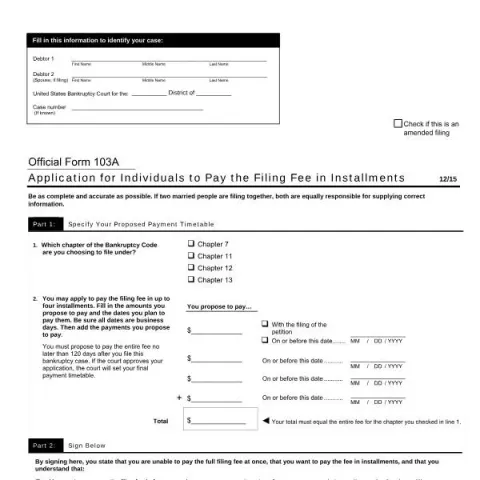
Understanding Official Form 103A: Application for Individuals to Pay the Filing Fee in Installments
The Official Form 103A is a crucial document used in the United States bankruptcy process, specifically designed for individuals seeking to pay their bankruptcy filing fee in installments rather than a lump sum. This form is issued by the United States Bankruptcy Court and is applicable across various districts. Its primary purpose is to enable debtors who are unable to pay the full filing fee upfront to request a payment plan approved by the court.
When to Use Form 103A
This form should be completed and submitted at the time of filing for bankruptcy when the debtor cannot afford to pay the entire filing fee immediately. It is particularly relevant for individuals filing under chapters 7, 11, 12, or 13 of the Bankruptcy Code who wish to request an installment plan. The court considers such requests on a case-by-case basis, primarily focusing on the debtor’s financial situation.
Key Components of the Form
Part 1: Proposed Payment Schedule
This section requires the debtor to specify their preferred payment timetable. The debtor must indicate the chapter under which they are filing and propose up to four installment payments. Each proposed payment must include the amount and the due date, which must be a business day. The total of these payments should equal the full filing fee for the chosen chapter.
- Chapter selection: The debtor must select the appropriate chapter (7, 11, 12, or 13).
- Payment amounts and dates: The debtor proposes specific amounts and due dates for each installment, with a maximum period of 120 days from the initial filing date.
Part 2: Signatures and Acknowledgments
This section confirms that the debtor understands the obligations associated with paying the fee in installments. By signing, the debtor affirms:
- They cannot make additional payments or transfer property for services related to the case until the fee is paid in full.
- The entire fee must be paid within 120 days unless the court extends this deadline.
- Failure to make scheduled payments may result in case dismissal or other legal consequences.
Both debtors (if filing jointly) and their attorneys, if applicable, must sign and date the form to validate the request.
Role of the Court in Approving Payment Plans
Once the debtor submits Form 103A, the court reviews the proposed payment schedule. The court may:
- Approve the debtor’s proposed installment plan as submitted.
- Modify the proposed schedule, setting different amounts or due dates based on the debtor’s financial circumstances.
After review, the court issues an Order Approving Payment of Filing Fee in Installments, which formalizes the payment terms. Until the fee is fully paid, the debtor cannot make additional payments or transfer property related to their bankruptcy case.
Points of Attention and Best Practices
Debtors should carefully complete Form 103A, ensuring that the proposed payment schedule aligns with their financial capacity. It is essential to:
Fill in your form directly online
No printing: type your details into the boxes of the official form, tick, then download the PDF ready to send.
- 1Type into the form boxes
- 2Tick in one click
- 3Save and download the PDF
- Accurately calculate the total fee and the proposed installment amounts.
- Propose realistic due dates, considering their income and expenses.
- Submit the form promptly with the bankruptcy petition to avoid delays or dismissal.
Failing to pay the fee in accordance with the court-approved schedule may lead to dismissal of the bankruptcy case, so adherence to the payment plan is critical.
Conclusion
Official Form 103A offers a practical solution for individuals facing financial hardship during bankruptcy proceedings. By requesting to pay the filing fee in installments, debtors can proceed with their case without the immediate burden of a full payment. However, it requires careful planning, honest disclosure of finances, and strict adherence to the approved payment schedule to ensure a smooth bankruptcy process.