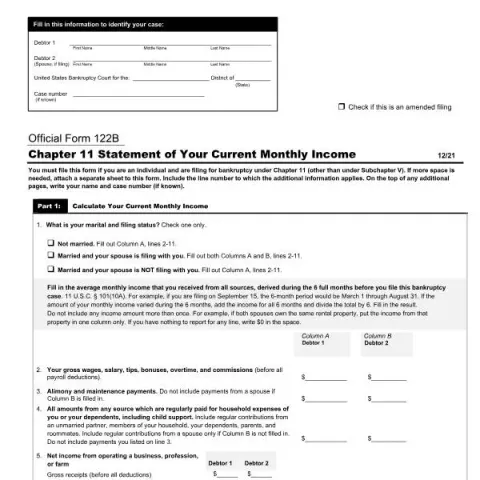
Understanding the Official Form 122B: Statement of Your Current Monthly Income in Chapter 11 Bankruptcy
The Official Form 122B is a crucial document for individuals filing for bankruptcy under Chapter 11 (excluding Subchapter V) in the United States. This form provides a detailed account of your current monthly income, which is a key factor in determining your eligibility and the scope of your bankruptcy proceedings. Here, we will explore when and why you need to complete this form, what information it requires, and best practices for submitting it correctly.
When and Why to Use Form 122B
This form must be filed by individual debtors seeking Chapter 11 bankruptcy protection, except when filing under Subchapter V. The primary purpose of Form 122B is to give the bankruptcy court an accurate snapshot of the debtor’s income during the six months prior to filing. This information influences the court’s decisions regarding repayment plans, eligibility, and the debtor’s ability to pay creditors.
Completing this form accurately is essential because it helps establish the debtor’s financial situation, which impacts the bankruptcy process. Failure to provide complete and truthful information can lead to delays, dismissal of the case, or other legal consequences.
Key Sections and Required Information
Part 1: Calculating Your Current Monthly Income
The first part of the form involves calculating your average monthly income over the six full months before filing. This period is determined based on your filing date; for example, if you file on September 15, the relevant period is from March 1 to August 31.
- Marital and filing status: You must check one of the options—single, married filing jointly, or married filing separately—and complete the relevant columns accordingly.
- Income sources: Report all income received from various sources, including wages, salaries, tips, bonuses, overtime, commissions, alimony, rental income, dividends, unemployment benefits, pensions, and other income.
- Additional income: If you have income from business operations, rental properties, or other sources not listed, specify these on separate sheets if necessary.
Part 2: Certification and Signature
The form concludes with a declaration under penalty of perjury that all information provided is true and correct. Both debtors, if applicable, must sign and date the form to certify its accuracy.
Points of Attention and Best Practices
When completing Form 122B, accuracy is paramount. Here are some key points to keep in mind:
Fill in your form directly online
No printing: type your details into the boxes of the official form, tick, then download the PDF ready to send.
- 1Type into the form boxes
- 2Tick in one click
- 3Save and download the PDF
- Use precise figures: Calculate your income based on the six months prior to filing, dividing total income by six to determine the average monthly amount.
- Include all income sources: Ensure you report all regular income, including contributions from household members or partners, but exclude benefits under the Social Security Act, as these are not considered income for bankruptcy purposes.
- Attach additional sheets if needed: If your income sources or amounts are extensive, attach separate sheets, clearly marking the relevant line numbers and your case information.
- Review before signing: Double-check all entries for accuracy and completeness before signing, as false statements can have serious legal consequences.
Submitting the Form
The completed Form 122B must be filed with the bankruptcy court handling your case. It is typically submitted electronically through the court’s filing system or in person at the court clerk’s office. Ensure that all pages, including any attachments, are included and correctly labeled with your case number and name.
In summary, Form 122B is an essential legal document that provides a transparent view of your financial situation during bankruptcy proceedings. Proper completion and timely submission can facilitate a smoother process and help the court determine the appropriate course of action for your case.