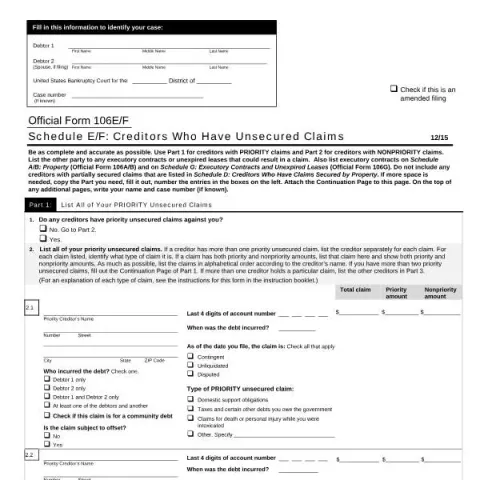
Understanding Schedule E/F: Creditors Who Have Unsecured Claims in Bankruptcy Cases
When filing for bankruptcy in the United States, one of the essential steps is completing the Schedule E/F. This form, officially titled Schedule E/F: Creditors Who Have Unsecured Claims, is used to list all creditors holding unsecured claims against the debtor. It is a critical document that helps the bankruptcy court assess the debtor's liabilities and determine how claims will be handled during the bankruptcy process.
What Is the Purpose of Schedule E/F?
The primary purpose of Schedule E/F is to provide a detailed account of all unsecured creditors—those who do not hold collateral against their claims. This includes both priority and nonpriority unsecured claims. Priority claims are given special treatment under bankruptcy law and must be paid before nonpriority claims. Examples include certain taxes, domestic support obligations, and claims for personal injury or death caused while intoxicated.
By listing these creditors, the court and the debtor's attorneys can evaluate the total amount owed, the nature of each claim, and how they will be addressed in the bankruptcy plan. Accurate completion of Schedule E/F ensures transparency and helps prevent disputes over debts during the proceedings.
Who Must Fill Out Schedule E/F?
Any individual debtor or business filing for Chapter 7, Chapter 11, or Chapter 13 bankruptcy must complete Schedule E/F if they have unsecured claims. This includes debts owed to government agencies, private creditors, or any other entities that have unsecured claims against the debtor.
Debtors should include all claims, whether they are contingent (dependent on future events), unliquidated (uncertain amount), or disputed (challenged by the debtor). Failing to disclose all unsecured claims can lead to legal complications or the dismissal of the bankruptcy case.
How to Complete Schedule E/F
Part 1: Priority Unsecured Claims
This section is dedicated to listing creditors with priority claims. These are claims that must be paid before other unsecured claims, such as taxes or domestic support obligations. For each creditor, provide:
- The creditor’s name and address
- The last four digits of the account number (if applicable)
- The date the debt was incurred
- The amount of the claim, distinguishing between priority and nonpriority amounts
- The type of priority claim (e.g., taxes, domestic support)
- Whether the claim is contingent, unliquidated, or disputed
- Who incurred the debt (debtor 1, debtor 2, or both)
Part 2: Nonpriority Unsecured Claims
In this section, list all other unsecured claims that do not have priority status. Similar details are required, including creditor information, claim amounts, and claim status. If additional space is needed, continuation pages can be attached, clearly identifying the case number and debtor’s name.
Fill in your form directly online
No printing: type your details into the boxes of the official form, tick, then download the PDF ready to send.
- 1Type into the form boxes
- 2Tick in one click
- 3Save and download the PDF
Key Tips for Completing Schedule E/F
- Be thorough: List every unsecured claim, including disputed or unliquidated debts.
- Use accurate information: Double-check creditor names, addresses, and account numbers.
- Order claims alphabetically: This helps in organizing and reviewing the list.
- Attach continuation pages: If you have many claims, ensure all are included by adding extra sheets, numbered accordingly.
- Review for errors: Mistakes can delay your case or lead to disputes; verify all entries before submission.
Where and How to Submit Schedule E/F
The completed Schedule E/F is filed as part of the debtor’s bankruptcy petition package with the United States Bankruptcy Court handling the case. The form can be submitted electronically through the court’s electronic filing system or physically at the court clerk’s office, depending on local procedures. Ensure all pages are properly attached and labeled with the case number and debtor’s name.
Conclusion
Accurately completing Schedule E/F is vital for a transparent and efficient bankruptcy process. It provides the court with a comprehensive overview of unsecured claims, ensuring proper prioritization and distribution of assets. Debtors should take care to fill out this form carefully, seeking legal advice if necessary, to avoid delays or complications in their bankruptcy case.