Understanding Official Form 121: Statement About Your Social Security Numbers in Bankruptcy Cases
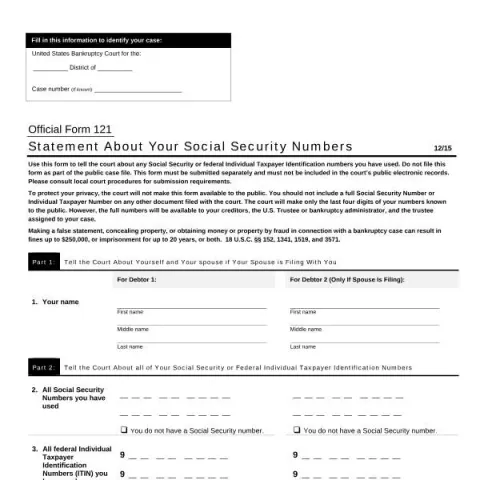
The United States Bankruptcy Court requires certain debtors to complete and submit Official Form 121, titled Statement About Your Social Security Numbers. This form plays a crucial role in protecting your privacy while ensuring the court and relevant parties have the necessary information to process your case accurately. This article explains when and why you need to fill out this form, what information it requests, and how to properly submit it.
Purpose of Form 121 in Bankruptcy Proceedings
Form 121 is designed to inform the court about any Social Security Numbers (SSNs) or federal Individual Taxpayer Identification Numbers (ITINs) associated with the debtor and, if applicable, the debtor’s spouse. Its primary goal is to balance transparency with privacy: the court needs enough information to identify the filer, but the full SSNs are not made publicly accessible to prevent identity theft or privacy breaches.
Importantly, this form must be submitted separately from the main bankruptcy case file and is not included in the public electronic records. Only the last four digits of the SSNs or ITINs are made available to the public, while full numbers are accessible to creditors, the U.S. Trustee, and the bankruptcy trustee.
When Should You Complete Form 121?
You are required to fill out Form 121 if:
- You are filing for bankruptcy and have used a Social Security Number or ITIN related to your case.
- You want to ensure the court and involved parties have accurate identification information.
Failure to provide complete and accurate SSN or ITIN information can lead to delays or complications in your case. It’s essential to update this form if your SSN or ITIN changes or if you acquire new numbers during the case.
What Information Is Requested on Form 121?
Part 1: Debtor Information
This section asks for your full legal name and, if applicable, your spouse’s name if they are filing jointly. Accurate identification here ensures the court correctly associates the numbers with the right individual(s).
Part 2: Social Security and ITIN Numbers
| Type of Number | Details |
|---|---|
| Social Security Numbers (SSN) |
|
| Federal ITINs |
|
Part 3: Certification and Signature
Under penalty of perjury, you must sign and date the form, certifying that the information provided is true and correct. This declaration is legally binding and emphasizes the importance of honesty in bankruptcy proceedings.
How to Submit Form 121
Submission procedures vary by court jurisdiction. You should consult your local bankruptcy court’s procedures to determine whether the form should be mailed, filed electronically, or submitted in person. Remember, the form must be filed separately from your main case documents and should not be included in the public case file.
It is advisable to keep a copy of the completed form for your records. If your circumstances change, such as acquiring a new SSN or ITIN, you should update and resubmit the form accordingly.
Fill in your form directly online
No printing: type your details into the boxes of the official form, tick, then download the PDF ready to send.
- 1Type into the form boxes
- 2Tick in one click
- 3Save and download the PDF
Points of Attention and Legal Considerations
Providing false information on Form 121 can have serious legal consequences, including fines up to $250,000 or imprisonment for up to 20 years. The form’s confidentiality provisions are designed to protect your privacy while allowing the court and authorized parties to verify your identity.
Always ensure that you fill out the form accurately and completely. If you are unsure about any part of the process or the information required, consider consulting a bankruptcy attorney or the clerk of your local bankruptcy court for guidance.
Conclusion
Official Form 121 is a vital document in the bankruptcy process, serving to identify the filer while safeguarding sensitive information. Proper completion and timely submission help facilitate a smooth case process and protect your privacy. Be attentive to local submission guidelines and legal obligations to ensure your case proceeds without unnecessary delays or complications.