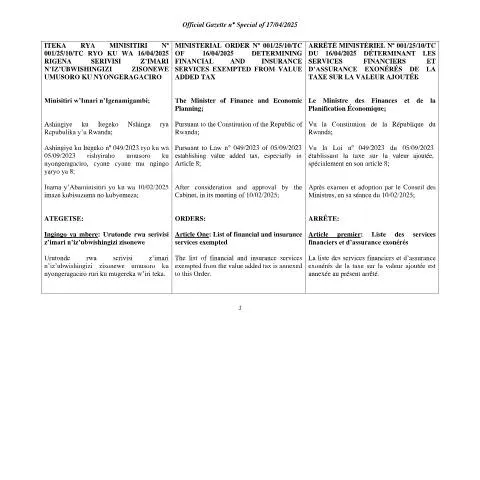
A Detailed Exploration of the Iteka rya Minisitiri Serivise z'Imari n'Ubwishingizi Zisonewe TVA 2025
The Iteka rya Minisitiri serivise z'imari n'ubwishingizi zisonewe TVA 2025 is a crucial document within Rwanda’s tax framework. Its significance extends beyond a mere formality; it is integral for businesses and individuals engaged in financial activities requiring Value Added Tax (VAT) exemptions. This document serves as a gateway for eligible entities to obtain tax relief, ultimately stimulating economic growth and compliance.
Understanding the Purpose and Importance of the Document
The core of the Iteka rya Minisitiri revolves around facilitating the management of VAT exemptions to various services and sectors as established by the Rwandan government. The overarching goal is to create an environment conducive to investment and economic development by alleviating the tax burden on qualifying entities.
Who Should Submit the Form?
Any business entity or service provider that operates within sectors eligible for VAT exemptions must file this document. Notably, this includes entrepreneurs, non-governmental organizations (NGOs), and certain government contractors. Each applicant must ensure they meet the specific criteria outlined in the Presidential order that governs VAT exemptions.
Navigation Through the Submission Process
Filing the Iteka rya Minisitiri requires careful navigation through various submission channels. The choice of channel may influence the processing time and required documentation.
Available Submission Channels
- Online Submission via Irembo: This digital platform is recommended for its efficiency. Applicants can fill out the application form electronically, attaching digital copies of required documentation. The online submission process is streamlined, allowing for quicker processing and easier tracking of application status.
- Physical Submission: For those less familiar with digital platforms, applications can also be submitted in person at designated Ministry of Finance and Economic Planning offices. This method may provide additional assistance but could involve longer wait times.
- Mail Submission: Although less common, applicants may choose to send their documents via registered mail. It is crucial to confirm receipt as this method could lead to delays in processing.
A Step-by-Step Guide to Completing the Form
Understanding the form’s sections is essential for a successful submission. Each part of the Iteka rya Minisitiri serves a specific purpose and must be filled out accurately to avoid complications.
Breaking Down the Form Sections
| Section | Description | Common Pitfalls |
|---|---|---|
| Applicant Information | Includes the name, business registration number, and contact details of the applicant. | Ensure the business registration number is current and matches official records. |
| Type of Exemption Requested | Specify the type of VAT exemption being applied for along with supporting reasons. | Failing to provide a clear justification can lead to automatic rejection. |
| Supporting Documentation | Attach necessary documents such as previous tax returns, financial statements, and any legal agreements. | Missing documents can delay processing. Double-check requirements specific to your sector. |
| Declaration and Signature | A confirmation of the truthfulness of the information provided, signed by the applicant. | A missing signature invalidates the application. |
Timelines: When to Apply and What to Expect
The timeframe for the submission of the Iteka rya Minisitiri aligns with the fiscal calendar, which runs from July to June. Understanding key dates can help applicants plan accordingly.
Key Dates to Note
- Submission Period: Applications for VAT exemptions typically open at the start of the fiscal year. Ensure your application is submitted as early as possible to avoid potential processing delays.
- Processing Time: Once submitted, the review process may take several weeks. Regular checking of the application status via the Irembo platform is advisable.
- Decision Notifications: Applicants will receive notifications through their chosen submission channel once a decision has been reached. Be prepared for follow-up inquiries if additional information is required.
Addressing Common Concerns: Rejections and Follow-Ups
Upon submission, there may be instances where applications are rejected or require further clarification. Knowing how to address these issues is crucial.
What to Do if Your Application is Rejected
In case of rejection, the applicant will receive a notification outlining the reasons for denial. Understanding these reasons is vital for reapplication. Key steps include:
- Review the Feedback: Carefully analyze the rejection message to identify specific shortcomings.
- Gather Additional Information: If required documentation is lacking, collect all necessary papers before resubmission.
- Clarify Misunderstandings: In some cases, discrepancies in the information provided can lead to rejection. Reach out to officials for clarification.
- Reapply: Once all issues have been addressed, submit a new application incorporating the feedback received.
Preparing Supporting Documents: A Sector-Specific Breakdown
The strength of your application largely depends on the supporting documents you provide. Different sectors may require different sets of documents.
Essential Documents Based on Sector
- For Tourism and Hospitality:
- Proof of hotel or service registration
- Previous VAT filings
- For Non-Governmental Organizations:
- Evidence of registration with the Rwanda Governance Board
- Financial reports detailing operational expenditures
- For Manufacturing:
- Production permits
- Equipment purchase invoices
Conclusion: Your Path to VAT Exemption
Successfully navigating the Iteka rya Minisitiri serivise z'imari n'ubwishingizi zisonewe TVA 2025 requires diligence and attention to detail. By understanding the purpose of the document, adhering to submission guidelines, and preparing the necessary documentation, applicants can enhance their chances of receiving VAT exemptions. The financial benefits of such exemptions can significantly impact business operations and contribute to the overall economic landscape of Rwanda.
Understanding the Tax Exemption Services Provided by the Ministry of Finance and Economic Planning
The Ministry of Finance and Economic Planning (MINECOFIN) plays a pivotal role in the management of tax policies in Rwanda, particularly in relation to the Value Added Tax (VAT) exemptions. These exemptions are not merely administrative maneuvers; they represent strategic decisions aimed at fostering economic growth and development within specific sectors. Key industries, such as agriculture, tourism, and healthcare, often benefit from these exemptions, allowing them to operate more competitively.
To qualify for these tax exemptions, businesses must demonstrate their alignment with government objectives, typically by contributing to job creation or enhancing public welfare. Applicants often need to provide comprehensive documentation detailing their operations, the intended use of the funds, and how the exemption will contribute to their growth. The application process is facilitated through the Rwanda Revenue Authority (RRA) and emphasizes transparency and efficiency.
The strategic significance of these tax exemptions extends beyond immediate financial relief. They encourage investment in critical areas, easing the burden on startups and small to medium-sized enterprises (SMEs) particularly. Businesses must stay informed about periodic reviews of exemption policies, as the government may adjust these in response to changing economic circumstances or sectoral needs.
The Application Process for VAT Exemptions: Step-by-Step Guide
Applying for VAT exemptions through the RRA can appear complex at first glance, but understanding the step-by-step process can facilitate a smoother experience. Below is a detailed guide tailored for applicants seeking to navigate this administrative pathway effectively.
Step 1: Pre-Application Preparation
Before initiating the official application, businesses should conduct a thorough assessment of their eligibility for VAT exemptions. This involves reviewing the relevant guidelines published by MINECOFIN, which outline the sectors eligible for exemption and the criteria for qualification. Important documents typically include:
- Business registration certificate
- Tax Identification Number (TIN)
- Detailed business plan
- Financial statements demonstrating operational capacity
Step 2: Submitting the Application
The actual submission of the application occurs through the Irembo platform, which is designed to enhance the accessibility of government services. Applicants will need to locate the 'VAT Exemption Application' service on Irembo and fill out all required fields accurately. It’s crucial to attach all necessary documentation as failure to provide complete information may result in delays or rejections.
Step 3: Review and Approval Process
Once submitted, the RRA will initiate a thorough review of the application. This process may involve direct communication with the applicant for clarifications or additional information. Timeliness is vital; thus, businesses should monitor their application status on Irembo and respond promptly to any inquiries from tax officials.
Step 4: Notification of Decision
After the review process, applicants will receive a formal notification regarding the approval or denial of their VAT exemption request. If approved, businesses must adhere to any conditions stipulated in the approval notice, which may include regular reporting on the use of exempted funds. In the case of denial, the RRA provides feedback outlining the reasons, enabling businesses to make necessary adjustments for future applications.
Step 5: Compliance and Reporting
Post-approval, businesses need to maintain compliance with the conditions of the exemption. This may involve periodic audits by the RRA to ensure that the exemption is being utilized for its intended purpose. Businesses must have rigorous accounting practices to track expenditures related to the exempted activities accurately.
The overall success of this process not only impacts individual businesses but contributes to the broader economic landscape of Rwanda, promoting sustainable practices and enhanced corporate responsibility.
The Future of VAT Exemption Policies in Rwanda
As Rwanda continues to develop its economic strategies, the future of VAT exemption policies will likely evolve to better meet the needs of its citizens and businesses. The government is anticipated to engage in ongoing consultations with industry stakeholders to refine these policies, ensuring they remain relevant and effective. Moreover, trends such as digital transformation and global economic shifts will likely influence the direction of these exemptions.
Emerging technologies, particularly in financial management and reporting, may offer new avenues for businesses to prove their eligibility and compliance regarding VAT exemptions. For instance, businesses utilizing digital tools for accounting may streamline their reporting processes, thereby increasing transparency and accountability.
Additionally, the Rwandan government is likely to expand its focus on sectors that can significantly contribute to its Vision 2050 goals. This may include areas such as renewable energy, technology, and advanced manufacturing, which could be integrated into future VAT exemption frameworks.
In conclusion, as Rwanda navigates the complexities of its economic landscape, stakeholders must remain proactive and engaged with the evolving policies surrounding VAT exemptions. By doing so, they can not only benefit from current opportunities but also contribute to shaping future frameworks that will support sustainable growth and development across the nation.