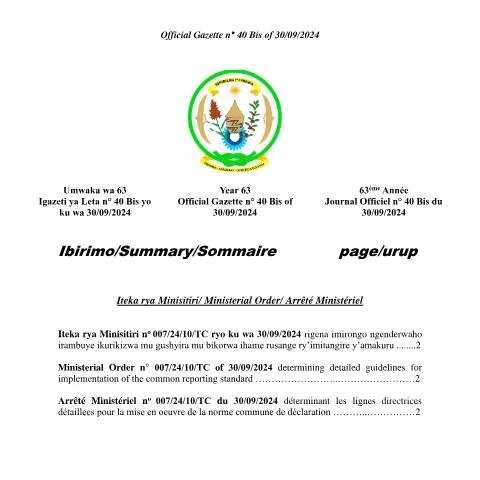
Understanding the Ministerial Order on Common Reporting Standard Sept 2024
The Ministerial Order No. 007/24/10/TC of 30/09/2024 plays a crucial role in standardizing financial reporting in Rwanda. This order outlines the guidelines that must be adhered to when reporting information as part of the Common Reporting Standard (CRS). It affects various stakeholders, particularly financial institutions and individuals holding accounts, by imposing specific obligations and procedures surrounding data reporting.
The Context of CRS Implementation
As Rwanda aims to enhance transparency and curb tax evasion, adherence to the Common Reporting Standard is essential. This standard, developed by the OECD, aims to promote automatic exchange of financial account information between participating countries. The Ministerial Order sets the foundation for compliance within Rwanda, emphasizing the importance of accurate reporting.
Who Must Comply with the Order?
Compliance with the Ministerial Order primarily concerns:
- Financial Institutions: Banks, insurance companies, and other entities engaged in financial services are required to report their clients' information.
- Individuals: Account holders and beneficial owners must ensure their information is correctly reported through their respective financial institutions.
- Service Providers: Entities that offer services related to account management and compliance must also be aware of their obligations under this order.
Key Elements of the Reporting Requirements
Individuals and financial institutions must navigate several key articles within the Ministerial Order that dictate how and what information should be reported.
Article 5: Reportable Information
This article specifies the types of information that must be reported, which includes:
- Account holder's name and address.
- Tax Identification Number (TIN).
- Date and place of birth.
- Account balances and any income accrued from the accounts.
Inaccurate reporting or failure to provide this information can lead to significant penalties, underscoring the importance of meticulous compliance.
Article 4: Electronic Return System
The order introduces a mandatory electronic return system, which aims to streamline the reporting process. Financial institutions are required to submit their reports electronically through the designated platform. This digital approach not only enhances efficiency but also minimizes errors associated with manual submissions.
Preparing for Compliance: Documentation and Processes
Preparation is key when it comes to compliance with the CRS and the associated reporting standards. Here are some helpful hints on managing documentation:
Essential Documents for Financial Institutions
Financial institutions are required to maintain robust records to support their reporting obligations:
- Client Identification Documents: Ensure all client information is up to date, including proof of identity and address.
- Account Information: Maintain accurate records of all account transactions, balances, and relevant communications with clients.
- Internal Compliance Policies: Establish clear internal policies that align with the reporting obligations under the Ministerial Order.
Additional Considerations for Individuals
Individuals must also ensure their own records are in order:
- Tax Compliance: Maintain awareness of your tax obligations and ensure your TIN is correctly linked to your accounts.
- Communication with Financial Institutions: Regularly communicate with your bank or financial service provider regarding any changes in your personal circumstances that may affect your financial reporting.
Decoding the Reporting Process: Step by Step
Understanding the reporting process is essential for both financial institutions and individual account holders. Here’s a breakdown of the steps involved:
Step 1: Data Compilation
Gather all necessary data as outlined in Article 5. Financial institutions should prepare by ensuring they have comprehensive records of all accounts and transactions.
Step 2: Submission through Electronic Return System
Once data is compiled, financial institutions must log into the electronic return system. The interface should be user-friendly, allowing for straightforward data entry. Proper training on the system ensures accurate submissions.
Step 3: Confirmation of Submission
After submission, financial institutions will receive a confirmation of successful reporting. It is crucial to retain these confirmations as proof of compliance.
Potential Consequences of Non-Compliance
Failing to adhere to the Ministerial Order can have serious implications:
- Financial Penalties: Financial institutions that fail to report accurately can face significant fines.
- Legal Consequences: Individuals and institutions may face legal action for non-compliance, especially in cases of tax evasion.
- Reputation Damage: Non-compliance can lead to loss of trust from customers and stakeholders, potentially affecting business operations.
Specific Scenarios and Exceptions
The Ministerial Order acknowledges that not all cases will fit neatly within the outlined requirements. Certain exceptions and considerations are detailed in various articles:
Article 10: Excluded Accounts
Some accounts may be excluded from reporting requirements, such as:
- Accounts held by certain governmental bodies.
- Accounts with balances below specified thresholds.
Understanding these exemptions can aid financial institutions and individuals in determining their reporting obligations accurately.
Article 19: Enhanced Review Procedures
For high-value accounts, additional scrutiny is required. Institutions must have enhanced review processes in place to verify account details and maintain compliance with the CRS.
Comparative Analysis: CRS vs Other Reporting Frameworks
The Ministerial Order on Common Reporting Standard can easily be confused with other reporting requirements, such as those related to anti-money laundering (AML) or Know Your Customer (KYC) regulations. Here’s how they differ:
| Feature | CRS | AML/KYC |
|---|---|---|
| Focus | Tax compliance and information exchange | Prevention of financial crime and identity verification |
| Reporting Frequency | Annually | Ongoing, as needed |
| Target Audience | Financial institutions and account holders | All entities engaging in financial transactions |
Navigating the Future: Ongoing Compliance and Adaptation
As Rwanda continues to align with international standards, ongoing adaptation to the Ministerial Order is essential. Stakeholders should:
- Stay informed about updates and amendments to the order.
- Participate in training sessions to familiarize themselves with the electronic return system and reporting requirements.
- Engage with regulatory bodies for clarification on complex reporting scenarios.
Understanding and embracing the obligations set forth in the Ministerial Order on Common Reporting Standard Sept 2024 is not just a regulatory requirement; it is a step towards fostering a transparent and accountable financial system in Rwanda.
Understanding the Common Reporting Standard (CRS) in Rwanda
The Common Reporting Standard (CRS), developed by the Organisation for Economic Co-operation and Development (OECD), aims to combat tax evasion and enhance tax compliance through automatic exchange of financial account information among jurisdictions. In Rwanda, the implementation of the CRS is governed by the Ministerial Order issued in September 2024. This regulation establishes the framework for financial institutions’ responsibilities in reporting and the obligation of account holders to provide accurate information. As a result, individuals and businesses must ensure they are compliant to avoid potential penalties.
Under this framework, Rwandan financial institutions, including banks, insurance companies, and investment firms, are required to identify account holders who are tax residents in CRS participating jurisdictions. This process necessitates a comprehensive understanding of the various jurisdictions that Rwanda has entered into agreements with, as well as the specific reporting requirements outlined by the Ministerial Order. Failure to comply with these regulations may lead to serious repercussions, including fines and legal actions.
Who is Affected by the CRS Ministerial Order?
The scope of the Ministerial Order extends beyond just financial institutions. It also impacts individuals, businesses, and even non-profit organizations that have bank accounts or financial dealings within Rwandan banks. All account holders must be aware of their obligations under the CRS to provide accurate declarations regarding their tax residency. Furthermore, entities with international operations may find themselves subject to the compliance requirements not only in Rwanda but also in the jurisdictions where they operate.
Additionally, companies that are classified as passive non-financial entities (NFEs) must disclose information about their controlling persons, which may include individuals who own or control the entity. Rwandan entities must work closely with their legal and tax advisors to understand what constitutes a controlling person in the context of the CRS and ensure compliance with the reporting obligations set forth in the Ministerial Order.
Preparing for CRS Compliance: Steps for Financial Institutions and Account Holders
To ensure compliance with the CRS Ministerial Order, financial institutions in Rwanda must take several preparatory steps. Initially, they must implement robust due diligence procedures to identify account holders and gather the required information for reporting purposes. This involves training staff on CRS requirements, establishing clear protocols for collecting and storing data, and maintaining records for the required retention period as specified by the Ministerial Order.
Moreover, financial institutions should leverage technology, including digital platforms like Irembo, to simplify the information collection process and enhance data accuracy. Integration of these technologies not only streamlines operations but also aligns with Rwanda's goal of promoting digital governance.
On the other hand, account holders need to prepare themselves by understanding their status concerning the CRS. Individuals and businesses should gather relevant documentation, such as proof of tax residency, and be proactive in communicating with their financial institutions to ensure compliance. It is essential to regularly review and update any changes in ownership or residency status, as such changes may affect their obligations under the CRS.