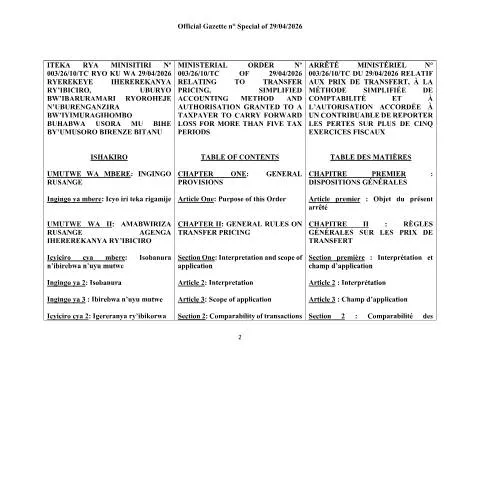
Navigating the Ministerial Order on Simplified Accounting Method: A Practical Guide
The Ministerial Order on Simplified Accounting Method, effective from April 2026, is a crucial document for businesses and organizations in Rwanda that seek to streamline their accounting processes. This order provides a framework for simplified accounting practices, targeting small and micro enterprises which often struggle with the complexities of more traditional accounting methods.
Understanding this order begins with recognizing its purpose within the broader context of Rwanda’s push towards better governance and fiscal accountability. With the emphasis on digital transformation, this order also aligns with the government's initiatives to boost accessibility and efficiency in administrative procedures.
Understanding the Unique Role of the Ministerial Order
At its core, the Ministerial Order on Simplified Accounting Method serves as a regulatory directive that outlines eligibility criteria, application procedures, and compliance requirements for entities wishing to adopt simplified accounting practices. It's essential to note that this document is distinct from other financial forms, such as standard tax returns or compliance reports issued by the Rwanda Revenue Authority (RRA).
One key distinction lies in its focus on simplification, aimed at reducing the administrative burden on small businesses. Unlike traditional accounting methods that require extensive documentation and reporting, this order allows for a more streamlined approach to bookkeeping.
Who Should Consider This Method?
The simplified accounting method primarily appeals to small and micro enterprises, which often lack the resources for complex accounting systems. Understanding who qualifies can help streamline the application process:
- Small enterprises: Businesses with fewer than 20 employees and relatively low annual revenue.
- Micro enterprises: Family-run businesses or sole proprietorships often operating with minimal staff and turnover.
- Non-profit organizations: Organizations focused on community service that must adhere to specific accounting standards but face resource constraints.
Step-by-Step Process: From Initiation to Submission
The journey of applying for the simplified accounting method begins with a clear understanding of the steps involved. Here’s a chronological overview that outlines the essential phases of this application process:
1. Identifying Eligibility
Before initiating any paperwork, businesses must first determine their eligibility based on size, revenue, and operational structure. Consult the guidelines provided by the Ministry of Local Government (MINALOC) to assess your business profile.
2. Preparing Required Documentation
While the simplified accounting method is designed to reduce paperwork, certain documents are still necessary:
- Identification: National Identification Number (NIN) for business owners and authorized representatives.
- Business registration: Proof of registration with relevant local authorities.
- Financial statements: Basic records that demonstrate your financial position (income and expenses).
3. Completing the Application Form
The application for the simplified accounting method is primarily conducted online through the Irembo platform. Here’s how to navigate this critical step:
- Log in to your Irembo account.
- Navigate to the 'Ministerial Order on Simplified Accounting Method' service.
- Follow the prompts to fill out the application form, ensuring all fields are accurately completed.
- Upload the necessary documents as specified in the guidelines provided on the platform.
4. Submitting Your Application
Once your application form is completed and documents are uploaded, the next step is submission:
- Review all entered information for accuracy.
- Submit the application directly through the Irembo platform.
- Take note of any confirmation numbers or receipts generated post-submission, as these will be crucial for tracking the progress of your application.
5. Awaiting Approval
After submission, the evaluation of your application will commence. The processing time may vary, but it's advisable to regularly check your application status through the Irembo dashboard. If additional documentation or clarifications are required, you will be notified through the platform.
Distinct Features of This Order Compared to Other Accounting Methods
One might wonder how the Ministerial Order on Simplified Accounting Method contrasts with other accounting frameworks. Here are a few differentiating aspects:
| Feature | Simplified Accounting Method | Traditional Accounting Methods |
|---|---|---|
| Documentation Requirements | Minimal documentation; basic records suffice | Extensive documentation; requires detailed reporting |
| Complexity | Easy to understand and implement | Can be complex, often requiring expertise |
| Target Audience | Small and micro enterprises | Larger firms and those with diverse operations |
| Regulatory Oversight | Less stringent; focuses on essential compliance | Heavily monitored; rigorous compliance standards |
Handling Unique Situations: A Closer Look at Special Cases
While the simplified accounting method is designed to be accessible, certain situations may require additional considerations. Here are a few unique case scenarios:
Foreign Entities
Foreign businesses operating in Rwanda may seek to adopt the simplified accounting method, but certain conditions apply. These entities must ensure their compliance with both Rwandan regulations and their home country’s laws. It is advisable to consult with legal and financial experts to navigate this complex landscape.
Minors and Guardianship
In instances where a minor operates a business, the application must be submitted by a legal guardian or authorized adult representative. This ensures that all legal obligations are met while enabling the minor to benefit from the simplified accounting method.
Complex Business Structures
Businesses with multiple branches or those that engage in various activities may face additional challenges when applying. Such entities are encouraged to consider their overall revenue and operational structure to determine if simplified accounting is feasible. Consultations with MINALOC can provide clarity tailored to specific circumstances.
Submission Channels: Online vs. Offline
The manner in which applications are submitted can greatly influence the processing experience. Here’s a breakdown of the main channels:
Online Submission via Irembo
The Irembo platform stands as the preferred method for submitting the application for the simplified accounting method. Benefits of this channel include:
- Accessibility: 24/7 access from anywhere with an internet connection.
- Real-time Tracking: Immediate updates and notifications about the status of your application.
- Reduced Paperwork: Minimal physical documentation required.
Paper Applications
Although digital submission is encouraged, businesses may still opt to submit paper applications in specific cases. However, this method comes with its own set of challenges:
- Longer Processing Times: Paper applications typically take longer to process due to manual handling.
- Limited Tracking: Without electronic confirmation, tracking progress on paper submissions can be cumbersome.
Final Thoughts: Leveraging the Simplified Accounting Method for Business Growth
Embracing the Ministerial Order on Simplified Accounting Method is a significant step for small and micro enterprises in Rwanda. By understanding the nuances of this order, businesses can effectively navigate the challenges of accounting while focusing on growth and sustainability.
As Rwanda continues its journey towards economic development and digital transformation, the simplified accounting method exemplifies the government’s commitment to fostering an environment conducive to entrepreneurship. By leveraging this method, businesses can enhance their financial management practices, enabling them to thrive in a competitive landscape.
Understanding the Ministerial Order: Scope and Objectives
The Ministerial Order on Simplified Accounting Method, issued in April 2026, aims to streamline financial management and enhance transparency among small and medium-sized enterprises (SMEs) in Rwanda. This order is particularly relevant for businesses that fall below a specified revenue threshold, which is designed to alleviate the burden of complex accounting practices. The primary objective is to foster an environment where SMEs can efficiently manage their finances while adhering to the legal frameworks established by the Rwanda Revenue Authority (RRA).
This order outlines the criteria for eligibility, which includes not only revenue limits but also the nature of business activities. For instance, SMEs engaged in retail, services, or non-manufacturing sectors may find the simplified accounting method particularly beneficial. This method reduces the paperwork associated with traditional accounting practices, allowing businesses to focus more on growth and development rather than administrative tasks.
The key provisions also encompass guidelines on record-keeping, which emphasize the importance of maintaining accurate and organized financial records, albeit in a simplified format. This ensures that SMEs remain compliant with tax obligations while simultaneously supporting economic growth.
Implementation Process: Key Steps for SMEs
Implementing the Simplified Accounting Method as outlined in the April 2026 Ministerial Order involves several critical steps for SMEs. Firstly, businesses must assess their eligibility against the criteria set forth by the Ministerial Order. This assessment often requires the submission of necessary documentation to the RRA for verification. Eligible SMEs are then encouraged to register on the Irembo platform, which serves as the digital gateway for administrative services in Rwanda. This registration will facilitate access to various resources, including training materials and support documents tailored to the simplified accounting method.
Subsequent to registration, SMEs should engage in training sessions offered by the local authorities or relevant educational institutions. These sessions are designed to equip business owners and their employees with the skills needed to effectively implement the simplified accounting practices. The training covers essential aspects such as basic bookkeeping, financial reporting, and the use of digital tools for record-keeping.
Moreover, SMEs must establish a dedicated accounting framework that aligns with the simplified accounting method. This could involve adopting standardized templates for invoices, receipts, and other financial documents. It is vital for businesses to implement these practices consistently to ensure compliance and ease of reporting to the RRA.
Lastly, ongoing monitoring and evaluation of financial performance should be instituted, enabling businesses to assess the effectiveness of the simplified accounting method. This feedback loop is crucial for continuous improvement and can provide insights into areas where further training or adjustments may be required.
Challenges and Support Mechanisms under the Ministerial Order
While the Ministerial Order on Simplified Accounting Method presents significant advantages for SMEs in Rwanda, certain challenges may arise during its implementation. One primary concern is the potential lack of familiarity with digital tools and simplified accounting practices among business owners. To address this, the RRA and MINALOC have established supportive initiatives, including workshops and digital literacy programs aimed at equipping SMEs with the necessary skills.
Additionally, access to financial resources poses a challenge for many SMEs. The government, in collaboration with various financial institutions, is working to provide tailored loan products and grants specifically designed to assist SMEs in transitioning to the simplified accounting method. These financial products often come with flexible repayment terms, allowing businesses to invest in the necessary technology and training without jeopardizing their operational stability.
Another challenge lies in the adherence to the new recording and reporting requirements. Businesses must acclimate to the changes, which may require a cultural shift in how they perceive financial management. Continuous engagement with local authorities can help facilitate this transition, as SMEs can receive real-time support and guidance as they navigate the new system.
Overall, understanding the challenges and available support mechanisms under the Ministerial Order is vital for SMEs to harness the full potential of the simplified accounting method. By leveraging the resources provided by the RRA and MINALOC, SMEs can effectively adapt to these changes, propelling their business growth and contributing to Rwanda's economic development.