Navigating the Iteka rya Minisitiri rigena ishimwe rya TVA Updated 2025
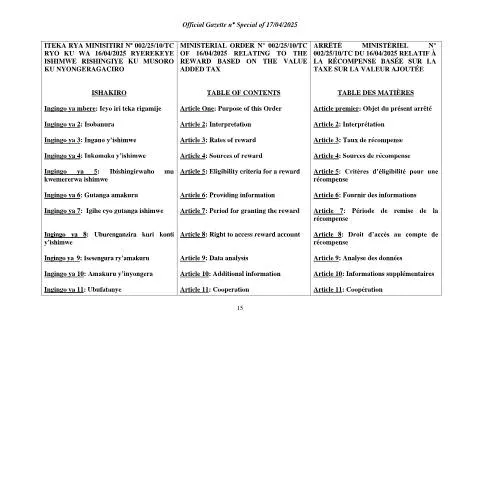
The Iteka rya Minisitiri rigena ishimwe rya TVA Updated 2025 stands as a significant document within Rwanda's administrative framework, impacting both consumers and the tax administration. Established under the recent Ministerial Order N° 002/25/10/TC, this official decree outlines the parameters for rewards based on Value Added Tax (VAT), a crucial element for fostering fiscal responsibility and transparency. As Rwanda continues to embrace progressive economic policies, understanding this document's implications and the nuances of its application becomes paramount for Rwandans and foreign entities alike.
Understanding the Context: VAT in Rwanda
The adoption of VAT in Rwanda, articulated under Law No. 049/2023, has transformed the country’s tax landscape. The objective of this legislation is to enhance revenue generation while ensuring fairness in taxation. The Iteka rya Minisitiri specifically addresses how rewards are calculated for final consumers who engage with VAT through electronic invoicing.
Rwanda's approach to VAT not only aims to boost government revenue but also incentivizes consumers to demand invoices, thereby integrating transparency into the marketplace. This is particularly important in a country where efforts to combat tax evasion are ongoing.
Who Is Impacted?
This ministerial order affects various stakeholders:
- Final Consumers: Individuals purchasing goods and services, expected to demand electronic invoices to qualify for rewards.
- Businesses: VAT-registered entities that must comply with invoicing requirements.
- Tax Administration: The body responsible for implementing and governing the reward system.
A Step-by-Step Guide to the Reward Process
The process begins with the consumer making a purchase and requires a series of actions to ensure eligibility for the VAT reward. The following outlines the critical steps involved from initiation to reward acquisition:
- Purchase and Invoice Generation: Consumers must obtain a valid electronic invoice from the seller, certified by the Rwanda Revenue Authority (RRA).
- Verification of VAT Payment: It is essential that the consumer has paid the appropriate VAT, as specified by law.
- Submission of Details: Consumers may need to provide personal details and invoice information through a designated electronic portal.
- Processing Period: The tax administration reviews the submission to validate eligibility for the reward.
- Reward Disbursement: Once approved, the consumer receives the reward in their designated account.
Eligibility Criteria: What You Need to Know
To qualify for the VAT reward, certain criteria must be met, as stipulated in Article 5 of the ministerial order. The following aspects are essential:
- Invoice Requirements: The consumer must possess an official electronic invoice.
- Payment Verification: Payment must be made at the VAT rate determined by the law.
- Compliance with Submission Timelines: Consumers must submit their claims within the prescribed timeframe.
Failure to adhere to these stipulations could result in disqualification from receiving the reward, underscoring the importance of meticulous record-keeping and awareness of the requirements.
Exploring the Sections of the Ministerial Order
The ministerial order comprises several articles, each with tailored stipulations that guide the implementation of the VAT reward program. Understanding these sections can aid in comprehending the operational framework.
Article 1: Purpose of the Order
This introductory article establishes the foundation of the order, delineating the reward mechanisms based on VAT. It clarifies that the focus remains on enhancing consumer engagement with the VAT system while ensuring proper revenue flow to the government.
Article 2: Interpretation
This section provides essential definitions that clarify terms used throughout the document, such as:
- Invoice: The official document that records a transaction, verified by tax authorities.
- Reward: The monetary incentive offered to final consumers who comply with the VAT requirements.
- Final Consumer: The end-user who purchases goods or services without the intent to resell.
Article 3: Rates of Reward
This article discusses the varying rates at which rewards can be granted based on different categories of goods and services. It emphasizes that consumers should remain informed about the applicable rates, as these can significantly influence the incentive received.
Article 4: Sources of Reward
The sources of funding for the reward program are articulated here, indicating that these rewards will be derived from the collected VAT revenue, thus integrating the incentive system into the broader tax framework.
Article 6: Providing Information
This section mandates that consumers must provide accurate and necessary information during the reward claim process, reinforcing the integrity and transparency of the system.
Unique Cases and Exceptions
While the standard process is straightforward, peculiar scenarios may arise that require special consideration. Here are a few examples:
Foreign Consumers
Foreign individuals or entities purchasing goods or services in Rwanda may encounter different stipulations. It’s crucial for them to understand local taxation laws, as their eligibility for VAT rewards can differ significantly from local consumers.
Minors and Legal Guardians
For consumers under the age of 18, legal guardians typically handle the transaction and reward claims. This necessitates an understanding of how guardianship affects the right to access rewards and the submission of claims on behalf of minors.
Channels for Submission: Online and Offline
The Rwandan government emphasizes digital solutions for administrative processes, and the VAT reward system is no exception. Here's how submissions can be made:
Online Submission via Irembo
The Irembo platform serves as the primary online portal for tax-related services, including VAT reward submissions. Here’s what to expect with online submissions:
- Convenience: Access from anywhere at any time, streamlining the process for consumers.
- Guided Workflow: The platform offers systematic prompts to guide users through the submission process.
- Immediate Confirmation: Users receive instant feedback on their submissions, aiding in tracking progress.
Paper-Based Submissions
For individuals who may not have internet access or prefer conventional methods, paper-based submissions are still an option. However, these submissions may require visiting local administrative offices, which can be time-intensive and may lead to delays.
Implications of Non-compliance
Understanding the repercussions of neglecting VAT obligations is crucial for both consumers and businesses. Non-compliance can lead to significant penalties, including:
- Financial Penalties: Fines imposed for failing to file claims or submit required documentation.
- Loss of Eligibility: Permanent disqualification from receiving rewards and potential legal consequences.
Thus, it is in the best interest of all parties involved to remain compliant and engaged with the VAT system.
The Future of VAT Rewards in Rwanda
As Rwanda moves toward a more digital and transparent tax system, the Iteka rya Minisitiri rigena ishimwe rya TVA Updated 2025 is a critical component of ongoing reforms. Its significance lies not only in financial incentives for consumers but also in cultivating a culture of accountability and civic engagement in taxation.
The approach taken by the Rwandan government reflects broader trends in fiscal policy aimed at enhancing compliance and maximizing revenue through consumer participation. As such, staying informed about these changes and understanding the mechanisms involved is essential for anyone affected by VAT regulations.
Finally, as the system evolves, continued discourse between consumers, businesses, and tax administrators will be instrumental in refining the VAT reward framework to better serve all stakeholders involved.
Understanding the VAT Incentives and Their Impact on Local Businesses
The regulation regarding VAT incentives in Rwanda, as outlined in the Ministerial Order set to be updated in 2025, is designed to bolster local businesses by reducing their tax burden and fostering a competitive environment. These incentives are particularly essential for Small and Medium-sized Enterprises (SMEs) that play a pivotal role in the Rwandan economy.
One of the key aspects of these VAT incentives is the focus on sector-specific reliefs. For instance, businesses operating within sectors deemed crucial for national development, such as agriculture, manufacturing, and technology, may benefit from reduced VAT rates or exemptions. For local entrepreneurs, understanding which categories fall under these incentives is paramount for maximizing their profitability and sustainability.
Moreover, the updated order encourages local businesses to engage in exports by offering VAT refunds on goods and services sold outside the country. This is particularly advantageous as it not only promotes export-oriented growth but also aligns with Rwanda's vision of becoming a regional trade hub. Businesses looking to take advantage of this should familiarize themselves with the documentation required to claim refunds, such as export invoices and customs clearance forms.
Additionally, the updated regulations emphasize the importance of compliance and transparency. Businesses must maintain accurate records to affirm their eligibility for any incentives. This involves utilizing proper accounting software and regularly consulting with tax professionals to ensure that all transactions are appropriately documented and reported to the Rwanda Revenue Authority (RRA).
The Role of Digital Platforms in Facilitating VAT Compliance
As Rwanda continues to embrace digital transformation in its public services, the importance of online platforms like Irembo cannot be overstated when it comes to VAT compliance. The RRA, in collaboration with the Ministry of Local Government (MINALOC), has streamlined the filing and payment processes through digital means, thus enhancing accessibility for taxpayers.
Through the Irembo platform, VAT-registered businesses can file their returns electronically, reducing the time and resources spent on manual submissions. This digitization not only increases efficiency but also minimizes the risks of errors associated with paper-based processes. Furthermore, businesses can access various forms, including 'VAT Return Submission' and 'VAT Refund Application', directly from the platform, ensuring that they are utilizing the most current documents as per the updated regulations.
Moreover, the RRA is committed to providing continuous support and resources through online tutorials and training sessions designed to help businesses understand their VAT obligations and the benefits of compliance. Utilizing these resources can significantly simplify the VAT process, enabling businesses to focus on growth rather than bureaucratic hurdles.
Future Projections: The Long-term Effects of VAT Regulations on Economic Growth
The upcoming updates to the Ministerial Order governing VAT are anticipated to have long-term effects on Rwanda's economic landscape. By reducing the VAT burden on local businesses and encouraging consumer spending, these changes are expected to stimulate economic growth. The strategic focus on sectors that drive national development aligns with Rwanda's goals for sustainable economic advancement.
In addition to direct tax reliefs, the increased VAT compliance and reporting requirements aim to enhance the overall efficiency of tax collection in Rwanda. This is crucial for funding public services and infrastructure projects that are essential for economic development. Therefore, businesses can expect that successful navigation of the VAT landscape will significantly contribute to a more robust economic climate.
Furthermore, by fostering a culture of compliance through education and digital tools, the RRA and MINALOC are setting the stage for a more transparent and accountable tax system. This transparency can attract foreign investment, as international businesses are often more inclined to engage with economies that showcase fair tax practices.
In conclusion, the updated regulations surrounding VAT in Rwanda signal a shift towards a more supportive framework for local businesses. By understanding the implications of these regulations, including the incentives available and the role of digital platforms in compliance, businesses can strategically position themselves for growth and contribute to the broader economic aspirations of the nation.