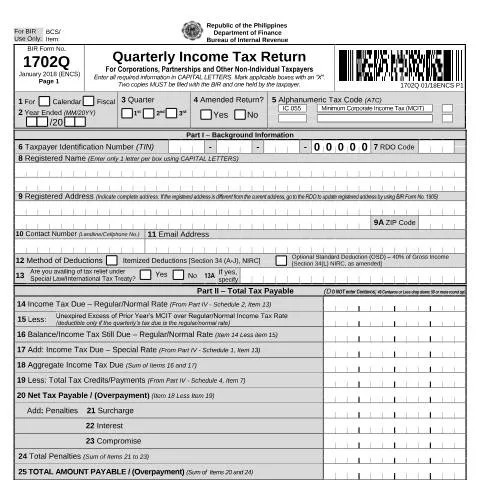
A Comprehensive Guide to BIR Form No. 1702Q: Quarterly Income Tax Return for Corporations
Navigating the complex landscape of taxation can be daunting for corporate entities in the Philippines. Among the essential documents required to fulfill tax obligations is the BIR Form No. 1702Q, the Quarterly Income Tax Return for Corporations, Partnerships, and Other Non-Individual Taxpayers. Understanding this form is crucial for compliance and effective financial management.
Understanding the Key Sections of BIR Form No. 1702Q
This official form consists of various sections that require meticulous attention. Each part gathers specific information necessary for calculating the tax liabilities of corporations and partnerships.
Part I – Background Information
- Taxpayer Identification Number (TIN): The unique number assigned to every taxpayer. Ensure accuracy to avoid processing delays.
- Registered Name: List the official name of the corporation, ensuring each letter is entered separately in capital letters.
- Contact Information: Include current phone numbers and email addresses for communication purposes.
- Method of Deductions: Choose between Itemized Deductions or Optional Standard Deduction (OSD). The OSD allows companies to claim 40% of gross income, simplifying the deduction process.
Part II – Total Tax Payable
This section is critical for determining the tax liability. Here, taxpayers must carefully compute their Income Tax Due based on their gross income and applicable tax rates. The calculations should consider any previous overpayments, which can affect the overall tax due.
| Description | Calculation Method |
|---|---|
| Income Tax Due - Regular Rate | From Part IV - Schedule 2, Item 13 |
| Balance Due | Item 14 Less Item 15 (if applicable) |
| Total Amount Payable | Sum of Income Tax Due and Total Penalties |
Part III – Details of Payment
Understanding the payment process is essential to ensure timely compliance. This section requires taxpayers to specify the payment method, whether through cash, checks, or bank debit memos. Accurate documentation of payments is critical, as it aids in tracking and resolving any discrepancies with the Bureau of Internal Revenue (BIR).
The Timeline for Filing BIR Form No. 1702Q
Awareness of deadlines is crucial for taxpayers to avoid penalties. The BIR Form No. 1702Q must be filed quarterly with specific deadlines as follows:
- 1st Quarter: April 15
- 2nd Quarter: August 15
- 3rd Quarter: November 15
- 4th Quarter: The final annual income tax return is due by April 15 of the following year.
Filing after these deadlines may incur penalties, including surcharges and interest, which can significantly increase the total tax liability.
Submitting the Form: Channels and Options
Taxpayers can submit the BIR Form No. 1702Q through various channels, each offering distinct advantages.
Online Submission via eBIRForms
The BIR has digitized many of its processes, allowing taxpayers to file their returns online. The eBIRForms application facilitates submission and ensures that all required data fields are completed correctly, thereby minimizing errors. Online filing is often the most efficient method, as it offers immediate confirmation of submission.
Paper Filing
For those who prefer traditional methods, paper filing is still an option. Taxpayers must complete two copies of the form and file them at their respective Regional District Office (RDO). One copy is for the BIR, while the other must be retained by the taxpayer for their records. Care must be taken to ensure that all entries are clear and legible to avoid processing issues.
Authorized Agent Banks (AAB)
Taxpayers may also opt to file through an Authorized Agent Bank, which offers the convenience of paying taxes while submitting returns. Payments can be made directly to these banks, providing immediate receipt of confirmation.
Unique Situations and Considerations for Taxpayers
Certain taxpayers may encounter unique circumstances that warrant special attention when filing the BIR Form No. 1702Q.
Foreign Corporations
Foreign entities operating in the Philippines must ensure compliance with local tax laws, including the proper completion of the form. This often involves understanding applicable international tax treaties that might provide benefits such as reduced rates or exemptions.
Complex Ownership Structures
Businesses with various partnerships or organizational structures may face additional complexities in reporting their income and determining the applicable tax rates. In these cases, seeking professional advice or consulting with a tax expert can help clarify obligations and optimize tax benefits.
Impact of Late Filings and Payments
Failure to file the BIR Form No. 1702Q on time may lead to substantial penalties, including:
- Surcharges: A specific percentage imposed on the unpaid tax amount.
- Interest: Accumulating interest on unpaid taxes can significantly increase the overall liability.
- Compromise Penalties: In some situations, taxpayers may negotiate with the BIR for a reduced penalty based on circumstances.
Practical Implications for Taxpayers
Proper filing of the BIR Form No. 1702Q is not merely a bureaucratic obligation; it carries substantial implications for corporations and partnerships.
Tax Credits and Deductions
Taxpayers can utilize credits and deductions effectively to lower their taxable income. Understanding which tax credits are applicable based on previous payments or withholding can significantly affect the overall tax liability.
Potential Refunds
In cases where a corporation has overpaid its taxes, filing the form correctly ensures that the taxpayer can claim necessary refunds. This process often necessitates thorough documentation to justify overpayments.
Legal Compliance and Responsibility
Filing the BIR Form No. 1702Q showcases fiscal responsibility and compliance with Philippine tax laws. Consistency in filing not only builds a positive reputation but also avoids potential legal complications.
From Preparation to Submission: A Step-by-Step Journey
Successfully navigating the filing process for the BIR Form No. 1702Q requires a clear chronological approach:
- Gather Required Documentation: Collect all necessary financial records, including sales, expenses, and previous tax returns.
- Complete the Form: Fill out the form with accurate information, double-checking for any errors or omissions.
- Select the Filing Method: Decide whether to file online or via paper submission.
- Submit the Form: Ensure the submission is made before the deadline to avoid penalties.
- Retain Copies: Keep a copy of the submitted form and all supporting documents for reference and audit purposes.
Following these steps can help ensure a smooth filing experience and uphold compliance with tax regulations.
Moving Forward: The Importance of Diligent Tax Practices
Ultimately, the process of filing the BIR Form No. 1702Q highlights the need for diligent financial practices among corporations and partnerships in the Philippines. A proactive approach can yield benefits, from reducing tax liability to establishing a solid foundation for future compliance. In an ever-evolving tax environment, staying informed and prepared is crucial for all corporate entities.
Understanding BIR Form No. 1702Q: Who Is Required to File?
The BIR Form No. 1702Q is specifically designed for corporations, partnerships, and other non-individual taxpayers in the Philippines who are required to submit their quarterly income tax return. This form captures the income earned during the quarter and determines the corresponding tax liabilities. It is essential for business entities, including but not limited to domestic corporations, partnerships registered with the Securities and Exchange Commission (SEC), and cooperatives, to comply with these requirements. However, there are specific criteria that dictate which taxpayers must file this form.
Companies that have opted for the 8% income tax rate under the Tax Reform for Acceleration and Inclusion (TRAIN) law, as well as those engaged in businesses subject to specific tax treatments, must ensure they file BIR Form No. 1702Q. On the other hand, certain entities may be exempt from this requirement, such as those classified as non-stock, non-profit organizations, provided they meet conditions set by the Bureau of Internal Revenue (BIR) and the Department of Finance (DOF). Moreover, it is crucial for eligible taxpayers to evaluate their revenue thresholds as set forth in the law, as these thresholds further determine whether they need to file this quarterly return or can opt for other tax filing methods. Regular consultation with a tax adviser can further illuminate obligations specific to each taxpayer.
Completing BIR Form No. 1702Q: Step-by-Step Guide
Filling out BIR Form No. 1702Q might seem daunting, especially for new businesses or those unfamiliar with tax compliance procedures. However, it can be simplified by breaking the process down into comprehensive steps. First, ensure that you have your financial statements ready, as these will serve as the primary source of information for the return. You will need to compile your gross sales or receipts, which must be properly documented and summarized for accuracy.
Once you have your financial data, begin by filling out the top portion of the form, which requires basic information such as the taxpayer's TIN (Tax Identification Number), registered name, and address. Following this, complete the sections detailing your gross income, allowable deductions, and any other pertinent tax computations. Don't forget to include any preferential tax rates or special deductions applicable to your business entity under the current tax laws.
The net income computed from the sections above will help you determine your tax due for the quarter. Ensure all figures are meticulously recorded and double-check your calculations to avoid any discrepancies that could lead to penalties or additional liabilities. After completing the form, submit it along with any required support documents to the BIR. As of recent regulations, the BIR encourages the use of e-filing via the eBIRForms system, streamlining the process and ensuring timely submission.
Penalties for Non-Compliance with BIR Form No. 1702Q
Failing to file BIR Form No. 1702Q by the designated deadlines can result in severe repercussions. The BIR imposes penalties on taxpayers who fail to comply, which can include interest on unpaid taxes, surcharges, and even criminal liability in cases of willful neglect to file. Specifically, taxpayers who fail to file the form within the prescribed period—usually within 60 days after the end of the quarter—risk incurring a penalty of 25% of the amount of tax due, in addition to the applicable interest on the unpaid tax.
Moreover, the issuance of a tax assessment notice serves as an additional consequence of non-compliance. This notice often outlines the discrepancies noted by the BIR during compliance checks, leading to further scrutiny of your tax affairs and potential audits of your financial records. For businesses, consistent non-filing can lead to reputational risks, affecting partnerships and relationships with stakeholders, as business compliance is a significant factor in maintaining trust.
To avoid penalties, maintaining accurate records, tracking due dates, and regularly consulting with tax professionals can be invaluable strategies. Adhering to the tax compliance timeline not only helps businesses stay on the right side of the law but also contributes to a healthy financial standing, which is crucial for sustainable growth.