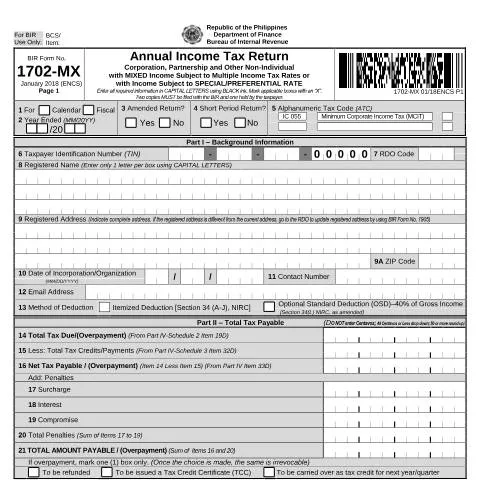
Navigating the BIR Form No. 1702-MX: A Comprehensive Guide
The BIR Form No. 1702-MX plays a critical role in the fiscal landscape of the Philippines, particularly for corporations, partnerships, and other non-individual entities. This document is designed for entities with mixed income subject to multiple tax rates or that qualify for special/preferential tax rates. Understanding the nuances of this form is essential for compliance with the Bureau of Internal Revenue (BIR) regulations and avoiding potential penalties.
The Legal Framework Behind BIR Form No. 1702-MX
The BIR Form No. 1702-MX is rooted in the National Internal Revenue Code (NIRC), amended over the years to ensure that tax regulations evolve with the economic landscape. As stipulated in the Administrative Code of 1987, this form is part of the broader annual income tax return regulations that govern corporate taxation.
Entities that fall under the jurisdiction of this form may experience varying tax obligations based on numerous factors, including their registered activities and the duration of their operations. The form serves as a declaration of income and an accounting of tax liabilities for entities that do not fit neatly into standard tax categories, providing a structured means for compliance.
Who Must Use BIR Form No. 1702-MX?
- Corporations and partnerships earning mixed incomes.
- Non-individual entities with income subject to multiple tax rates.
- Entities qualifying for special tax rates or exemptions.
Step-by-Step Completion of BIR Form No. 1702-MX
Completing the BIR Form No. 1702-MX involves several detailed steps. Each section of the form must be filled out carefully to ensure accuracy and compliance.
Part I: Background Information
The first section of the form requires fundamental information about the taxpayer:
- Tax Identification Number (TIN): This is a unique number assigned to each taxpayer.
- Registered Name: Fill out this section in capital letters.
- Registered Address: Ensure the address is complete. If there’s a discrepancy, update your records using BIR Form No. 1905.
- Date of Incorporation: Enter the date as MM/DD/YYYY.
- Contact Information: Provide a reliable contact number and email address.
Part II: Total Tax Payable
This section is crucial as it calculates the net tax payable or overpayment. Remember:
| Item | Description |
|---|---|
| 14 | Total Tax Due/(Overpayment) |
| 15 | Less: Total Tax Credits/Payments |
| 16 | Net Tax Payable/(Overpayment) |
It's essential to note that amounts should not include centavos; round as necessary when reporting.
Part III: Payment Details
Detailing how you will pay the tax due is the focus of this part. You can specify various payment methods such as:
- Cash/Bank Debit Memo
- Check
- Tax Debit Memo
- Other methods (please specify)
Filing Process: From Submission to Receipt
Understanding the filing process helps in managing timelines and expectations effectively. The BIR mandates that two copies of the form be filed, with one copy retained by the taxpayer.
How to Submit the BIR Form No. 1702-MX
There are multiple channels for filing the BIR Form No. 1702-MX:
- In-Person Submission: You may file the form directly at the Revenue District Office (RDO) where the taxpayer is registered.
- Online Filing: Utilize eBIRForms or the eGovPH app for e-filing, which enhances convenience and tracking.
- Authorized Agent Banks (AAB): Certain banks are designated to accept tax filings and payments. Verify the list of AABs with the BIR.
Regardless of the submission method chosen, ensure you keep a copy of the filed form and the acknowledgment of receipt for your records.
Understanding the Timeline: Key Dates to Remember
Fiscal accountability hinges on adhering to prescribed timelines for filing the BIR Form No. 1702-MX. Typically, the deadline for annual income tax returns is set for April 15 of the following year after the end of the calendar year. It is advisable to submit even earlier to mitigate the risk of penalties.
Important Dates
- Start of Filing Period: January 1 of the taxable year.
- Deadline: April 15 of the following year.
- Extensions: In certain situations, extensions may apply, but these must be formally requested.
Special Circumstances: Who Else Should Consider BIR Form No. 1702-MX?
Entities with unique circumstances such as foreign corporations engaged in business in the Philippines or those operating under special tax regimes must also consider utilizing this form. Understanding the specific regulations affecting these entities is critical to avoiding compliance issues.
Foreign Entities
Foreign corporations doing business in the Philippines must register with the BIR and are required to file this form if they meet the criteria outlined earlier. Additional layers of complexity may arise due to bilateral tax treaties that could influence tax obligations.
Minors and Other Unique Situations
In some cases, partnerships or corporations owned by minors may also be subject to filing this form. Educators and guardians should seek advice on how income is reported and ensure compliance with local tax laws.
Post-Submission: Tracking Your Filing
After submitting the BIR Form No. 1702-MX, it is crucial to monitor its processing. Taxpayers can check the status of their filings through the BIR’s official channels or by contacting their respective RDO. Keeping communication lines open with the BIR can help alleviate concerns and facilitate resolutions on any discrepancies.
Responding to Notifications
In case of any notifications regarding your submission—be it additional documentation requests or clarifications—promptly addressing these inquiries is vital. Failure to respond may lead to penalties or assessments of additional tax liabilities. Always keep records of your communications with the BIR for reference.
Conclusion: The Importance of Compliance
Filing the BIR Form No. 1702-MX is not merely a bureaucratic obligation; it is a reflection of fiscal responsibility and compliance in the Philippines. By understanding the intricacies of this form and the processes surrounding it, entities can ensure they meet their tax obligations effectively while taking advantage of any allowable deductions or credits.
Staying informed and proactive about the filing process and timelines will help mitigate any risks of non-compliance. As fiscal landscapes evolve, maintaining accurate knowledge of tax obligations remains imperative for all entities operating within the Philippines.
Understanding Mixed Income and Its Implications on BIR Form No. 1702-MX
Mixed income refers to the combination of various sources of income that a corporation or partnership may earn, which can be subject to distinct tax rates based on their nature. In the context of BIR Form No. 1702-MX, understanding how mixed income impacts a taxpayer's obligations is crucial for compliance and accurate reporting.
Corporations and partnerships receiving both regular income and income subject to special preferential rates must carefully categorize their earnings. Regular income generally refers to revenue derived from typical business operations, while special rates might apply to sectors such as tourism, real estate, or agriculture. For instance, if a corporation earns standard profits from retail operations alongside preferential income from government contracts, it is essential to differentiate these sources for effective tax computation.
Filing BIR Form No. 1702-MX requires not only an accurate declaration of total income but also an itemized breakdown of the different income types. This separation is necessary as each income type may have different deductions, exemptions, and tax rates. Corporations must also be aware that failure to properly report these mixed income streams can lead to penalties, including fines and interest on unpaid taxes. Therefore, it is advisable to maintain thorough financial records that clearly distinguish each income source during the fiscal year.
Common Pitfalls and How to Avoid Them When Filing BIR Form No. 1702-MX
While filing BIR Form No. 1702-MX may seem straightforward, various common pitfalls can lead to complications or errors in submission. One major issue arises from the inadequate categorization of income. Corporations and partnerships often neglect to correctly classify income sources, leading to improper tax computations. To avoid this, it is best practice to consult with tax professionals who possess a nuanced understanding of Filipino tax regulations and can provide guidance tailored to your specific circumstances.
Another frequent challenge involves the late filing of the annual income tax return. The deadline for submission is set for April 15 of the following year after the tax year. Missing this deadline can result in penalties and interests that accumulate daily. To mitigate this risk, businesses can utilize electronic filing systems like the eBIRForms and eGovPH app, which offer convenient platforms for timely submissions. Setting up reminders well in advance of the deadline can also help keep the filing process on track.
Moreover, many organizations overlook the importance of supporting documentation when filing the BIR Form No. 1702-MX. Taxpayers are responsible for retaining comprehensive records, including financial statements, receipts, and any documents that substantiate deductions claimed. These records not only facilitate a smoother filing process but also protect the organization in the event of an audit. Ensuring all documentation is organized and readily available will minimize discrepancies and potential disputes with the Bureau of Internal Revenue (BIR).
Navigating Tax Incentives and Special Rates on BIR Form No. 1702-MX
For corporations and partnerships eligible for tax incentives or special rates, comprehending how these elements affect BIR Form No. 1702-MX is critical. The Philippines offers various tax incentives to encourage investment in specific sectors, such as the Special Economic Zones and the Philippine Economic Zone Authority (PEZA). Taxpayers who qualify for such incentives must ensure they understand the specific conditions attached to these benefits, as failure to comply with the requirements can lead to disqualification from the preferential tax rates.
When filing Form No. 1702-MX, it is essential to accurately reflect any income that benefits from these special rates. The form provides sections for taxpayers to declare income subject to special rates, allowing them to apply the correct taxation level. This aspect of filing requires detailed knowledge of applicable regulations and the ability to substantiate claims with appropriate documentation.
Additionally, businesses aiming to maximize their tax benefits should regularly engage with tax consultants who specialize in Filipino tax law. These professionals can provide insights into any changes in legislation, ensuring that the corporation or partnership remains compliant while taking full advantage of available incentives. By keeping abreast of tax policies and engaging in proactive tax planning, organizations can optimize their financial outcomes and ensure adherence to tax obligations, thus fostering sustainable business growth.