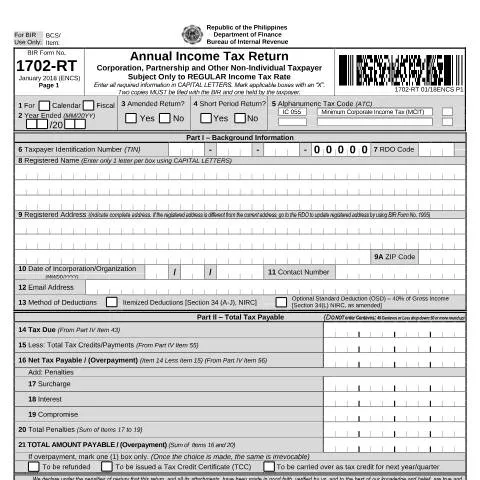
The Essence of BIR Form No. 1702-RT in the Philippine Tax Landscape
For any corporation or partnership operating in the Philippines, understanding the intricacies of tax compliance is crucial. One vital document in this process is the BIR Form No. 1702-RT, officially known as the Annual Income Tax Return for Corporations, Partnerships, and Other Non-Individual Taxpayers Subject Only to Regular Income Tax Rate. This form encapsulates various essential details regarding a business's income, deductions, and ultimately its tax liabilities, making it a cornerstone in the broader framework of Philippine tax administration.
Navigating the Regulatory Waters: Historical Context and Framework
The framework governing BIR Form No. 1702-RT is grounded in the provisions laid out in the National Internal Revenue Code, as amended by various laws over the years, including the Administrative Code of 1987 (Executive Order No. 292). The importance of this form can be traced back to the transitioning of the Philippine tax system towards more organized and regulated practices, ensuring that entities contribute their fair share to government revenue.
Since its introduction, the form has undergone numerous revisions to adapt to the evolving economic landscape and to incorporate changes in tax policy. For instance, Republic Act No. 10963, otherwise known as the Tax Reform for Acceleration and Inclusion (TRAIN) Law, brought substantial changes, including modifications in tax rates and exemptions applicable to various sectors. Such adaptations signify the government's commitment to fostering a compliant business environment, promoting transparency, and enhancing revenue collection mechanisms.
Who Needs to File BIR Form No. 1702-RT?
The primary filers of BIR Form No. 1702-RT include corporations and partnerships that are not classified under special tax regimes. Specifically, the following entities are required to submit this form:
- Domestic Corporations: Companies incorporated in the Philippines subject to regular income tax.
- Partnerships: Including general partnerships and limited partnerships that are not subject to special tax rates.
- Non-Individual Taxpayers: Other non-individual entities, such as associations and cooperatives, that fall under the regular income tax bracket.
However, certain exceptions apply. For instance, entities that are subject to the Minimum Corporate Income Tax (MCIT) or those availing of special tax rates are not mandated to use this form. Furthermore, corporations availing of tax incentives or special preferential rates are required to comply with different reporting obligations.
Timeframes and Deadlines: The Tax Calendar
Tax compliance is time-sensitive, and the BIR Form No. 1702-RT is no exception. The return is filed annually, with the following critical deadlines:
- Filing Deadline: The form must be filed on or before April 15 of the year following the close of the taxable year, typically aligned with the calendar year (January 1 to December 31).
- Payment Due Dates: Any taxes owed must be settled at the time of filing, or the entity may opt for a payment scheme, ensuring that compliance is upheld.
Late submissions incur penalties, including surcharges and interest. Thus, maintaining a meticulous calendar for filing and payment is vital for avoiding financial repercussions.
Completing BIR Form No. 1702-RT: Essential Components
Filling out BIR Form No. 1702-RT necessitates precise adherence to the prescribed format. Here is a comprehensive breakdown of the crucial sections involved:
Section 1: Basic Information
This section gathers fundamental details about the taxpayer, such as:
- Taxpayer Identification Number (TIN): Essential for processing the tax return.
- Registered Name and Address: Legal name and business address are crucial for identification purposes.
- Date of Incorporation: Establishes the entity’s legal standing.
- Email and Contact Number: For communication regarding the return.
Section 2: Method of Deductions
Filing entities must choose between:
- Itemized Deductions: Based on actual expenses.
- Optional Standard Deduction (OSD): Set at 40% of gross income, simplifying the process for those opting for less complexity.
Section 3: Computation of Tax
One of the most critical parts of the form, here the taxpayer calculates:
- Total Sales/Receipts/Revenues
- Gross Income: After deducting costs and other reductions.
- Net Taxable Income: Deductions should be carefully calculated to determine the final tax liability.
Section 4: Payment Details
Accurate reporting of tax payments is imperative. This section encompasses:
- Tax Due: Amount owed upon completion of the tax computation.
- Tax Credits: Any credits applicable must be detailed here to offset the tax due.
Section 5: Signatures
Finally, authorized representatives must sign the form, including:
- President/Principal Officer
- Treasurer/Assistant Treasurer
Each signatory must include the TIN, reinforcing the form's credibility and verifying that the information submitted is accurate and complete.
Submission Process: From Completion to Filing
Once the BIR Form No. 1702-RT is completed, entities must adhere to specific submission protocols to ensure compliance and avoid issues:
- Submission Copies: Two copies of the completed form must be filed with the Bureau of Internal Revenue (BIR), and one should be retained by the entity for its records.
- Filing Methods: Depending on the entity's preference, this can be done through electronic filing via the eBIRForms application or in person at designated BIR offices.
For electronic submissions, ensure that the data is correctly inputted and that digital signatures, if applicable, are verified. For physical submissions, double-check that the form is free from errors and that attachment requirements are met.
Post-Filing Considerations: What to Expect Next
After submitting the BIR Form No. 1702-RT, entities should remain vigilant for subsequent steps:
- Confirmation of Filing: The BIR typically issues a stamped copy of the return as a receipt of filing, which is essential for record-keeping.
- Possible Assessments: The BIR may conduct assessments based on the submitted return. Be prepared to provide additional documentation or clarification if requested.
- Handling Overpayments: If the return indicates an overpayment, entities can choose to have it refunded, converted into a Tax Credit Certificate, or carried over to the next taxable year.
Entities should maintain an organized filing system with all documentation related to BIR Form No. 1702-RT for potential audits and for seamless future filings.
Special Circumstances: Unique Situations Requiring Attention
Various unique situations may necessitate specialized attention when filing BIR Form No. 1702-RT:
Foreign Entities and Tax Treaties
Foreign corporations operating in the Philippines must be particularly cautious. They might be entitled to certain tax treaty benefits, which could significantly reduce their tax liabilities. Engaging a tax professional familiar with the nuances of tax treaties between the Philippines and other jurisdictions is advisable.
Amended Returns
Entities discovering discrepancies post-filing can submit an amended return. It’s crucial to indicate that it is an amended return on the form to avoid penalties associated with incorrect reporting.
Short Period Returns
In cases where a corporation is newly established or has undergone dissolution, a short period return may be applicable. Indicating this on the BIR Form No. 1702-RT is essential for accurate tax reporting.
Conclusion: Embracing Compliance and Governance
Navigating through the requirements of BIR Form No. 1702-RT is not merely a bureaucratic obligation; it signifies a corporation's commitment to transparency and legal compliance in the Philippine tax landscape. With the ongoing changes in tax regulations, being well-informed and proactive ensures that entities remain in good standing with the Bureau of Internal Revenue, thereby fostering a culture of accountability within the business community.
For thorough assistance with the intricacies surrounding BIR Form No. 1702-RT, it is often beneficial to consult a tax professional or legal advisor familiar with Philippine tax law and practices. Their insights can help in optimizing tax obligations and ensuring adherence to the regulations, ultimately aiding in the sustainable growth of the business.