Understanding the BIR Form No. 1702-EX: A Guide for Exempt Non-Individual Taxpayers in the Philippines
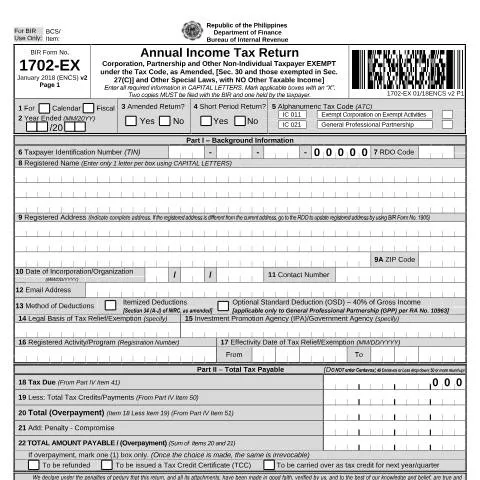
The Bureau of Internal Revenue (BIR) in the Philippines requires certain non-individual taxpayers, such as corporations and partnerships that are exempt from income tax under specific provisions of the Tax Code, to file an annual income tax return. The official form designated for this purpose is BIR Form No. 1702-EX, which serves as the official declaration of income and tax relief status for eligible entities with no other taxable income.
Scope and Purpose of BIR Form No. 1702-EX
The primary objective of Form 1702-EX is to facilitate the reporting process for entities that are exempt from income tax due to their activities being covered under Section 30 of the Tax Code, as amended, and those specifically exempted under Section 27(C). This includes entities engaged solely in activities that qualify for tax exemption, such as certain government agencies, non-profit organizations, and corporations involved in specific exempt activities identified by registered investment promotion agencies or government authorities.
This form is designed for taxpayers with no other taxable income besides their exempt activities. It streamlines the reporting process by focusing on confirming the exemption status and ensuring compliance with legal requirements without the need to report taxable income or deductions.
Key Features and Dispositions of the Form
Part I: Background Information
This section captures essential details about the taxpayer, including the Taxpayer Identification Number (TIN), the registered name and address, the date of incorporation or organization, and contact information. It also includes the alphanumeric tax code (ATC), which indicates the nature of the exemption, such as “IC 011 Exempt Corporation on Exempt Activities.”
Taxpayers must specify the legal basis of their exemption, the relevant government agency or investment promotion authority involved, and the date the exemption became effective. These details are crucial for verifying the taxpayer’s exempt status and for proper classification within the BIR system.
Part II: Total Tax Payable
Since the form pertains to entities with no taxable income, the tax due section generally reflects zero. However, this part also includes the computation of any overpayment or credit that may be carried over or refunded, based on prior payments or credits. It is important to accurately declare the total tax credits or payments made in previous periods to determine if there is an overpayment or remaining balance.
Part III: Payment Details
This section records the specifics of any tax payments made, such as bank or agency details, payment date, and amount. For entities that have paid their taxes through bank debit, check, or other means, proper documentation must be attached to support the declarations.
Legal and Filing Considerations
Filing of Form 1702-EX is mandatory for eligible exempt entities, and it must be submitted annually, typically on or before April 15 of the following year, aligning with the calendar year or fiscal year end. The form requires the signature of the authorized representative, with their TIN and position clearly indicated, under penalty of perjury.
Two copies of the completed form must be filed with the BIR, with one retained by the taxpayer for their records. Submission can be made either in person at the Revenue District Office (RDO) where the taxpayer is registered or through electronic filing systems such as the BIR eFPS or eBIRForms, subject to availability and compliance with the BIR’s digital filing requirements.
Implications for Tax-Exempt Entities
Filing the BIR Form No. 1702-EX confirms the taxpayer’s exemption status under the law and ensures compliance with Philippine tax regulations. It also provides a record for the BIR to verify the entity’s activities and exemption eligibility during audits or reviews.
While entities with no taxable income are not required to pay income tax, they must remain diligent in their reporting obligations. Failure to file or inaccuracies in the submission can lead to penalties or the revocation of exemption status.
Conclusion
The BIR Form No. 1702-EX is a crucial document for exempt corporations and partnerships in the Philippines. Proper understanding and timely submission of this form help maintain legal compliance and uphold the transparency of exempt activities. Taxpayers are advised to consult the latest BIR regulations or seek professional guidance to ensure accurate and complete filing, especially considering the evolving nature of tax laws and digital filing procedures.