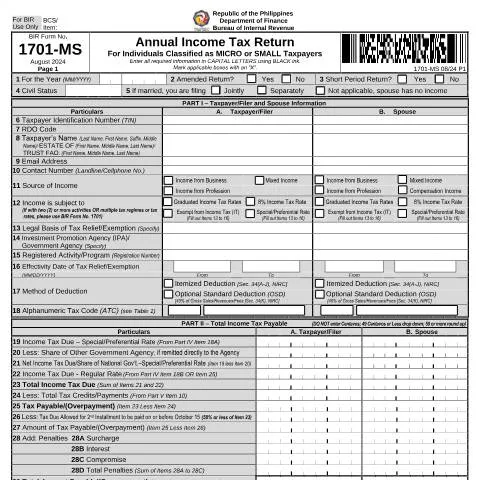
Navigating the BIR Form No. 1701-MS: An Essential Guide for Micro and Small Taxpayers
Understanding the complexities of tax obligations in the Philippines can be daunting, especially for micro and small taxpayers. Each year, they are required to file their Annual Income Tax Return using the BIR Form No. 1701-MS, a crucial document that not only delineates their income and tax liabilities but also ensures compliance with the country's tax laws. This article aims to unravel the significance of this form, the profile of users, the nuances of the filing process, and the implications of non-compliance, providing you with a comprehensive understanding of your responsibilities as a taxpayer.
Historical Context and Regulatory Framework
The origins of the BIR Form No. 1701-MS can be traced to the broader framework established under the National Internal Revenue Code of 1997, which has undergone various amendments over the years. The Administrative Code of 1987, specifically Executive Order No. 292, lays the foundational principles for administrative procedures, including tax filing. This form was introduced to simplify the filing process for individuals classified as micro and small taxpayers, in line with the government's initiative to enhance compliance and facilitate tax collection.
Micro and small taxpayers are defined through specific revenue thresholds and are often engaged in small-scale business activities. By creating a distinct form for this demographic, the Bureau of Internal Revenue (BIR) acknowledges their unique status and aims to lessen the bureaucratic burden typically associated with tax compliance.
Distinguishing Features of BIR Form No. 1701-MS
While there are several income tax return forms available, such as the BIR Form No. 1701 for individuals classified as medium or large taxpayers, BIR Form No. 1701-MS stands out in several ways:
- Target Audience: Exclusively designed for micro and small taxpayers who may have simpler income sources and lower revenue thresholds.
- Filing Simplicity: The form requires less detailed reporting compared to its larger counterparts, accommodating the less complex financial structures of its users.
- Tax Rate Options: It offers varied tax rate options, including graduated rates and an 8% income tax rate, allowing taxpayers to choose the most beneficial method of computation.
The Stakes: Rights, Obligations, and Consequences of Non-Compliance
Filing the BIR Form No. 1701-MS is not merely a bureaucratic exercise; it carries significant implications for taxpayers:
- Legal Compliance: Timely and accurate filing helps avoid penalties. The Philippines has strict regulations regarding tax compliance, and failure to adhere can lead to fines and legal action.
- Access to Benefits: Proper filing can open avenues for tax credits and other benefits, such as a potential refund of overpaid taxes.
- Financial Integrity: Regular filing fosters good financial practices and transparency, essential traits for small business sustainability.
On the flip side, neglecting to file or submitting inaccurate information can result in severe consequences, including:
- Financial penalties for late filing or underreporting income.
- Legal disputes with the BIR, possibly culminating in criminal charges.
- Loss of credibility with potential clients and business partners, as tax compliance is often seen as a reflection of a business's integrity.
Understanding the Filing Process: A Step-by-Step Breakdown
The process of submitting the BIR Form No. 1701-MS involves several steps, each crucial for ensuring a smooth filing experience. Understanding these steps will minimize errors and facilitate compliance:
Preparation of Required Information
Before filling out the form, it is imperative to gather all necessary information, including:
- Your Taxpayer Identification Number (TIN)
- Revenue District Office (RDO) Code
- Income sources and amounts for the year
- Details of any applicable tax credits or deductions
Completing the Form
The BIR Form No. 1701-MS consists of several sections that require careful attention:
- Taxpayer Information: Fill in your name, TIN, contact details, and income sources.
- Income Details: Report gross income, deductions, and compute the tax due based on the chosen tax regime.
- Payment Information: Clearly indicate how the tax payment will be made, whether through cash, check, or other means.
Review and Submission
Once the form is filled out, double-check all entries for accuracy. Errors can lead to delays and penalties. After completing the review, the form can be submitted in one of the following ways:
- Electronic Filing: Utilizing the eBIRForms or eGovPH app for online submission, facilitating a faster and more efficient process.
- In-person Submission: Delivering the form to the appropriate BIR office or Authorized Agent Bank (AAB), ensuring you obtain a stamped copy as proof of submission.
Profiles of Taxpayers: Who Needs to File?
Taxpayers eligible to file the BIR Form No. 1701-MS typically fall into the following categories:
- Micro Enterprises: Small businesses with a gross annual income of up to PHP 3,000,000.
- Small Enterprises: Businesses that surpass the micro classification but still operate on a relatively modest scale.
- Professional Individuals: Freelancers and independent contractors earning below the specified threshold.
Special Considerations
It is essential to note that certain taxpayers may be exempt or have different requirements:
- Non-resident Aliens: May be subject to different filing rules.
- Other Documented Exceptions: Taxpayers involved in specific industries or activities may have distinct forms or additional obligations.
Essential Supporting Documents: Preparing for Submission
Collecting the right documentation is crucial to support your income declarations and claims for deductions or tax credits. Here’s what to prepare:
| Type of Document | Purpose |
|---|---|
| Income Statements | To verify all declared income sources. |
| Receipts for Deductions | To substantiate any claimed deductions. |
| Bank Statements | For proof of income transactions and financial health. |
| Previous Tax Returns | To provide a reference for your current filing. |
Delivery Channels: Paper vs. Electronic Submissions
Taxpayers have options when it comes to submitting their BIR Form No. 1701-MS. Understanding these delivery channels can enhance efficiency:
- Online Submission:
- Advantages include immediate processing and reduced paperwork.
- Access to electronic confirmation of receipt, providing peace of mind.
- Paper Submission:
- In-person visits can be beneficial for those requiring assistance or clarification.
- Physical copies may be preferred by some taxpayers for record-keeping purposes.
Choosing the Right Channel
Your choice of submission method may depend on several factors, including:
- Your level of comfort with technology.
- The availability of resources for online submission.
- Your specific circumstances, such as needing assistance or having complex financial situations.
Consequences of Non-Compliance: What Lies Ahead?
Failure to file the BIR Form No. 1701-MS can have dire repercussions. The BIR has stringent enforcement mechanisms in place, and non-compliance can lead to:
- Penalties and Interest: These can significantly increase the amount owed, making timely filing crucial.
- Legal Consequences: Tax evasion is taken seriously, with potential criminal charges for willful neglect.
- Reputational Damage: An unfiled tax return can adversely affect business relationships and trust with clients and partners.
Moreover, taxpayers should be aware of their right to appeal any penalties imposed. Engaging with the BIR to clarify or dispute charges is often possible, provided that taxpayers act promptly and offer adequate evidence to support their case.
Final Thoughts: Empowering Your Tax Compliance Journey
In the Philippines, the BIR Form No. 1701-MS serves as more than just a tax return; it embodies the responsibilities and rights of micro and small taxpayers. By understanding the intricacies of this form, you can navigate the tax filing process with confidence, ensuring compliance while maximizing your financial benefits. Remember, the key to successful tax compliance lies in thorough preparation, timely submission, and a proactive approach to understanding your obligations. With the right knowledge and resources, you can turn the complexities of tax filing into a manageable task.
Understanding BIR Form No. 1701-MS: Key Features and Eligibility Criteria
BIR Form No. 1701-MS is specifically designed for individuals classified as micro and small taxpayers in the Philippines. Understanding the features of this form is crucial for compliance and ensuring correct filing of tax returns. This form caters to self-employed individuals, professionals, and those engaged in business whose gross sales or receipts do not exceed certain thresholds.
To qualify as a micro taxpayer, an individual's gross sales or receipts must be P3,000,000 or less, while small taxpayers must not exceed P7,500,000. This classification is essential for determining tax obligations and availment of specific benefits, such as simplified reporting and tax rates. Taxpayers should ensure they meet these classifications to avoid penalties or incorrect tax assessments.
An important aspect of BIR Form No. 1701-MS is its provision for optional flat income tax rates, which may simplify the tax burden on qualified individuals. This is particularly advantageous for new businesses or those with fluctuating incomes. Taxpayers should familiarize themselves with these options to determine what is most beneficial for their specific situation.
Step-by-Step Process for Filing BIR Form No. 1701-MS
Filing BIR Form No. 1701-MS involves several key steps that require careful attention to detail in order to ensure compliance with the Bureau of Internal Revenue regulations. Here’s a step-by-step guide:
- Gather Required Documents: Before starting the filing process, ensure you have all necessary documents on hand. This includes income statements, receipts, and any other relevant financial records to substantiate your claims.
- Access the Form: Download BIR Form No. 1701-MS from the BIR website or obtain a physical copy from your local BIR office. Ensure you are using the most current version of the form.
- Fill Out the Form Accurately: Complete the form with accurate information, including your personal details, income sources, deductions, and any taxes withheld. Pay special attention to the computation of your taxable income, as errors can result in penalties.
- Review and Double-Check: Before submission, review the form thoroughly to ensure there are no discrepancies. It may be beneficial to consult with a tax professional if you are unsure about any aspect of your filing.
- Submit the Form: Once finalized, you can file the form either manually at your local BIR office or electronically through eBIRForms. If filing electronically, ensure you have a valid email address and have registered with the online system.
- Payment of Taxes Due: If there are taxes owed, make sure to pay them prior to the deadline to avoid interest and penalties. Payments can be made through authorized banks or online payment platforms.
- Keep Proof of Filing: After submission, retain a copy of the filed form and any proof of payment. This documentation is essential for both future reference and in case of any audits from the BIR.
It is vital to adhere to these steps and deadlines, as failure to comply can lead to significant penalties, including fines and interest on unpaid taxes. Understanding this process will equip taxpayers to navigate their responsibilities with confidence.
Common Challenges and How to Overcome Them When Filing BIR Form No. 1701-MS
Filing BIR Form No. 1701-MS, while straightforward, can come with its own set of challenges. Awareness of these potential issues and knowing how to address them can significantly ease the filing process.
1. Lack of Understanding of Tax Obligations: Many micro and small taxpayers struggle with understanding what qualifies as taxable income and what deductions can be claimed. It is vital to consult the BIR's official guide or seek advice from a tax professional who can help clarify these aspects.
2. Difficulty in Accessing Online Filing Systems: Some individuals may face challenges navigating the eBIRForms system, particularly if they are not tech-savvy. To overcome this, it is recommended to attend BIR seminars or workshops focused on e-filing, which can provide practical hands-on guidance.
3. Errors in Form Completion: Errors in filling out BIR Form No. 1701-MS can lead to delays in processing and potential penalties. To minimize this risk, taxpayers should take their time when completing forms, using drafts before finalizing submissions. Peer reviews can also help spot mistakes.
4. Missing Deadlines: The deadline for filing the BIR Form No. 1701-MS usually falls on April 15 of the following year after the taxable year. Setting reminders and keeping a tax calendar can assist in ensuring all submissions are made on time.
By proactively addressing these challenges, micro and small taxpayers can ensure a smoother filing experience. It is essential to remain informed and proactive to navigate the complexities of tax compliance effectively.