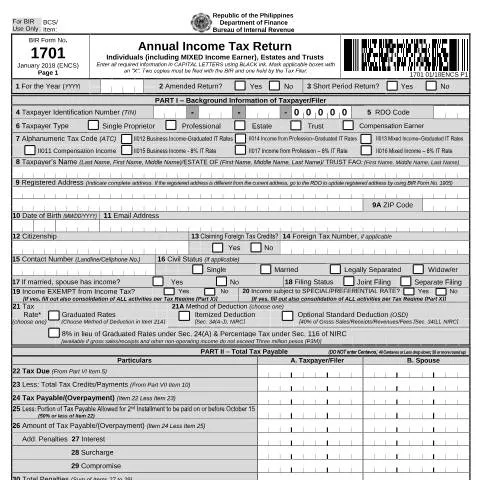
Understanding BIR Form No. 1701: A Critical Element for Tax Filers
When engaging in the annual ritual of filing income tax returns in the Philippines, the significance of BIR Form No. 1701 cannot be overstated. This document is essential for individuals, mixed income earners, estates, and trusts, serving as the official declaration of one’s taxable income and the computations necessary for tax obligations. The process can be intricate, yet understanding its components can lead to smoother compliance with the Bureau of Internal Revenue (BIR) regulations.
Who Is Required to File BIR Form No. 1701?
Not everyone is mandated to fill out this form. Primarily, this form targets:
- Individuals earning income from business, profession, or a combination of various income sources (mixed income earners).
- Estates and trusts that have generated taxable income during the year.
- Taxpayers who opt for a graduated income tax rate or choose to declare under special tax regimes.
Knowing whether you fall within these categories is the first step toward ensuring compliance with tax obligations. Failure to file can result in penalties, interest charges, or legal complications.
The Chronology of Filing: From Preparation to Submission
The journey of filing taxes using BIR Form No. 1701 begins with preparation and culminates in submission. Understanding this timeline can significantly ease the burden of tax compliance.
Step 1: Gathering Necessary Documentation
- Income Statements: Collect all income statements such as sales invoices, receipts, and proof of other earnings.
- Previous Tax Returns: Keeping copies of previous returns can aid in accurate reporting.
- Tax Identification Number (TIN): Ensure your TIN is readily available for filling out the form.
Step 2: Completing the Form
Filling out BIR Form No. 1701 involves careful attention to detail. Each section requests specific information such as:
- Background information: Including your name, address, and taxpayer type.
- Income declarations: Clearly specify all income sources, distinguishing between business and professional income.
- Deduction claims: Choose between itemized deductions and optional standard deductions, marking the selected method accurately.
Step 3: Review and Validate
Before submission, review all entries to ensure accuracy. Mistakes can lead to adjustments later, which may incur penalties. Furthermore, validate the attachments to be submitted alongside the form.
Step 4: Submission Channels
Taxpayers can file BIR Form No. 1701 through various channels:
- In-Person at BIR Offices: Submit two copies directly to the BIR office and keep one for your records.
- Authorized Agent Banks: Filing through these banks may expedite processing.
- Online Filing: Utilize the eBIRForms system for electronic submissions, making the process more efficient.
It’s crucial to remember the deadline for filing is typically on or before April 15 of the following year, with certain exceptions for amended returns.
Decoding the Sections of BIR Form No. 1701
Each section of BIR Form No. 1701 contains critical aspects that require careful consideration. Understanding each segment can help taxpayers navigate potential pitfalls.
Part I: Background Information of Taxpayer/Filer
This section lays the groundwork for your return. Be meticulous in providing:
- Taxpayer Identification Number (TIN): Essential for tracking your tax obligations.
- Registered Address: Ensure that it matches your records with the BIR.
Part II: Total Tax Payable
Accurate computations are vital in this section. Here’s a breakdown of what to include:
- Tax Due: Derived from your reported income.
- Less: Total Tax Credits: Include all applicable credits to avoid overpayment.
Duplicate entries can cause discrepancies, so ensure figures are double-checked.
Part III: Details of Payment
In this section, outline how you intend to settle your tax dues. This includes:
- Payment Method: Whether through cash, check, or other means.
- Date of Payment: Important for record-keeping and compliance purposes.
Keep all receipts and proof of payments as part of your documentation.
Common Pitfalls in Completing Form 1701
As with any form of official documentation, several common mistakes can arise when completing BIR Form No. 1701:
- Incorrect Tax Identification Number: Verify your TIN before submission.
- Omitting Sources of Income: Failing to declare all income can lead to legal repercussions.
- Calculation Errors: Double-check all calculations, especially deductions and credits.
Taking the time to review these common errors can save significant hassle and financial repercussions.
The Legal Framework Supporting BIR Form No. 1701
BIR Form No. 1701 operates under the provisions set forth by the Administrative Code of 1987 and subsequent regulations from the BIR. Understanding this legal backdrop lends insight into the obligations attached to tax filings.
These regulations not only mandate the filing of income tax returns but also outline the penalties for non-compliance, establishing a clear expectation for all taxpayers to engage in accurate reporting.
Consequences of Non-Compliance: What You Need to Know
Failing to file BIR Form No. 1701 on time or inaccurately reporting income can have significant consequences:
- Penalties and Interest: Late submissions incur both penalties and interest charges based on the unpaid amount.
- Legal Action: Continued non-compliance can lead to audits or legal proceedings initiated by the BIR.
- Loss of Rights: Taxpayers may lose the ability to claim certain deductions or benefits in the future.
Understanding these ramifications emphasizes the importance of timely and accurate filing.
Tools and Resources for Effective Filing
Utilizing available resources can streamline the filing process:
- BIR Website: The official portal offers downloadable forms, guidelines, and updates on tax regulations.
- Professional Assistance: Engaging with certified tax preparers or accountants can mitigate risks associated with filing.
- Tax Workshops: Attend seminars organized by the BIR or other institutions to stay informed about current tax obligations.
Utilizing these resources can significantly enhance the experience of filing income tax returns, ensuring compliance and reducing the likelihood of errors.
Final Thoughts: The Importance of Diligence in Filing
The process of completing BIR Form No. 1701 is not merely a bureaucratic hurdle but a critical civic responsibility. Being thorough and attentive while completing the form ensures compliance and promotes financial integrity. This not only helps maintain personal financial health but also contributes to the larger economic framework of the Philippines. The stakes are high, but the rewards of diligent compliance and accurate reporting are invaluable.
Understanding the Components of BIR Form No. 1701
BIR Form No. 1701 is a comprehensive document utilized by individuals, including those earning mixed incomes, as well as estates and trusts, to declare their annual income and calculate their tax obligations. The form comprises several sections, each serving a distinct purpose:
- Part I: Personal Information - This section requires basic demographic information such as your name, address, contact number, and Tax Identification Number (TIN). Accuracy in this section is vital, as it ensures proper correspondence and identification by the BIR.
- Part II: Income Types - Here, you will categorize your income sources. Mixed-income earners must differentiate between compensation income and income from business or practice of profession. Correctly identifying these income types is crucial because they are subject to different tax treatments.
- Part III: Allowable Deductions - This section allows you to deduct certain expenses from your total income, which can significantly impact your taxable income. Familiarize yourself with what qualifies as allowable deductions—these can include business expenses, personal exemptions, and other allowable deductions stipulated by the tax code.
- Part IV: Tax Computation - Calculate the tax due based on your net taxable income. This part may require meticulous attention to detail, as errors in calculations can lead to penalties or overpayments.
- Part V: Payment Details - After determining the tax due, you must provide details regarding how you intend to pay the tax. Options include cash, check, or electronic payment methods. If you are filing through eBIRForms, ensure all payment methods align with the electronic filing protocols.
Filing and Payment Deadlines for BIR Form No. 1701
Adhering to the specified deadlines for filing BIR Form No. 1701 is paramount to avoid penalties and interest on unpaid taxes. The general deadline for filing this annual income tax return is on or before April 15 of the following year. For example, for income earned in the year 2023, the filing deadline would be April 15, 2024.
However, it is essential to note that extensions may be granted under certain circumstances. For individuals whose sources of income are solely derived from employment, the BIR allows a possible extension of up to 30 days, provided a written request is submitted before the deadline. Conversely, mixed-income earners and estates do not automatically qualify for this extension, so it is advisable to consult the latest revenue regulations or a tax professional for specific guidance.
Payment of taxes should coincide with your filing. If you fail to pay your tax due by April 15, penalties will accrue based on applicable laws. The penalty for late payment is usually 25% of the tax due, plus an interest of 20% per annum on the unpaid tax. To avoid these additional fees, timely payment through e-filing platforms or designated banks is recommended, ensuring that you obtain a proof of payment.
Common Mistakes to Avoid When Filing BIR Form No. 1701
Filing BIR Form No. 1701 can be straightforward; however, various pitfalls can result in unnecessary complications. Here are some common mistakes taxpayers should avoid:
- Incomplete Information: Ensure that all required fields are filled out accurately. Omissions can lead to processing delays or rejections.
- Incorrect Income Reporting: Mixed-income earners must ensure they differentiate between compensation and business income accurately. Misclassifying income can result in incorrect tax calculations.
- Failure to Keep Documentation: Maintaining records of all income and deductible expenses is essential. In the event of an audit, you will need to substantiate the entries on your tax return with appropriate documentation such as receipts, invoices, and contracts.
- Neglecting to Sign the Form: A common oversight is submitting the form without the necessary signatures. This includes the taxpayer’s signature and, if applicable, the signature of the authorized representative.
- Missing Deadlines: Be aware of all deadlines to avoid penalties. Planning ahead can help ensure that your filing and payment occur on time.
By being mindful of these common errors, you can facilitate a smoother filing process and maintain compliance with BIR regulations.
Resources and Support for BIR Form No. 1701 Filing
For taxpayers looking to assist with their filing of BIR Form No. 1701, several resources are available:
- BIR Official Website: The Bureau of Internal Revenue's official website offers comprehensive resources, including downloadable forms, instructional materials, and updates on tax laws and regulations.
- Taxpayer Assistance Centers (TACs): Located throughout the Philippines, TACs provide in-person assistance for tax-related inquiries, including filing guidance for BIR Form 1701.
- Online Tax Forums and Communities: Engaging with online communities or forums where taxpayers share experiences and advice can be beneficial. These platforms often provide practical tips on navigating the complexities of tax filing.
- Professional Tax Consultants: For those who may find the filing process overwhelming, hiring a certified public accountant or tax consultant can ensure compliance and optimal tax strategy. Professional advice can be particularly advantageous for mixed-income earners who may require assistance in distinguishing income types and maximizing deductions.
Overall, taxpayers should be proactive in seeking out necessary resources and support to ensure they meet their obligations regarding BIR Form No. 1701.