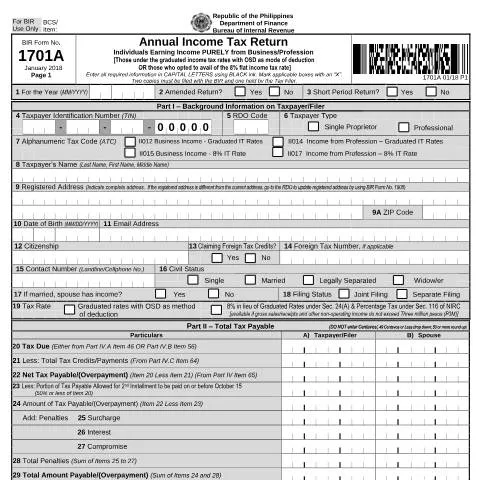
Understanding BIR Form No. 1701A: A Vital Component for Business Tax Filers
For individuals running their own businesses or practicing a profession in the Philippines, timely and accurate tax filing is crucial for regulatory compliance and financial health. The BIR Form No. 1701A is specifically designed for those earning income purely from business or profession, under specific tax regimes. This article delves into the intricacies of this form, ensuring that taxpayers understand its role, requirements, and filing procedures.
The Role of BIR Form No. 1701A in the Tax Filing Process
The BIR Form No. 1701A serves as the annual income tax return for individuals who fall under the graduated income tax rates with Optional Standard Deduction (OSD) or those who have opted for the 8% flat income tax rate. This form is vital for ensuring compliance with the National Internal Revenue Code (NIRC) as it summarizes the taxpayer's earnings and calculates the tax due.
Who is Required to Use Form 1701A?
- Business owners or professionals earning purely from their respective fields.
- Individuals opting for the graduated income tax rates with OSD.
- Taxpayers who qualify for the 8% flat income tax rate, provided their gross receipts do not exceed ₱3 million.
By adhering to the guidelines set forth in this form, taxpayers can ensure they are accurately reporting their income and paying the correct amount of tax due.
Key Sections of BIR Form No. 1701A: A Closer Look
Understanding the individual sections of BIR Form No. 1701A is essential for accurate completion. Each section caters to specific information that the Bureau of Internal Revenue (BIR) requires for processing the tax return.
Part I: Background Information on Taxpayer/Filer
This section gathers essential personal information about the taxpayer or filer, including:
- Taxpayer Identification Number (TIN): A unique number assigned to each taxpayer.
- RDO Code: Indicates the Revenue District Office where the taxpayer is registered.
- Taxpayer Type: Whether the filer is a single proprietor or a professional.
- Name and Address: Complete details are required; if there’s a change, updates should be made using BIR Form No. 1905.
Accurate information here is essential as it directly affects the processing of the tax return.
Part II: Total Tax Payable Calculation
This section is crucial for determining how much tax is owed to the BIR. Taxpayers must calculate their nominal tax due, taking into account any tax credits or payments made throughout the fiscal year.
| Particulars | Amount |
|---|---|
| Tax Due | (From Part IV.A Item 46 or Part IV.B Item 56) |
| Less: Total Tax Credits/Payments | (From Part IV.C Item 64) |
| Net Tax Payable/(Overpayment) | (Item 20 Less Item 21) |
Filing Deadlines and Important Dates
Awareness of critical dates is essential for compliance. The BIR requires individual taxpayers to file their annual income tax returns by April 15 of the year following the taxable year. For example, for incomes earned in 2023, returns must be filed by April 15, 2024.
In situations where an amended return is needed, taxpayers can indicate this on the form and submit it promptly to avoid penalties. It is crucial to keep a copy of the filed return for personal records and future reference.
Consequences of Late Filing
The BIR imposes penalties for late filing, which may include:
- Surcharges on unpaid taxes.
- Interest on unpaid obligations.
- Potential legal actions for extreme non-compliance.
Thus, ensuring timely submission of BIR Form No. 1701A is indispensable for maintaining good standing with tax authorities.
Special Cases and Considerations for Taxpayers
Various scenarios may impact how taxpayers complete BIR Form No. 1701A. Understanding these nuances is essential for accurate filing.
Foreign Earners and Residents
Taxpayers who earn income from foreign sources must also declare this income. However, they may be eligible for foreign tax credits, which should be claimed in the appropriate section of the form.
Minors and Dependents
For minors earning independent income, the responsibility to file rests with their guardians. Additionally, married couples with dependent children must consider their combined income when determining liability and which tax filing status to select.
Regarding dependents, it is vital for taxpayers to keep records of all allowable deductions, as they can significantly affect the overall tax liability.
Understanding the Filing Process: A Step-by-Step Guide
Filing BIR Form No. 1701A involves a systematic approach. Here’s a streamlined process to follow:
- Gather Required Documents: Collect all necessary documents, including proof of income, receipts, and previous tax returns.
- Complete the Form: Fill out all relevant sections accurately, ensuring all figures are rounded off to the nearest peso.
- Review for Accuracy: Double-check the information provided to avoid any discrepancies or errors.
- Submit the Form: File two copies of the form with the BIR and retain one for personal records. Submission can be done in person or through authorized agent banks.
- Follow Up on Processing: After submission, taxpayers may track the status of their filing through the BIR’s official channels.
This structured approach minimizes errors and ensures compliance with tax regulations.
Frequently Overlooked Details in Completing BIR Form No. 1701A
While filling out BIR Form No. 1701A, it is essential to note common oversights that can lead to processing delays.
- Incomplete Information: Every section must be filled out with no missing fields. Incomplete submissions can result in penalties.
- Incorrect TIN: Ensure the TIN is correct, as it serves as a unique identifier for tax purposes.
- Failure to Sign: The form must be signed by the taxpayer or authorized representative to be deemed valid.
Addressing these details can save time and prevent unnecessary complications during the filing process.
Post-Filing: What to Expect
Once BIR Form No. 1701A is filed, several processes unfold. The BIR will review the submission, and taxpayers can expect the following:
- Processing Time: The BIR typically processes returns within a few weeks, although this can vary based on the volume of submissions and compliance checks.
- Refunds or Tax Credits: If a taxpayer has overpaid, they can choose to receive a refund or apply for a tax credit against future liabilities.
- Notice of Assessment: If discrepancies arise, the BIR will issue a notice requiring clarification or additional documentation.
Staying proactive after filing ensures any issues are promptly resolved, maintaining compliance with tax obligations.
Conclusion: The Importance of Understanding BIR Form No. 1701A
In the realm of taxation in the Philippines, understanding BIR Form No. 1701A is essential for any individual earning income purely from business or professional services. Proper compliance ensures not only adherence to the law but also the effective management of finances.
By following this comprehensive guide, taxpayers can navigate the complexities of the filing process with confidence, ensuring their rights and responsibilities are upheld while contributing to the nation’s economic framework.
Understanding the Graduated Income Tax Rates and Optional Standard Deduction (OSD)
In the Philippines, individuals earning income purely from business or profession can file BIR Form No. 1701A, which is applicable for those who choose to be taxed under the graduated income tax rates with Optional Standard Deduction (OSD). Understanding the nuances of the graduated income tax system is essential for effective tax planning.
The graduated income tax rates in the Philippines range from 0% to 35%, depending on the taxable income. For taxable income not exceeding ₱250,000, there are no taxes due. The rates then incrementally increase. For those opting for OSD, taxpayers can deduct a flat rate of 40% of their gross receipts from their taxable income. This method simplifies the calculation of allowable deductions, making it particularly appealing for small business owners and professionals.
To effectively utilize this option, it’s essential to maintain accurate records of all gross sales and receipts, as the OSD will be applied against these figures. It is important to note that taxpayers electing this mode of deduction should compute their obligations carefully to determine if OSD is indeed more beneficial compared to itemized deductions. Additionally, once this option is chosen, it remains valid for the taxable year and cannot be revoked after the filing of the income tax return unless under specific circumstances laid out by the Bureau of Internal Revenue (BIR).
Filing Process and Deadlines for BIR Form No. 1701A
Filing BIR Form No. 1701A involves several steps, and adherence to deadlines is crucial to avoid penalties. The income tax return must be filed annually, with the deadline typically set for April 15 of the following taxable year. It is advisable for taxpayers to prepare ahead of time to ensure all necessary documents are in order.
When preparing to file, individuals must gather all relevant documentation, including proof of income, bookkeeping records, and any supporting documents for allowable deductions. The return can be filed either manually at the designated BIR office or electronically through the BIR’s eBIRForms system. For those opting for electronic filing, it's essential to secure a stable internet connection and ensure that all electronic signatures and authentication steps are followed to complete the submission successfully.
In addition to the filing of the return itself, any tax due must also be paid on or before April 15. Failure to comply with this deadline can result in interest and penalties. Taxpayers are encouraged to utilize online payment channels provided by the BIR to facilitate their payments conveniently.
Common Challenges and Solutions in Filing BIR Form No. 1701A
Filing BIR Form No. 1701A can present various challenges for individuals earning income from business or profession. Common issues include difficulty in record-keeping, misunderstanding of allowable deductions, and compliance with BIR regulations. Addressing these challenges proactively can significantly ease the filing process.
One prevalent challenge is maintaining accurate records of all income and expenses. It is crucial for taxpayers to establish a systematic bookkeeping process to track all transactions throughout the year. Utilizing accounting software or engaging a professional accountant can help streamline this process, ensuring compliance with BIR regulations.
Additionally, taxpayers often struggle with the nuances of allowable deductions. It is vital to familiarize oneself with the specific items that can and cannot be deducted under the OSD, as well as the required documentation to substantiate these claims. Regular consultations with a tax professional can provide clarity and minimize the risk of errors that could lead to audits or penalties.
Moreover, taxpayers may encounter issues with the electronic filing system. Technical glitches can sometimes impede the filing process, leading to missed deadlines. It is advisable to file as early as possible, allowing ample time to resolve any issues that may arise. If problems persist, taxpayers can seek assistance from the BIR’s customer service channels.