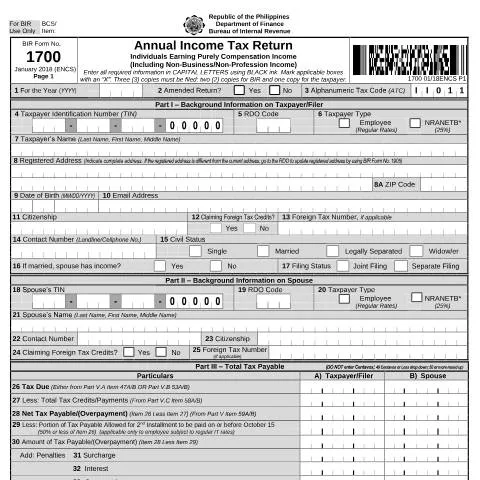
Understanding BIR Form No. 1700: A Crucial Document for Employees
Filing taxes can often feel like a daunting task, especially for those who earn a salary without the complexities of business operations. For individuals earning purely compensation income, the BIR Form No. 1700 serves a vital role in ensuring compliance with the tax obligations set forth by the Bureau of Internal Revenue (BIR) in the Philippines. This form is specifically designed for employees, capturing all pertinent financial details needed to compute annual income tax accurately.
Whom Does BIR Form No. 1700 Affect?
The primary filers of BIR Form No. 1700 are individuals receiving compensation income without engaging in other business or professional activities. This encompasses:
- Regular employees receiving a salary
- Employees eligible for bonuses and other non-taxable benefits
- Individuals earning from non-business sources like royalties or interests
However, it is essential to note that even within this category, certain nuances exist:
- Non-Resident Aliens Not Engaged in Trade or Business (NRANETB): They are also required to use this form, albeit subject to a flat tax rate of 25% on their income.
- Married Couples: If both spouses are earning, they have the option to file jointly or separately, which can affect their overall tax liability.
Navigating the Completion of BIR Form No. 1700
Completing the BIR Form No. 1700 requires meticulous attention to detail. Here’s a step-by-step overview:
- Gather Required Information: Ensure you have your Taxpayer Identification Number (TIN), contact details, and the details of your spouse if applicable.
- Fill in Personal Information: Utilize capital letters and black ink as specified. Sections include your full name, registered address, date of birth, and civil status.
- Tax Computation Section: This part entails calculating your gross income, determining tax-exempt compensations, and arriving at your total tax due based on the applicable income tax rates.
- Tax Credits and Payments: Report any tax withheld from your income as documented in BIR Form No. 2316, which your employer should provide.
- Signature and Declaration: Lastly, sign and date the return, declaring under penalty of perjury that the information provided is accurate.
Detailed Breakdown of Key Sections
The form comprises various sections, each designed to capture specific details that cumulatively determine your tax liability:
| Section | Description |
|---|---|
| Part I: Background Information | Collects personal data including your TIN, civil status, and spouse information if applicable. |
| Part II: Income Details | Details your gross compensation income and items such as non-taxable or exempt compensation. |
| Part III: Tax Computation | Calculates the total tax due, taking into account income, deductions, and any applicable tax credits. |
| Part IV: Payment Details | Outlines the payment method for your tax dues, whether through cash, check, or other means. |
Importance of Accurate Submission: Consequences of Non-Compliance
Failing to file BIR Form No. 1700 accurately or missing the filing deadline can lead to severe penalties. Employees, especially, must be vigilant about their tax obligations. The consequences include:
- Penalties and Interest: Late submissions incur surcharges and interest on any tax due, which can accumulate quickly.
- Legal Repercussions: Persistent non-compliance can lead to legal actions by the BIR against individuals, including tax evasion charges.
- Loss of Benefits: Not filing could jeopardize claims for certain tax credits or refunds that you may be entitled to under Philippine tax law.
Amending a BIR Form No. 1700 Submission
Errors in the original submission? The BIR provides a mechanism for amendment. You must file an amended return using the same BIR Form No. 1700, clearly marking it as an “Amended Return.” This process requires careful attention to ensure that all corrections are thoroughly documented. Key considerations include:
- Filing Deadlines: Amendments must be filed within the prescribed deadlines to avoid additional penalties.
- Supporting Documentation: Attach any necessary documentation that justifies the amendments made, such as corrected earnings data or tax credits.
Key Differences Between BIR Form No. 1700 and Other BIR Forms
While BIR Form No. 1700 is tailored for individuals earning purely compensation income, it’s easy to confuse it with other tax forms that address different circumstances. Here’s how it differs:
| BIR Form | Applicable To | Key Differences |
|---|---|---|
| BIR Form No. 1700 | Employees earning purely compensation income. | No engagement in business or profession; exclusive tax liabilities are tax withholding. |
| BIR Form No. 1701 | Self-employed individuals and professionals. | Involves different income sources; includes business deductions and potential losses. |
| BIR Form No. 2551Q | Quarterly income tax return for self-employed individuals. | Focuses on quarterly income; requires different timing of submissions and payments. |
Filing Channels: Online vs. Manual Submission
Submitting your BIR Form No. 1700 can be done through various channels, each with its own advantages:
- Online Submission: Utilizing the BIR’s eBIRForms system allows for easier submission and faster processing of payments. This method is highly encouraged for its convenience.
- Manual Submission: Taxpayers can file in person at designated BIR offices, which may offer personalized assistance but can result in longer wait times.
- Authorized Agent Banks: You can also submit your payment at authorized banks, ensuring secure processing and prompt acknowledgment.
Final Considerations: Best Practices for Filing BIR Form No. 1700
As the tax deadline approaches, keeping a few best practices in mind can facilitate a smoother filing experience:
- Start Early: Begin gathering documents and filling out the form well in advance of the deadline to avoid last-minute rush.
- Double-Check Information: Ensure that all figures and personal details are accurate to minimize the potential for amendments.
- Maintain Records: Keep copies of your submitted form and any supporting documents for your records, as these may be required in the event of audits or queries.
Understanding BIR Form No. 1700: Key Sections and Their Implications
BIR Form No. 1700 is crucial for individuals earning purely compensation income, as it serves as the Annual Income Tax Return that must be filed for the preceding calendar year. The form encompasses various sections that require careful attention to detail to ensure compliance with Philippine tax laws. Key sections include:
- Taxpayer Information: This section captures personal details such as name, taxpayer identification number (TIN), and address. Accuracy is paramount, as any discrepancies can lead to delays in processing or issues with future filings.
- Income Details: Here, you will declare all sources of compensation income, including salary, bonuses, and fringe benefits. It is essential to ensure that this information aligns with what has been reported by your employer on your BIR Form 2316, which certifies income tax withheld.
- Deductions: Taxpayers may be eligible for specific deductions, such as those pertaining to personal exemptions and additional exemptions for dependents. The correct calculation of these deductions is critical as they directly affect your tax liabilities.
- Tax Computation: This section outlines the applicable tax rates, calculated based on the income bracket. For 2022, the tax rates range from 0% to a maximum of 35%, depending on the amount of income earned.
- Payments and Penalties: It is important to note any penalties for late filing or payment. Filing the BIR Form No. 1700 on or before April 15 each year is necessary to avoid incurring additional charges.
Each section must be filled out meticulously, as inaccuracies can lead to audits or penalties. Taxpayers are advised to review their entries multiple times and, if necessary, seek assistance from a tax professional.
Special Circumstances: Exemptions and Special Cases in Filing BIR Form No. 1700
This section addresses specific circumstances under which certain taxpayers may not need to file BIR Form No. 1700 or may have special requirements when doing so. Understanding these nuances is key for compliance and effective tax planning.
- Exempt Individuals: Certain individuals, such as those earning below the taxable income threshold, may be exempt from filing. For the taxable year 2022, individuals earning less than ₱250,000 are not subject to income tax and do not need to file BIR Form No. 1700.
- Non-Resident Aliens: Non-resident aliens engaged in trade or business in the Philippines are required to file a different form. Individuals not engaged in trade or business must declare their income using BIR Form No. 1701.
- Seniors and Persons with Disabilities: Senior citizens and persons with disabilities who qualify under the relevant laws may be entitled to additional tax exemptions. It is essential to provide proper documentation to support these claims when filing.
Each of these exemptions has its own set of regulations and thresholds, which can change annually. Taxpayers should consult the latest BIR guidelines or a tax consultant to ensure they fully understand their obligations.
Common Mistakes and Best Practices When Filing BIR Form No. 1700
Filing your Annual Income Tax Return is a significant responsibility, and mistakes can lead to unnecessary complications. Below are common errors to avoid and best practices to follow when completing BIR Form No. 1700:
- Inaccurate Information: Double-check all personal information, income figures, and deductions for accuracy. Using the wrong TIN or entering incorrect income figures can lead to severe penalties or audits.
- Neglecting to Attach Required Documents: Ensure that all necessary supporting documents, such as BIR Form 2316, are attached to your filing. Failure to submit required documents can result in delayed processing or additional scrutiny from BIR.
- Missing Deadlines: Remember that the deadline for filing BIR Form No. 1700 is April 15 of each year. Setting reminders and preparing your documents well in advance can mitigate potential issues.
- Filing Amendments: If you realize you have made a mistake after submitting your form, it is possible to amend your BIR Form No. 1700. You must file an amended return, typically using the same form, to correct any errors.
- Consulting a Tax Professional: Especially for first-time filers or those with complex income situations, consulting with a tax professional can provide valuable insights and guidance throughout the filing process.
By adhering to these best practices, taxpayers can minimize errors and ensure a smooth filing experience for their Annual Income Tax Return.