Navigating the IR7P: A Practical Guide for Partnership Taxation
For many business partners in New Zealand, the completion of the IR7P form is a crucial step in navigating the complexities of partnership taxation. This document is not merely a bureaucratic hurdle; it's an essential tool for ensuring that each partner's share of the partnership's income or loss is accurately reported to the Inland Revenue Department (IRD). Understanding how to fill it out, recognize its implications, and what to expect afterward is key to maintaining compliance and optimizing tax situations.
Diving Deeper into Partnership Reporting
The IR7P form specifically targets the attribution of income or losses from partnerships. Partners need to be aware that this form serves a different purpose than individual income tax returns or other partnership-related forms. The primary role of the IR7P is to distribute the financial outcomes of a partnership among its partners, ensuring that everyone pays the correct amount of tax based on their share of the profits or losses.
- The IR7P must be attached to page three of the partnership's IR7 income tax return.
- Each partner must report their share of the partnership's income or loss on their individual tax returns.
- This ensures that tax obligations are accurately reflected according to each partner's participation.
The Essential Components of the IR7P Form
When completing the IR7P, it's critical to grasp its structure. The form is organized into sections that require specific financial information. Below are the key components you will encounter:
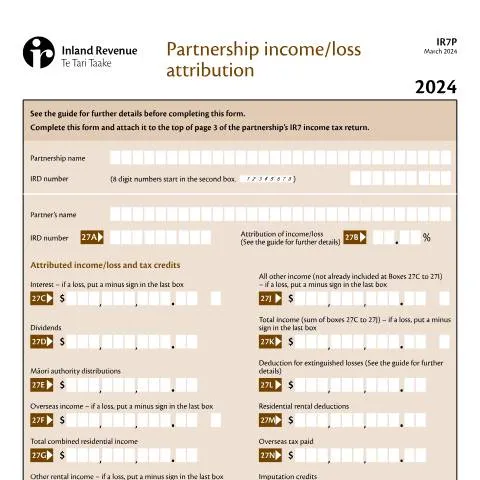
- Partner Details: Each partner's name and IRD number need to be clearly stated.
- Attribution of Income/Loss: This section captures the income or loss for each partner, including various types of income such as dividends and rental income. If there is a loss, the form requires that a minus sign be included.
- Tax Credits: This area allows partners to declare any imputation credits or other tax credits relevant to their share of income.
Step-by-Step Guide to Completing the IR7P
Completing the IR7P can seem daunting at first. However, a step-by-step approach can simplify the process significantly. Here’s how to tackle it:
- Gather Necessary Information: Collect all relevant financial statements and other documents related to the partnership's income and expenses.
- Enter Partner Details: Fill in the names and IRD numbers for all partners involved in the partnership.
- Detail Income and Loss: For each partner, indicate their share of the partnership's income and losses across the designated sections, ensuring that any losses are correctly marked with a negative sign.
- Include Tax Credits: Accurately report any applicable tax credits that might mitigate tax liabilities.
- Double Check Your Entries: Review the entire form for accuracy. Errors in reporting can lead to penalties or delayed processing.
Understanding the Implications of Your Entries
When you report your income or loss accurately, it can greatly affect your tax position. Each entry on the IR7P influences how much tax you owe or the refund you might receive. Partners must be aware that:
- Income reported is subject to the standard rates of income tax determined by the IRD.
- Losses may be carried forward under certain conditions, allowing for potential tax relief in future years.
- Incorrect reporting can trigger audits or additional scrutiny from the IRD, leading to a potentially lengthy resolution process.
Who Needs to File the IR7P?
The IR7P form is specifically targeted at individuals who are part of a partnership structure. This includes:
- Business Partners: Individuals or entities that share the ownership and management of a partnership.
- Trustees of Partnerships: In instances where a partnership is held in trust, the trustees are responsible for completing the IR7P on behalf of the partners.
- Partners in Limited Partnerships: Limited partners must also file the IR7P, ensuring their shares of income or loss are properly attributed.
Identifying Exceptions and Special Cases
While the IR7P form is required for most partnership income reporting, there are exceptions worth noting:
- Partners with limited liability companies may have different reporting requirements and might not use the IR7P.
- Partnerships generating minimal income may qualify for exemptions under certain thresholds set by the IRD.
What Happens After Submission?
Once the IR7P form is submitted alongside the IR7 income tax return, partners enter a waiting period during which the IRD processes the information. Here’s what to expect:
- Processing Time: The IRD typically processes tax returns within a few weeks, but it can extend longer during peak periods.
- Notifications: Partners will receive notifications regarding the acceptance or any issues with their returns via their RealMe accounts or through the postal service.
- Follow-up Actions: If discrepancies are identified, partners may be contacted by the IRD for clarification or additional documentation.
How to Track Your Submission Status
Keeping track of your IR7P submission can be streamlined through several methods, ensuring you remain informed throughout the process:
- Utilize the online services provided by the IRD through your RealMe account.
- Contact the IRD directly via phone or email to inquire about the status of your return, ensuring you have your IRD number on hand for reference.
- Regularly check your correspondence, as the IRD will notify you of any updates or requests for additional information.
Dealing with Errors or Omissions
It's not uncommon for partners to encounter issues while completing the IR7P form. Whether due to errors in reporting or missing information, it's essential to know how to rectify these situations promptly:
- Correction Process: Should you realize a mistake after submission, contact the IRD as soon as possible to rectify the error. They will guide you through the amendment process.
- Document Everything: Keep detailed records of all communications with the IRD regarding your correction request.
- Understand the Penalties: Depending on the nature of the error, there may be penalties imposed. Familiarize yourself with the IRD’s guidelines to minimize potential repercussions.
Future Considerations and Tax Planning
Completing the IR7P isn’t just a task to check off your list; it also opens the door to strategic tax planning for the future. Consider the following:
- Review past IR7P submissions to identify trends in income or losses that could inform future tax positions.
- Consult with tax professionals about potential deductions or credits that may apply to your partnership.
- Stay informed about changes in tax legislation that may affect partnership taxation and how it might influence your future IR7P submissions.
Understanding Your Rights and Privacy
As with all interactions with government agencies, understanding your rights when submitting the IR7P is crucial. The Official Information Act 1982 and the Plain Language Act 2022 protect your rights as a taxpayer:
- Your personal information is safeguarded, and the IRD is obligated to handle your data responsibly.
- You have the right to access information pertaining to your tax records and submissions.
- Ensure that you read the privacy policies provided by the IRD to understand how your data is used.
In summary, submitting the IR7P form is an integral part of fulfilling your obligations as a partner in a partnership. By understanding its requirements, implications, and processes, you can effectively manage your partnership’s tax responsibilities and navigate the complexities of New Zealand's tax system confidently.
Understanding Partnership Income Attribution in New Zealand
In New Zealand, partnerships are a common business structure, allowing two or more individuals to share the profits and losses of their business ventures. When it comes to tax obligations, understanding how income and losses are attributed within partnerships is crucial. The Income Tax Act 2007 governs these procedures, and it is essential for partners to comprehend how their share of partnership income or loss is calculated and reported.
Each partner's income from the partnership is typically attributed based on their share in the partnership agreement, although this can sometimes be influenced by changes in capital contributions or partnership structure. For tax purposes, the partnership itself does not pay tax. Instead, each partner must report their share of the income or loss on their individual tax return with the New Zealand Inland Revenue Department (IRD).
It’s important to remember that the fiscal year runs from 1 July to 30 June. Therefore, partners need to ensure they are accurately attributing income and losses within this timeframe, which will ultimately affect their income tax obligations. A partnership’s income is generally derived from various sources, including business operations, investments, and any additional revenue streams the partnership engages in.
Special Considerations for Losses in Partnerships
When discussing partnership income and loss attribution, special attention must be given to the treatment of losses. Losses can arise from numerous circumstances, including operational challenges, market downturns, or unexpected expenses. Unlike corporations, where losses can often be carried forward to offset future profits, the treatment of partnership losses can be more complex.
In New Zealand, each partner can generally claim their share of the partnership losses against their other income, such as salary or individual business income. However, there are specific criteria and limitations that must be adhered to. For example, if a partner's share of the loss exceeds their total taxable income, they will not be able to claim the entire amount in that fiscal year. This limitation is known as the "loss limitation rules." Understanding these rules is paramount, as they can significantly impact an individual’s overall tax liability.
Furthermore, partners must also keep a close eye on any changes in their partnership status or contributions. If a partner's share changes due to fluctuating capital contributions, this can affect how losses are shared among partners, potentially leading to disputes if not clearly outlined in the partnership agreement. To avoid complications, it is advisable for partnerships to maintain clear and detailed records of contributions and distributions, ensuring transparency in all financial matters.
The Role of Partnership Agreements in Income Attribution
Partnership agreements play a pivotal role in determining how income and losses are attributed among partners. A well-drafted partnership agreement should outline the profit-sharing ratios, the conditions under which income or losses will be distributed, and any restrictions or obligations of each partner. This clarity not only promotes cooperation among partners but also helps in resolving disputes that may arise over financial matters.
In practice, the agreement should specify whether profits and losses are shared equally or based on each partner’s capital contribution or active involvement in the business. This aspect is particularly significant in partnerships where one partner may contribute more capital while another contributes more in terms of labor or expertise. In such cases, the partnership agreement can stipulate various profit-sharing models to fairly compensate each partner's contribution.
Moreover, partnership agreements should be revisited regularly, especially in light of any changes in partnership dynamics, such as the introduction of new partners or changes in the role of existing partners. As business needs evolve, ensuring that the partnership agreement remains current is key to effective partnership functioning and legal compliance.
To formalize these agreements and ensure all partners are protected under New Zealand law, it may be wise to consult with legal and financial advisors who specialize in partnership law. This step helps ensure that the agreement is sound and reflects the intentions of all parties involved.