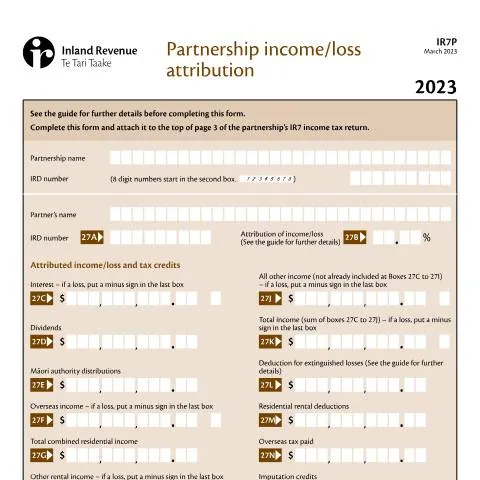
Navigating the IR7P: A Deep Dive into Partnership Income/Loss Attribution
In the intricate world of New Zealand's tax system, the IR7P form stands out as a critical component for partnerships. The form is designed to ensure that income and losses are accurately attributed among partners, which is essential for determining each partner’s tax obligations. Let’s explore the nuances of the IR7P, from its purpose to the specifics of completion, filing, and subsequent processes.
Understanding the Role of the IR7P in Partnership Taxation
The IR7P form serves a specific function within the broader landscape of income tax responsibilities in New Zealand. It is essential for partnerships to declare their income or losses to the Inland Revenue Department (IRD) to facilitate correct taxation for each partner.
When a partnership generates income or incurs losses, the IR7P form allows for the equitable distribution of these amounts among partners based on their respective share. This ensures compliance with the Income Tax Act, and it helps partners accurately reflect their financial status in their personal tax declarations.
Who Needs to Submit the IR7P?
- All partners involved in a registered partnership.
- Partnerships that have generated taxable income.
- Partnerships where losses need to be recorded for tax purposes.
Understanding who is required to submit the IR7P is key. Each partner, whether individual or corporate, must include their share of the partnership income or loss in their respective individual income tax returns.
Step-by-Step Guide to Completing the IR7P Form
Completing the IR7P may seem daunting, but breaking it down into manageable steps simplifies the process. Each section of the form corresponds to specific financial data points that partners must disclose.
Preparing the Necessary Information
Before diving into the form, gather the following information:
- Partnership name and IRD number.
- Individual partner names and their respective IRD numbers.
- Details of attributed income/losses, including categories such as interest, dividends, and various types of rental income.
Filling Out the Form
Each box on the form has specific instructions, often requiring numerical entries that reflect the income or losses attributable to each partner.
- Box 27A: Attribution of income/loss—enter relevant figures—if a loss, include a minus sign.
- Box 27B: Include details regarding attributed income/loss and any applicable tax credits.
- Continue filling out Boxes 27C through 27P, ensuring to follow the guidelines provided in the accompanying guide.
Particular attention should be given to Box 27K where partners must sum their total income, carefully noting any losses as indicated.
Timelines and Deadlines: When to Submit the IR7P
Timing is critical in the completion and submission of the IR7P form. Each tax year runs from July 1 to June 30 of the following year. Partners must adhere to the following timeline:
- Tax Year End: June 30
- Form Completion: Partners should aim to complete the IR7P shortly after the tax year concludes to ensure that individual returns can be filed on time.
- Submission Deadline: The IR7P should be submitted alongside the partnership’s IR7 income tax return, typically due by the end of the following February.
After submission, partners can expect communication from the IRD regarding their partnership tax assessment, which may influence their personal tax situations.
What Happens After Submission?
Upon submission of the IR7P, the IRD will process the information and will notify partners of their individual tax obligations based on the reported income or loss. This typically unfolds along the following lines:
- The IRD assesses the accuracy of the form based on the provided data.
- Partners may receive a notice detailing their tax liabilities or refunds, depending on the partnership’s financial performance.
- If discrepancies arise, partners may be contacted for clarification or additional documentation.
It is vital to keep all records related to the form and any communication from the IRD to maintain a clear account of the partnership's tax history.
Monitoring Your Submission
To monitor the status of your IR7P submission, partners should utilize the IRD’s online services. By creating a RealMe digital ID, partners can access their tax information directly, ensuring they’re aware of their standing and any required actions.
If there are delays or concerns regarding your submission, the IRD provides resources to assist with tracking progress or addressing any issues.
Unique Circumstances: Special Considerations for Partnerships
While the basic IR7P submission process applies broadly, there are unique circumstances that can complicate matters for certain partners.
Foreign Partners and Tax Obligations
For partnerships that include foreign partners, additional diligence is required. Foreign partners must meet specific tax obligations in New Zealand, including:
- Understanding how New Zealand’s tax laws apply to them.
- Potentially registering for an IRD number if they lack one.
Losses attributed to foreign partners may also affect their tax credits in their home country, creating a need for careful planning.
Minor Partners and Their Responsibilities
In situations where a partner is a minor, the tax responsibilities typically fall to their guardians or parents. However, it's essential to ensure that:
- The minor's share of income/loss is accurately recorded.
- Any income received on behalf of the minor is disclosed in the family’s tax return.
Engaging a tax advisor can clarify duties and implications for both the partnership and the minor.
When Things Don’t Go as Planned: Handling Rejections and Errors
Occasionally, issues arise post-submission that may lead to rejections or the need for resubmission of the IR7P form. Partners should be prepared to navigate these challenges effectively.
Common Reasons for Rejection
The IRD may reject the IR7P for several reasons, including:
- Inaccurate IRD numbers for partners.
- Calculation errors within the attributed income/loss entries.
- Missing necessary documentation or supporting information.
To address a rejection, partners should review the IRD’s feedback, correct the identified errors, and promptly resubmit the form as needed.
Missing Documents and the Path Forward
If a document or piece of information is missing, it's crucial to gather the necessary documentation quickly. The IRD allows for a degree of flexibility; however, timely communication about any delays is vital.
- Contact the IRD directly to inform them of the situation.
- Gather the missing documentation to submit as soon as possible.
- Follow up to confirm receipt of the resubmitted materials.
Practical Tips for Ensuring a Smooth IR7P Submission
To streamline the process of completing and submitting the IR7P, consider the following practical strategies:
- Stay Organized: Maintain a clear record of all partnership financial documents and IR7P-related paperwork.
- Consult the Guide: The IRD provides detailed guides that accompany the IR7P form. Familiarize yourself with these resources to avoid common pitfalls.
- Seek Professional Help: If in doubt, consulting with a tax professional can help navigate complexities and ensure compliance.
Utilizing Online Resources
The IRD's website offers extensive resources, including downloadable forms and guidelines. Partners should take advantage of these tools, ensuring they are well-informed and prepared.
In conclusion, successfully navigating the IR7P form is crucial for partnership tax responsibilities in New Zealand. By understanding the intricacies of the process—from initial completion to addressing potential issues—partners can ensure compliance and optimal tax outcomes.
Understanding the Partnership Structure in New Zealand
The partnership structure in New Zealand is an essential aspect of the business landscape, allowing individuals to pool resources and share profits and losses. It is governed under the Partnership Act 1908, which provides the legal framework for how partnerships operate within the country. A partnership is defined as a relationship between two or more persons carrying on a business with a view to profit. This structure offers flexibility in management and operations but comes with distinct tax implications, particularly concerning income and loss attribution.
In a partnership, each partner is considered a co-owner of the business. This means that partnerships do not pay income tax at the entity level. Instead, income and losses "flow through" to individual partners, who report their share on their personal tax returns. This ensures that the taxation process is straightforward; however, it requires partners to maintain accurate and comprehensive records to substantiate their claims for income, deductions, and losses. The Inland Revenue Department (IRD) outlines specific guidelines for partners regarding the distribution of income and losses, which can vary based on the partnership agreement and the nature of the business.
For tax purposes, partnerships may elect to use different methods for attributing income and losses, including fixed ratios, profit-sharing ratios, or percentages based on individual partner contributions. It is crucial for partners to have a written partnership agreement that specifies how profits and losses are to be shared. This agreement helps prevent disputes and ensures compliance with regulatory requirements. Furthermore, partners must consider any changes in the partnership, such as the addition or withdrawal of partners, which can alter income and loss attribution for the fiscal year.
Tax Obligations and Challenges for Partners
While partnerships can provide a flexible business structure, they also come with specific tax obligations that partners must navigate diligently. One of the primary obligations is the accurate reporting of partnership income and losses on individual tax returns. As previously mentioned, partners report their share of profits or losses on their IRD income tax returns, which follow the fiscal year running from 1 July to 30 June. It is important for partners to ensure that they understand their responsibilities and file their tax returns promptly to avoid penalties.
Additionally, partners must be aware of potential tax implications associated with distributions. If a partner receives a distribution that exceeds their share of the partnership profits for the year, it could result in a tax liability in subsequent years. On the other hand, if a partnership incurs losses, each partner's share of that loss can be offset against their other income, subject to certain limitations and thresholds. Therefore, understanding how losses can be utilized for tax purposes is crucial for partners, especially those in businesses that may experience fluctuating income.
Another challenge partners may face is the impact of the Goods and Services Tax (GST) if the partnership's turnover exceeds the registration threshold. Partnerships must register for GST and file regular returns with the IRD. This requires meticulous record-keeping and compliance to ensure that the correct amount of GST is charged and paid. Partners should regularly consult with tax professionals to navigate these complexities, optimize their tax positions, and ensure adherence to the IRD guidelines.
Impact of Changes in Partnership Structure on Income/Loss Attribution
Changes in the structure of a partnership can significantly impact how income and losses are attributed among partners. When a new partner joins or an existing partner exits, the existing partnership agreement may need to be reviewed and amended to reflect these changes accurately. Any changes in the ratio of profit sharing or roles within the partnership can lead to renegotiation of how income and losses are distributed.
For instance, if a partner contributes more capital or resources, it may warrant an adjustment in their share of profits and losses. Conversely, if a partner decides to withdraw from the partnership, the remaining partners must determine how to allocate income and losses for the period leading up to that exit. This process requires careful consideration and transparency to ensure all partners are satisfied with the agreement and are compliant with tax regulations.
Moreover, the partnership's stability can be affected by these changes. Frequent alterations in partnership structure may lead to administrative chaos and tax complications. Therefore, it is advisable for partners to establish clear protocols for handling such changes and to maintain an open line of communication. Seeking legal and tax advice when making structural changes can help mitigate potential issues and ensure that all partners are on the same page regarding income and loss attribution.