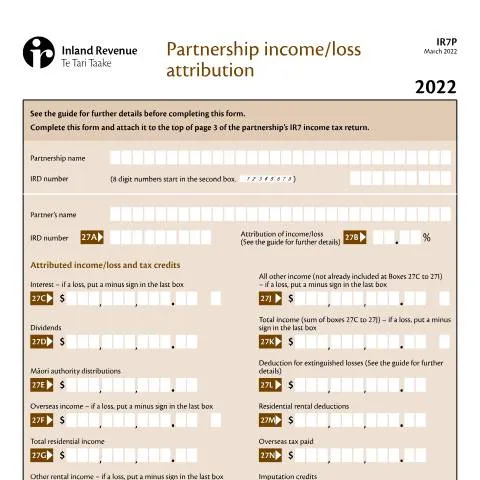
Navigating the IR7P: A Deep Dive into Partnership Income/Loss Attribution
Picture this: you’re a partner in a thriving business partnership in Aotearoa New Zealand, and as the fiscal year draws to a close, the responsibility of reporting your income and losses looms. You need to understand the intricacies of the IR7P form, a crucial document for attributing partnership income and losses. It’s not merely a bureaucratic formality; it serves a vital role in ensuring compliance with New Zealand's income tax obligations. Let's delve into the essential aspects of the IR7P form, including its purpose, completion, and submission procedures.
Understanding the Framework Behind the IR7P Form
The IR7P form, officially titled "Partnership Income/Loss Attribution," is rooted in New Zealand's taxation laws, reflecting the regulations set forth by the Inland Revenue Department (IRD). It is a tool to ensure that partners accurately report their share of the partnership’s income or losses in their individual income tax returns.
Since the introduction of the Income Tax Act 2007, partnerships in New Zealand have specific reporting obligations. This form was designed to simplify the attribution of income and losses among partners, thus adhering to the principles established by the Official Information Act 1982 and ensuring transparency in tax reporting.
Who Files the IR7P and When?
The responsibility to file the IR7P form lies with each partner in a partnership. Every partner must include their share of the partnership’s income or loss in their individual tax return. This includes but is not limited to:
- General Partnerships: Most common business structure where two or more individuals run a business.
- Joint Ventures: Temporary partnerships formed for specific projects.
- Māori Authorities: Special provisions apply to Māori authorities; income derived must be reported accurately using the IR7P.
To ensure compliance, partners must file their IR7P concurrently with their individual tax returns, which are typically due by 7 July of each year. However, if you're filing electronically, the deadline may be extended to 31 March.
Preparing to Complete the IR7P: Key Documents and Information
Before embarking on the completion of the IR7P form, it’s essential to gather all relevant financial documentation related to the partnership’s earnings and expenses. Below is a checklist of key documents to prepare:
- Partnership Agreement: This outlines the distribution of profits and losses among partners.
- Financial Statements: Recent statements, including income statements and balance sheets, clearly indicating profits and losses.
- IRD Numbers: Both the partnership's IRD number and each partner’s IRD number are critical for accurate attribution.
- Tax Credits and Deductions: Information on any applicable tax credits and deductions, including imputation credits.
Having these documents at hand will facilitate a smoother completion process and minimize the risk of errors in your submission.
Dissecting the IR7P: Section by Section Overview
Let’s break down the IR7P form into its core sections. Each section is essential for reporting accurately; understanding these components will help avoid common pitfalls during completion.
Partnership and Partner Identification
You must first provide the partnership name and IRD number, which consists of eight digits beginning with two boxes. Follow this with each partner's name and IRD number. Ensure that these details match what is registered with the IRD to avoid processing delays.
Box 27A: Attribution of Income/Loss
In Box 27A, you’ll indicate the total income/loss attributed to each partner. This section requires precise calculations reflecting each partner's share based on the agreement. Keep in mind the following:
- If the partnership incurred a loss, be sure to denote this by placing a minus sign in the last box.
- Documentation supporting the reported income/loss should be readily available for reference by IRD if requested.
Boxes 27B to 27P: Detailed Income Components
These boxes break down various income sources. Understanding each category is crucial for accurate reporting:
| Box | Description | Important Notes |
|---|---|---|
| 27B | Attributed income/loss and tax credits | Ensure tax credits are listed accurately to avoid underreporting. |
| 27C | Interest | Include any interest income; losses should be marked with a minus sign. |
| 27D | Dividends | Report dividends received by the partnership here. |
| 27E | Māori authority distributions | Specific rules can apply; consult relevant guidelines. |
| 27F to 27P | Various income sources | Each type of income has its own dedicated box; be thorough in reporting. |
For every income box, remember to indicate if it’s a loss by using a minus sign. This attention to detail is vital for the accuracy of your overall income declaration.
The Importance of Accuracy: What’s at Stake?
Filing your IR7P accurately is not just a bureaucratic checkbox; it carries significant implications:
- Tax Liability: Errors can lead to inaccurate tax assessments, potentially resulting in penalties, interest, or audits.
- Entitlement to Tax Credits: Properly reporting income ensures that partners can take advantage of eligible tax credits.
- Financial Planning: Understanding your attributed income/loss is essential for financial forecasting and planning within the partnership.
Failure to file the IR7P could result in the IRD imposing late filing fees, which can accumulate quickly if not addressed promptly.
What Happens After Submission? Next Steps and Considerations
Once you have submitted the IR7P alongside your individual tax return, the IRD will process your information. Here's what to expect:
- Processing Time: Typically, IRD processes returns within 4 to 6 weeks. However, delays may occur during peak filing periods.
- Notification of Assessment: Partners will receive a notification outlining the IRD's assessment of their reported income/loss.
- Right to Appeal: If you disagree with the assessment, you can appeal through the IRD’s established processes. Prompt action is essential.
Addressing Common Challenges and Resolving Issues
Despite diligent preparations, issues may arise. Here’s how to tackle them effectively:
Dealing with Missing Documents
If you find yourself without certain financial records, the first step is to communicate with your partners to gather what’s needed. In some cases, contacting financial institutions for copies of documents may be required.
Correction of Errors
Should you discover an error post-submission, it’s critical to rectify it with the IRD as soon as possible. This will typically involve:
- Gathering all relevant documentation supporting the correction.
- Filing an amendment with the IRD, detailing the original submission and the changes required.
- Understanding potential penalties associated with the amendment and addressing them proactively.
The Significance of Timely Filing and Future Planning
Timeliness is key in the realm of tax. The IR7P form must be lodged by the deadlines set by the IRD to avoid penalties and ensure that partners can effectively manage their tax liabilities. It’s advisable to start preparing well before the filing deadline for a thorough review.
Moreover, reflecting on the outcomes of your reported income/loss can provide insightful data for future business decisions and tax planning. Partners should coordinate and discuss strategies to optimize future income reporting and tax obligations.
With the IR7P form being a crucial element in the partnership reporting process, understanding its nuances will pave the way for successful compliance with New Zealand’s tax regulations.
Understanding Partnership Income Distribution
In New Zealand, partnerships are a common business structure, allowing two or more individuals to operate a business together while sharing the risks and rewards. The distribution of income and losses among partners is outlined in the partnership agreement. It's essential for partners to clearly define how profits and losses are attributed in order to avoid disputes and ensure compliance with the Income Tax Act 2007.
Under New Zealand tax law, partners do not receive a salary or wages; rather, their share of partnership income is taxed as personal income. The allocation of income typically reflects partners' percentage interests in the partnership unless the partnership agreement specifies otherwise. For example, if one partner puts in more capital but another takes on a greater share of the work, they may agree to a different income split.
It's crucial for partnerships to maintain accurate financial records, detailing income generated, expenses incurred, and distributions made. This documentation will not only support their tax filings but also provide transparency to all partners regarding the financial health of the business. Partners should also be aware of the implications surrounding the attribution of losses, as certain limitations may apply regarding how they can offset these losses against personal income.
Filing Requirements and Important Deadlines for Partnerships
Partnerships are required to file an annual tax return using the IRD's specific forms. Each partner must also complete their own income tax returns, declaring their share of partnership income or losses. It’s critical for partners to be aware of the deadlines for filing both partnership returns and personal income tax returns. Generally, partnerships must submit their returns by 7 July following the end of the fiscal year, while individual partners' tax returns are due on 7 July as well if they are filing their tax returns by paper, or 31 March if filing online.
The IRD has specific guidelines on how to complete partnership tax returns, including the need to provide each partner’s tax file number (TFN). If a partner prefers, they can also submit their tax return using their RealMe account for a smooth online experience. However, it is important for partners to ensure that all income and expenses are accurately reported, and all partners agree on the income allocation before filing.
Implications of Changes in Partnership Structure
Changes in the structure of a partnership, such as the introduction of a new partner or the departure of an existing one, can significantly affect income and loss attribution. When a new partner joins, the existing partners must decide how the incoming partner's share of income will be calculated. This may involve reassessing the partnership agreement to determine the new profit-sharing ratios.
Similarly, if a partner leaves the partnership, the remaining partners must re-evaluate the distribution of income and potentially adjust the partnership agreement to reflect the changes. It is advisable for partnerships to regularly review their agreements to ensure they reflect the current state of the partnership and abide by the legal requirements under the Partnership Act 1908.
Moreover, it's essential to consider the tax implications of these changes. The IRD requires that partners report any changes in the profit-sharing arrangements and may necessitate a reassessment of the partnership’s income tax obligations. This can be particularly complex if the partnership underwent major structural changes, and professional tax advice may be beneficial to navigate these requirements effectively.