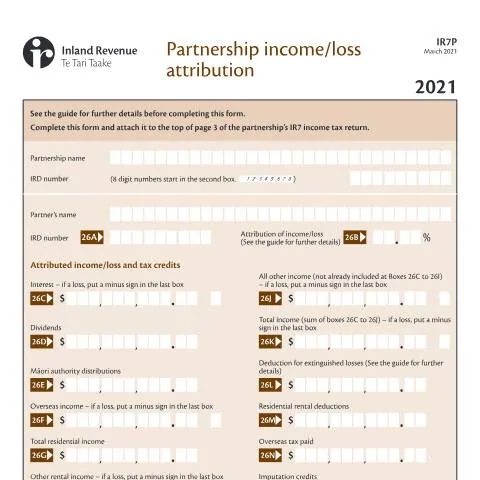
When managing a partnership in New Zealand, understanding how to accurately report your income can be the difference between a smooth tax season and complications with the Inland Revenue Department (IRD). The IR7P form, officially titled Partnership Income/Loss Attribution, serves a critical function in this process. While it may seem daunting, breaking down its components and knowing when and how to complete it will make this task much more manageable.
The IR7P form is essential for all partnerships operating in New Zealand. These partnerships typically consist of two or more individuals who are engaged in business together. Understanding who must file and under what circumstances is crucial:
- General Partnerships: All general partnerships must submit the IR7P form alongside their IR7 income tax return.
- Limited Partnerships: Limited partnerships also need to fill out the IR7P, ensuring that the income or loss is attributed correctly to partners.
- Foreign Partners: If a partnership includes foreign partners, their income specifics must still be reported accurately.
- Special Cases: Partnerships with minors or partners who are incapacitated may have additional considerations regarding consent and reporting procedures.
Each section of the IR7P form serves a specific purpose, and understanding these can help prevent common pitfalls in completion.
Partnership Identification
Begin with the partnership's essential details:
- Partnership Name: Ensure the name matches your registered partnership. Any discrepancies can delay processing.
- IRD Number: This eight-digit number helps identify the partnership within the New Zealand tax system. It must be filled in correctly, starting with the second box.
Attribution of Income or Loss
Boxes 26A and 26B are critical, wherein partners report their attributed income or loss:
| Box |
Description |
Notes |
| 26A |
Attribution of income/loss |
Include amounts distributed to each partner. |
| 26B |
Tax credits |
Specify credits that apply to the partners based on their shares. |
Itemizing Income Sources
In Boxes 26C to 26I, the form allows the breakdown of various income sources:
- Interest Income: If this is a loss, don’t forget to include a minus sign.
- Dividends: Include all dividends received by the partnership.
- Māori Authority Distributions: A specific category that requires careful reporting to ensure compliance.
- Overseas Income: Similar to interest, losses here should be denoted with a minus sign.
- Other Passive Income: Report any additional income sources not previously categorized.
Key Timelines: When to Complete the IR7P
Understanding the timeline for completing the IR7P is essential for compliance:
- Start Date: The tax year begins on 1 July and ends on 30 June the following year.
- Submission Deadline: The completed IR7P should be attached to the IR7 tax return, typically due by 31 March if filing online or by 7 July for paper returns.
Once submitted, the IRD will process your return, typically within a few weeks. Partners will receive notifications regarding their attributed income and any tax obligations.
Consequences of Missing Out: What Happens Next?
Failing to submit the IR7P correctly or missing the deadline can lead to several consequences:
- Penalties: Late submissions may incur penalties that escalate depending on the length of the delay.
- Tax Adjustments: Incorrect or missing information can lead to adjustments that could increase your tax liability.
- Impact on Partners: Each partner’s individual tax return will be affected, which can lead to financial implications for them as well.
Handling Errors: Your Next Steps
Errors in the IR7P form can happen. Here’s how to rectify them:
- Corrections: If you notice an error after submission, contact the IRD promptly. They may ask you to submit a revised form.
- Missing Information: If a piece of information was overlooked, be sure to provide this in your communication with the IRD to ensure compliance.
What If Your Form Gets Rejected?
In cases where the IRD rejects your IR7P, you’ll receive communication detailing the reasons. It's crucial to address any issues highlighted to avoid further complications:
- Review Rejection Notices: Understand the reasons for rejection, whether it's a missing signature, incorrect IRD numbers, or calculation errors.
- Submit Amendments: Once corrections are made, resubmit the form as quickly as possible, keeping all communication records for your reference.
Often, the IR7P form can be confused with other tax forms. Understanding the distinctions can help prevent costly mistakes:
| Form |
Purpose |
Notes |
| IR7 |
General income tax return for individuals |
Must be submitted by every partner along with IR7P. |
| IR8 |
Corporate tax returns |
Used by companies, not partnerships. |
| IR7C |
Used for Māori Authorities |
Only applicable to Māori authorities, not general partnerships. |
Completing the IR7P form doesn’t have to be a daunting task. By understanding the requirements and breaking down the process into manageable steps, partners can ensure accurate reporting of their income or losses. Make sure to consult the guides provided by the IRD for any updates or specific instructions, and consider seeking advice from a tax professional if your partnership's situation is complex.
In the eyes of the IRD, accuracy is paramount, and staying informed will help you and your partners navigate your tax obligations smoothly. Remember, the right approach today will save you potential headaches tomorrow.
Understanding Partnership Income Attribution in New Zealand
Partnerships in New Zealand contribute significantly to the business landscape, and understanding how income and losses are attributed within these entities is essential for partners and accountants alike. The Income Tax Act 2007 provides a framework for how income is allocated among partners, ensuring an equitable distribution based on their partnership agreement and their individual share of the partnership.
In a partnership, income is typically attributed based on the profit-sharing ratio established in the partnership agreement. It is crucial to review this document as it specifies how profits and losses are to be divided. Should there be no formal agreement, partners will default to an even split of profits and losses unless otherwise dictated by the nature of their contributions.
Partners can also receive different types of income from the partnership, such as salaries, drawings, or guaranteed payments, which can affect the income attribution. The IRD requires partners to declare their share of the partnership’s income on their individual tax returns. Each partner’s taxable income will include their allocated share of profits, and they must also report any losses that may arise.
It's important to note that the attribution of losses can also be subject to restrictions. Under certain circumstances, partners might not be able to claim the full amount of losses attributable to them, particularly if their partnership interest is limited. Partners should consult the IRD guidelines or seek professional advice to navigate the complexities of loss attribution effectively.
Tax Implications of Partnership Distributions
The distribution of income and losses in a partnership can have significant tax implications for the partners involved. Understanding the nuances of these tax responsibilities is essential for compliance with New Zealand tax laws and for effective financial planning.
When a partnership generates income, it is not taxed at the entity level. Instead, the income is passed through to the partners who then report it on their individual tax returns. This means that the individual tax rates applicable to each partner will dictate the ultimate tax liability. For instance, higher-earning partners may find themselves in higher tax brackets, significantly affecting their overall tax burden.
Furthermore, it is essential for partners to keep accurate records of their contributions, distributions, and share of the partnership income. The IRD requires detailed reporting, and a lack of proper documentation can lead to disputes or adjustments during tax assessments.
Partners must also be aware of the implications of distribution types. For example, if a partner takes a distribution in the form of a loan or capital withdrawal rather than a straightforward profit share, this may also impact their tax obligations. Understanding whether these distributions are treated as taxable income or as loans requiring repayment is vital for accurate tax reporting.
Classes of income such as interest, dividends, and capital gains may also arise, and these can be subject to different tax treatments. Partners should be aware of these classifications and ensure proper accounting practices are followed to delineate different types of income accurately.
In summary, both the nature of the partnership income attribution and the subsequent tax implications are critical areas that partners must navigate. Proper understanding and management of these factors can ensure that partners fulfill their tax obligations while optimizing their financial outcomes.
Partnership Agreements: Key Considerations for Effective Management
A well-structured partnership agreement is fundamental for the successful operation of any partnership in New Zealand. This document not only outlines the financial arrangements regarding income and loss attribution but also serves as a framework for decision-making, dispute resolution, and the overall governance of the partnership.
When drafting a partnership agreement, several key considerations should be addressed to ensure clarity and fairness. First, it is essential to define each partner's roles and responsibilities within the partnership. This includes their contributions, whether financial, intellectual, or operational, and how these contributions will influence their share of the profits and losses.
Additionally, the agreement should specify the profit-sharing ratio, which can be based on capital contributions or other criteria that reflect each partner's involvement and investment in the business. By having this clearly laid out, partners can avoid misunderstandings and disputes related to income attribution.
Another critical aspect of partnership agreements is the inclusion of provisions for handling losses. This might include stipulations about how losses will be carried forward or shared among partners, especially in the event of business downturns. These provisions can help partners manage their financial risks and expectations more effectively.
Moreover, it is also prudent to incorporate mechanisms for resolving disputes, whether through mediation, arbitration, or other means. Establishing clear pathways for handling disagreements can save time, reduce stress, and preserve the working relationship among partners.
Periodic review and updates to the partnership agreement are essential as the business evolves. Changes in partnership dynamics, such as the addition or departure of partners, or shifts in the business environment, may necessitate amendments to the agreement to ensure it continues to reflect the partners' intentions.
In conclusion, a comprehensive partnership agreement is not only a legal requirement but also a strategic tool for effective collaboration among partners in New Zealand. It provides clarity, aligns expectations, and sets a framework for fair income attribution and loss management.