Navigating the IR7P Form: A Comprehensive Guide for Partnerships
For partnerships operating in New Zealand, the IR7P form serves a critical function in the accurate declaration of income and loss attribution among partners. Failing to complete this form correctly can lead to significant implications for tax liabilities, affecting both the partnership and its individual partners. This guide aims to delve into the specifics of the IR7P, addressing everything from its purpose to detailed instructions for filling it out, ensuring no partner is left in the dark.
Understanding the Role of the IR7P Form
The IR7P form, officially titled “Partnership income/loss attribution,” is an essential document that determines how income and losses from a partnership are allocated to each partner for tax purposes. This allocation affects each partner's personal income tax return, making accurate completion vital.
Partnerships must remember that the IR7P form is not just supplementary paperwork—it is a core component that ties the partnership’s financial activities to the individual income tax obligations of its partners. Thus, any errors in the form can lead to discrepancies in tax filings, resulting in potential audits or penalties from the Inland Revenue Department (IRD).
Who Needs to File the IR7P Form?
Any partnership that generates income must complete and submit the IR7P form alongside its IR7 income tax return. This includes traditional partnerships as well as limited partnerships. The partners involved in these entities are responsible for ensuring that the form is filled out and submitted correctly. Here are key groups required to file:
- Partners in general partnerships
- Partners in limited partnerships
- Any partnership that has claimed deductions or declared income
It is also important to note that partners must include their share of the partnership's income or losses on their individual tax returns, making the accuracy of the IR7P form even more crucial.
Breaking Down the IR7P Form: Key Sections
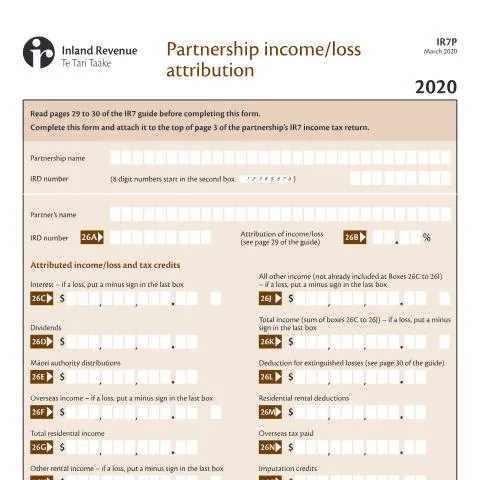
The IR7P form consists of several sections, each designed to capture specific information regarding income and losses attributed to each partner. Understanding these sections is key to ensuring accurate completion. Below is a detailed breakdown:
- Partnership Details:
- Partnership Name: Fill in the legal name of the partnership.
- IRD Number: Ensure the IRD number is correct; it consists of eight digits, with the first number starting in the second box.
- Individual Partner Details:
- Partner’s Name: Each partner must be listed with their respective IRD number.
- Income and Loss Attribution:
Box 26A to Box 26P: This section is crucial; it is where each partner’s attributed income or loss is reported. Be careful to:
- Put a minus sign for any losses.
- Ensure that all types of income (interest, dividends, Māori authority distributions, etc.) are accurately reported.
- Total Income Calculation:
The total income is calculated by summing the amounts in Boxes 26C to 26J. If there is a loss, a minus sign must be indicated in the designated box.
- Tax Credits:
Report any imputation credits and other tax credits associated with the partner. This is a crucial step to ensure accurate calculation of individual tax returns.
Each of these sections must be completed with precision to avoid complications with the IRD later on.
Common Pitfalls in Completing the IR7P Form
Completing the IR7P form may seem straightforward, but there are common pitfalls that can lead to errors. Awareness of these issues can save partners time and prevent potential audits from the IRD:
- Incorrect IRD Numbers: Double-check that all IRD numbers are accurate and correspond with the individual partners.
- Missing Signatures: Ensure that all partners have signed the form. Omitted signatures can lead to delays in processing.
- Failure to Account for Losses: Always remember to indicate losses with a minus sign as specified; neglecting to do so can result in inflated tax liabilities.
- Incomplete Information: Avoid leaving sections blank, especially regarding income types and tax credits.
Taking the time to carefully review the form before submission can prevent these common mistakes.
Digital vs. Paper Submission: Which is Best?
Partners have options when it comes to submitting the IR7P form, and understanding the pros and cons of each can facilitate a smoother filing process.
| Method | Advantages | Considerations |
|---|---|---|
| Online Submission |
|
|
| Paper Submission |
|
|
Both submission methods are valid; however, digital submission is generally faster and more efficient.
Dealing with Potential Errors: What to Do Next?
Errors on the IR7P form can happen, whether through simple mistakes or more complex issues. Knowing how to handle them is essential:
- Identifying Errors: If you discover an error after submission, do not panic; it can often be rectified.
- Contacting the IRD: Reach out to the IRD as soon as possible. They can guide you on the necessary steps to amend the information.
- Submitting Amendments: In many cases, you may be required to submit an amended IR7P form. Be clear that it is a correction and include all relevant information.
- Document Everything: Keep records of all communications with the IRD and copies of any forms submitted.
Proactive management of any errors can mitigate potential issues down the line.
Preparing Documentation for the IR7P: A Checklist
Ensuring you have all required documentation before filling out the IR7P form is crucial. Here’s a checklist to guide you:
- Partnership Agreement: This legal document outlines the distribution of income and losses among partners.
- IRD Numbers: Collect all partners' IRD numbers.
- Financial Statements: Accurate financial records that detail the partnership’s income and expenses.
- Tax Credits Documentation: Gather any supporting documents for tax credits being claimed.
- Prior Year Tax Returns: Review previous returns for consistency and reference.
Having these documents prepared ahead of time can streamline the completion of the IR7P form and ensure all necessary information is readily available.
Historical Context: The Evolution of the IR7P Form
Understanding the historical backdrop of the IR7P form adds depth to its significance within New Zealand's tax system. The IR7P was implemented as part of wider reforms in tax legislation aimed at simplifying compliance for partnerships. The evolution of tax regulations has seen shifts towards a more digitized and streamlined process, enabling better transparency and efficiency.
The introduction of the Official Information Act 1982 and the Plain Language Act 2022 has further underscored the importance of clarity in tax documentation, acting as guiding principles for the formulation of forms like the IR7P. This legislative framework aims to ensure that all taxpayers—regardless of their familiarity with tax laws—can understand and comply with their obligations.
Therefore, filling out the IR7P form is not only a legal requirement but also a contribution to the integrity of New Zealand's taxation system.
Final Thoughts on the IR7P
The IR7P form is more than just a tax document; it plays an integral role in the partnership's financial integrity and compliance with New Zealand's tax laws. Each partner must approach the completion of this form with diligence and attention to detail, as the ramifications of errors can extend beyond mere fines. With the right knowledge and tools, partnerships can navigate the complexities of the IR7P effectively, ensuring a seamless taxation process.
For further guidance, consider reviewing the IR7 guide, which provides detailed instructions on completing the IR7P form and insights into relevant tax regulations that may impact the partnership.