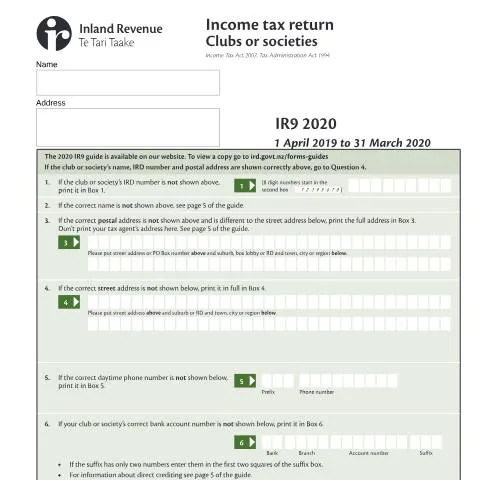
Understanding the IR9 Form: A Guide for Clubs and Societies in New Zealand
Engaging in community activities through clubs and societies is a fulfilling venture in New Zealand. However, these organizations must navigate the intricacies of the tax system, particularly regarding their income tax obligations. The IR9 form, officially titled Income Tax Return: Clubs or Societies, is crucial in this process. This comprehensive guide will walk you through the significance of the IR9 form, its requirements, and how to complete it accurately to ensure compliance with New Zealand’s tax laws.
The Regulatory Framework and Historical Context
The IR9 form emerges from the Income Tax Act 2007 and the Tax Administration Act 1994, which establish the legal foundations for income taxation in New Zealand. This form is designed for not-for-profit organizations, including clubs and societies, that generate income within the fiscal year running from 1 July to 30 June.
You might wonder how clubs differ from other organizations in their tax obligations. The distinction lies primarily in their structure and purpose. Clubs and societies typically promote a charitable, sporting, or community-focused agenda and may qualify for tax exemptions under specific circumstances. Consequently, accurate completion of the IR9 form is essential for determining tax liabilities and potential deductions.
Historical Milestones
The initiation of the IR9 form can be traced back to efforts aimed at simplifying tax compliance for community organizations, enhancing transparency, and ensuring that clubs and societies contribute fairly to public funds without imposing undue burdens on their operations.
As New Zealand evolved, so did the tax landscape. The implementation of the Official Information Act 1982 and the Plain Language Act 2022 reflects a commitment to making administrative processes more accessible and understandable, which is integral to the design of forms like the IR9.
Key Dates: When to File the IR9 Form
Understanding the timeline for filing your IR9 form is critical to maintaining compliance and avoiding penalties. The tax year that the IR9 pertains to runs from 1 April to 31 March of the following year. Here’s a brief overview of important dates associated with your IR9 filing:
- 1 April: Start of the fiscal year.
- 31 March: End of the fiscal year; the deadline for income and expense reporting.
- Due Date for Filing the IR9: Typically, the IR9 should be filed within four months after the end of the tax year. Therefore, for the year ending 31 March, the due date would be 31 July.
After submission, it’s essential to keep track of your filing status. The IRD (Inland Revenue Department) processes returns promptly, and you should receive acknowledgment of receipt shortly after filing. Should you need to follow up, ensure you have your IRD number and other relevant details on hand to expedite the process.
Preparing Your Documents: What You Need
Completing the IR9 form accurately hinges on rigorous documentation. Preparation is key, especially in classifying your organization's income and expenses appropriately. Here’s a breakdown of the documents you should gather:
1. Income Statements
Collect statements that detail various sources of income, such as:
- Membership fees
- Donations
- Grants
- Fundraising proceeds
- Income from special events
2. Expense Records
Document all expenditures related to your club’s operations, including:
- Venue rental
- Utilities
- Equipment purchases
- Promotional materials
- Travel expenses
3. Financial Accounts
If your club or society is registered as a friendly society or is under the Incorporated Societies Act 1908, you will need financial statements summarizing your accounts. Ensure that these are up-to-date and accurately reflect your financial activities for the year.
Step-by-Step Guide to Completing the IR9
Completing the IR9 form requires attention to detail and a clear understanding of the questions posed. Below is a step-by-step breakdown of how to fill out the IR9 to avoid common pitfalls:
1. Club or Society Identification
Begin by ensuring your organization's name, IRD number, and postal address are correctly entered in the designated boxes. If any information is missing or incorrect:
- Print your IRD number in Box 1 if not pre-filled.
- Rectify the name in Box 2, if necessary.
- Address discrepancies in Box 3 and Box 4.
2. Financial Details
Moving onto financial details, accurately report your income and any deductions. Pay close attention to the following sections:
- Residential Income and Expenditure: If applicable, indicate whether your organization derives income from residential properties and record the necessary totals in Boxes 10A through 10F.
- Taxable Property Sales: If any income was received from property sales, ensure to detail it in Box 11.
- Net Income Calculation: Boxes 12A, 13D, and 14F culminate in your total income, which is critical for determining tax liability.
3. Specific Income Types
Be aware of income categories specific to clubs and societies:
- If your organization qualifies as a friendly society, be sure to complete Box 12.
- Recognize exempt income that may apply, such as those from amateur sports or charitable societies, and correctly report any relevant income in Boxes 13 and 14.
4. Deductions and Final Calculations
After tallying your total income, proceed to calculate deductions and net income:
- Enter any applicable donations in Box 16 and calculate the net income in Box 17.
- Ensure to subtract deductions from your total income accurately, maintaining clarity to avoid errors.
Submission Process: How and Where to File Your IR9
Once you have meticulously filled out your IR9 form, the next step is submission. The IRD encourages online filing, making the process more efficient and accessible. Here’s how to proceed:
1. Online Submission via MyIR
If your organization has a MyIR account, logging in allows you to submit your IR9 electronically. Benefits of online filing include:
- Immediate confirmation upon submission
- Streamlined processes for amendments, if necessary
- Access to historical records of filed returns
2. Paper Submission
If you prefer to submit your IR9 in paper format, ensure that it is sent to the correct postal address as specified by the IRD. Double-check the following details:
- Use the correct address for the IRD based on your location.
- Consider sending your submission via registered post to confirm delivery.
The Role of the IR9 in the Tax Framework
The IR9 form is not just a formality; it plays a pivotal role in New Zealand’s tax system, particularly for non-profit organizations. It helps determine the taxable income of clubs and societies while ensuring compliance with tax regulations. Here’s why the IR9 is vital:
1. Maintaining Transparency
By mandating the completion of the IR9, the IRD promotes transparency among organizations that could otherwise operate without rigorous financial oversight. This contributes to the integrity of the tax system.
2. Facilitating Deductions and Exemptions
Completing the IR9 accurately allows clubs and societies to claim deductions and exemptions they are entitled to, thereby supporting their operations without disproportionate tax burdens.
3. Enabling the IRD to Monitor Compliance
Through information provided in the IR9, the IRD can monitor compliance and address discrepancies. This ensures that all organizations contribute fairly to the government’s revenue while complying with regulations.
How the IRD Processes Your IR9 Submission
After submitting the IR9, understanding the processing phase can demystify what happens next. Here’s how the IRD handles your submission:
1. Review and Validation
The IRD will review the information provided for completeness and accuracy. They may cross-reference data against other provided statements to ensure consistency.
2. Potential Follow-ups
If there are discrepancies or if the IRD requires further clarification, they may contact your organization. In such instances, having a designated contact person who is familiar with the submitted information can be beneficial.
3. Notification of Assessment
Upon finalizing the review, the IRD will issue an assessment. This document will outline your taxable income, any taxes owed, and potential refunds. Keep this document for your records as you may need it in future filings.
Understanding Who Needs to Complete the IR9
The IR9 form is not a one-size-fits-all document. Various types of clubs and societies exist, and each has differing obligations and exemptions. Here’s a breakdown of who should complete the IR9:
1. Incorporation Status
Firstly, determine if your club or society is incorporated. If so, you must complete the IR9, which can affect the tax rates applicable to your organization. If your organization is unincorporated, the filing requirements may differ.
2. Type of Activities
Organizations primarily involved in:
- Sporting activities
- Community service
- Charitable operations
Must assess their income and expenses according to the guidelines outlined in the IR9. Also, friendly societies must report differently due to their unique status.
3. Special Considerations for Exempt Entities
Some organizations may qualify for exemptions. For instance:
- Amateur sports clubs
- Charitable societies
- District improvement societies
These entities must still complete the IR9 but may have different reporting requirements or deductions available to them.
Final Remarks on the IR9's Significance
The IR9 form serves as a cornerstone for clubs and societies in New Zealand, providing a framework to report income, claim deductions, and ensure compliance with tax laws. By understanding the importance of this document and how to complete it accurately, organizations can navigate their tax obligations effectively while continuing to contribute positively to their communities.
Remember, while tax compliance can be daunting, resources are available, including the IRD's website and guides, to assist in the process. By preparing adequately and engaging with the IRD, clubs, and societies can thrive while fulfilling their financial responsibilities.
Understanding Tax Obligations for Clubs and Societies
In New Zealand, clubs and societies are often formed for recreational, cultural, or social purposes. Despite their non-commercial nature, it is crucial for these organizations to understand their income tax obligations under New Zealand's tax law. According to the Inland Revenue Department (IRD), a club or society might be classified as a 'taxable entity' if it earns income exceeding specific thresholds or engages in activities that qualify as business operations.
Typically, if a club or society's income is less than NZD 1,000 annually, it may not be required to file an income tax return. However, this threshold can be quite nuanced. For instance, if your organization operates a profit-generating activity (like running a café for members), it might be required to register for Goods and Services Tax (GST) and submit returns, regardless of whether the overall income exceeds the NZD 1,000 limit.
Furthermore, some clubs and societies might qualify for tax-exempt status under specific provisions of the Income Tax Act. This often applies to organizations primarily dedicated to promoting amateur sport or providing recreational facilities. To maintain this exemption, it is vital to adhere to the criteria set forth by the IRD, which includes ensuring that profits are reinvested back into the club's activities and not distributed to members.
Filing Procedures and Key Documentation
The process of filing an income tax return for clubs and societies can seem daunting, but it is manageable with the right guidance. The key form used is the IR 4 (Income Tax Return) specifically for clubs and societies. Before filing, it is essential to gather all relevant financial documentation, including:
- Financial Statements: A complete set of accounts for the financial year, including income statements and balance sheets.
- Bank Statements: Statements that reflect all transactions throughout the financial year help in cross-verifying income and expenses.
- Invoices and Receipts: Documentation supporting all income received and expenses incurred during the year.
Once the financial position of the club is established, the next step is to complete the IR 4 form, detailing all sources of income and any allowable deductions. It is worth noting that clubs and societies can claim various deductions, including operational costs, staff wages, and other expenses incurred in generating income. Filing online via the IRD's secure portal is recommended for efficiency, as it streamlines the process and provides immediate confirmation upon submission.
Engaging Members and Transparency in Financial Practices
Transparency in financial practices is vital for clubs and societies, not only for compliance with tax regulations but also for fostering trust and engagement among members. Regular financial reporting can help members understand how funds are being utilized and the overall financial health of the organization. Implementing regular financial reviews or meetings can also promote accountability.
Moreover, introducing a budget planning process can significantly benefit the club’s financial management. By allocating resources wisely and anticipating future expenses, clubs can ensure they remain financially viable while offering valuable services to their members.
Incorporating member feedback into financial decision-making can create a more inclusive environment. Utilizing tools such as surveys or discussion forums to gauge member opinion on financial matters or proposed expenditures can lead to better-informed decisions that reflect the collective interests of the organization.
This engagement can also extend to educating members about their roles and responsibilities concerning compliance with income tax obligations. Workshops or informational sessions on understanding tax returns, financial management, and the implications of being part of a club or society can empower members and enhance their overall experience.