Understanding the Tobacco Cultivation Income Tax Form
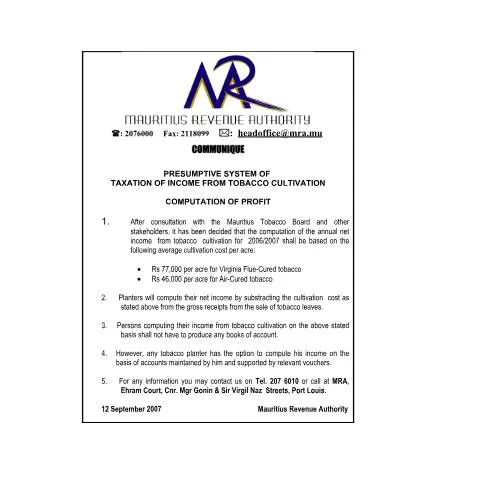
The document titled "Taxation of Income from Tobacco Cultivation," referenced under TobaccoCultivation and issued on 12 September 2007, plays a pivotal role in the financial framework for tobacco farmers in Mauritius. As part of the taxation system, it establishes guidelines on how income derived from tobacco cultivation should be reported and assessed. Those engaged in this agricultural sector must understand the implications of this form and how it fits into the broader taxation regime.The Context of Tobacco Cultivation in Mauritius
Tobacco farming holds economic significance in Mauritius, contributing to both local employment and export revenues. The Mauritius Revenue Authority (MRA) developed this form in response to discussions with the Mauritius Tobacco Board, aiming to streamline the tax assessment process for tobacco planters. This targeted approach acknowledges the unique challenges and dynamics of the tobacco industry, offering a presumptive taxation system that simplifies the filing requirements.Who Needs to Complete This Document?
The primary candidates for this form are local tobacco planters who either grow Virginia Flue-Cured or Air-Cured tobacco. However, complexity arises from different categories of planters, including:- Individual Farmers: Those who cultivate tobacco on a small scale for personal profit.
- Commercial Growers: Larger entities that may produce significant volumes of tobacco for sale in local or international markets.
- Foreign Investors: Entities or individuals from outside Mauritius who invest in local tobacco cultivation should also be mindful of their obligations regarding this form.
Steps to Prepare the Form
Filling out the Taxation of Income from Tobacco Cultivation form requires careful preparation and attention to detail. The MRA has outlined specific steps that must be followed to ensure the accuracy and completeness of submissions.Calculating Income from Tobacco Cultivation
Planters compute their annual net income based on average cultivation costs determined by the MRA. The following costs per acre apply:| Type of Tobacco | Average Cultivation Cost (Rs) |
|---|---|
| Virginia Flue-Cured | 77,000 |
| Air-Cured | 46,000 |
Documentation and Supporting Evidence
While the presumptive system alleviates the need for detailed bookkeeping, planters have the option to maintain accounts supported by relevant vouchers. This decision allows for a more precise calculation of income, which might be beneficial if actual profits exceed the presumed amounts. By keeping meticulous records, planters not only ensure compliance but can also leverage legitimate deductions.Where to Submit the Completed Form
The submission process for the Taxation of Income from Tobacco Cultivation form can happen through various channels, each catering to different preferences and circumstances.Online Submission
Leveraging Mauritius’s push for digital services, planters can submit their forms electronically using the MRA's online portal. The advantages of online submission include:- Accessibility: Farmers can file their forms from anywhere, reducing the need for physical travel to MRA offices.
- Instant Confirmation: Online submissions offer immediate acknowledgment, easing concerns regarding the status of the application.
Paper Submission
For those who prefer traditional methods, submitting a hard copy of the form is also an option. This can be done by visiting the MRA offices in person. The key steps involve:- Printing the completed form and ensuring all required fields are filled accurately.
- Gathering any necessary supporting documents, particularly if opting out of the presumptive taxation system.
- Visiting the MRA office located at Ehram Court, Corner Mgr Gonin & Sir Virgil Naz Streets, Port Louis, during business hours.
Post-Submission Process and Next Steps
After submitting the Taxation of Income from Tobacco Cultivation form, planters must remain vigilant and prepared for potential follow-up actions.Review and Acknowledgment
Upon receipt of the form, the MRA will conduct an initial review. Planters should expect an acknowledgment of receipt, which serves as a confirmation that the submission has been logged. This is crucial for maintaining a clear audit trail.Possible Audits and Verifications
Depending on various factors, including discrepancies in reported income or random selection, the MRA may initiate an audit. During this phase, planters should be ready to present any supporting documents and records:- Evidence of sales and receipts from tobacco sales.
- Documents related to cultivation expenses.
Special Circumstances and Considerations
Certain unique situations may arise during the submission of the Taxation of Income from Tobacco Cultivation form. Awareness of these can aid in smoother navigation through the process.Foreign Planters
Foreign investors engaging in tobacco cultivation must adhere to local tax laws. They need to ensure that they are compliant with Mauritian regulations and may want to seek guidance from local tax advisors to mitigate complexities arising from different legal jurisdictions.Minors and Guardianship
In cases where the tobacco plantation is managed by a minor, the form must be completed by a legal guardian. Such guardianship must be legally recognized, and the guardian should be prepared to submit appropriate documentation establishing their role.Final Thoughts on Navigating Tobacco Taxation
Engaging in tobacco cultivation in Mauritius presents both opportunities and responsibilities. The Taxation of Income from Tobacco Cultivation form is integral to ensuring compliance with local taxation laws and optimizing potential profits. Farmers should proactively prepare for the submission process, maintain accurate records, and be aware of the support available through MRA. By properly navigating this framework, they can not only secure their financial interests but also contribute positively to the agricultural economy of Mauritius. For any guidance or inquiries related to the completion and submission of this form, planters can contact the MRA at Tel. 207 6010 or visit their offices for personalized assistance.Understanding the Regulatory Framework for Tobacco Cultivation
The taxation of income derived from tobacco cultivation in Mauritius is governed by a complex regulatory framework designed to address both agricultural productivity and public health concerns. The Tobacco Control Act, alongside other legislative measures, outlines the permissible activities related to tobacco farming. As a prospective tobacco cultivator, it is crucial to familiarize yourself with these regulations. Compliance with local laws ensures not just successful cultivation but also avoids penalties that can arise from non-compliance. Additionally, being aware of the Environmental Protection Act can aid in understanding the implications of agricultural practices on local ecosystems.
A key aspect of this framework is the need for an agricultural license, which is issued by the Ministry of Agro-Industry and Food Security. This license not only legitimizes your operations but also enables you to access agricultural support services and resources. It is advisable to submit application forms well in advance of the planting season to ensure compliance with all regulatory requirements. Make sure to gather necessary documents such as proof of land ownership and a detailed cultivation plan, as these are typically required in the application process.
Moreover, understanding the implications of the Public Health Act is vital, as it governs the sale and marketing of tobacco products. The regulations restrict advertising and impose specific health warnings on packaging, which indirectly affects the cultivation and sale of tobacco. Therefore, it is prudent to stay informed about ongoing legislative changes that may impact your tobacco cultivation activities.
Tax Compliance and Reporting Obligations for Tobacco Farmers
Tobacco cultivators in Mauritius are subject to specific tax compliance and reporting obligations under the Mauritius Revenue Authority (MRA). The income generated from tobacco cultivation must be declared in your annual tax return. It's essential to maintain accurate records of all transactions related to the sale of tobacco, including details of buyers and quantities sold. This documentation will support your declarations and facilitate smooth audits, if necessary.
Additionally, the fiscal year in Mauritius runs from 1 July to 30 June. Therefore, it's important to prepare for tax filing well before the deadline, ensuring all financial documentation is in order. Farmers must file their income tax returns using the appropriate MRA form—usually, the Income Tax Return (ITR) form for individuals or partnerships. For companies involved in tobacco cultivation, the corporate tax return form must be used. Ensure your returns reflect all allowable deductions, which may include operational costs such as seeds, fertilizers, and labor. Familiarizing yourself with the specifics of deductions can significantly reduce your taxable income.
Moreover, tobacco farmers may be eligible for various tax incentives under the government’s agricultural initiatives aimed at boosting local production. For example, there could be exemptions or reductions in specific instances where sustainable farming practices are adopted. Therefore, it is recommended to consult with a tax advisor who is knowledgeable about agricultural taxation in Mauritius. This would aid in maximizing your tax benefits while ensuring compliance with all statutory obligations.
Market Access and International Trade Considerations
Market access for tobacco cultivators in Mauritius is contingent upon understanding both local demand and international trade agreements. The tobacco industry is heavily influenced by regulations that govern trade in agricultural products, particularly under the framework of the World Trade Organization (WTO) agreements. As a tobacco farmer, it is critical to stay updated on international tariffs and trade barriers that may affect your ability to export tobacco products. Engaging with the Ministry of Foreign Affairs and International Trade can provide insights into the latest trade agreements and negotiations that impact the tobacco sector.
In addition to compliance with local regulations, understanding the global market dynamics is essential. For instance, fluctuations in global tobacco prices can significantly affect profitability. Factors such as changes in consumer preferences towards less harmful alternatives or shifts in public policy concerning tobacco use can influence market conditions. Farmers are encouraged to conduct thorough market research and possibly engage in cooperatives or associations that can provide shared insights and resources related to market access and pricing strategies.
Lastly, staying connected with organizations like the Mauritius Chamber of Commerce and Industry can facilitate networking opportunities with potential buyers and distributors. Participation in agricultural fairs and trade shows can enhance visibility and open avenues for new contracts. Effective marketing strategies, including building a brand identity, can further bolster your position in both the local and international markets.