Understanding the Presumptive System of Taxation for Tobacco Cultivation
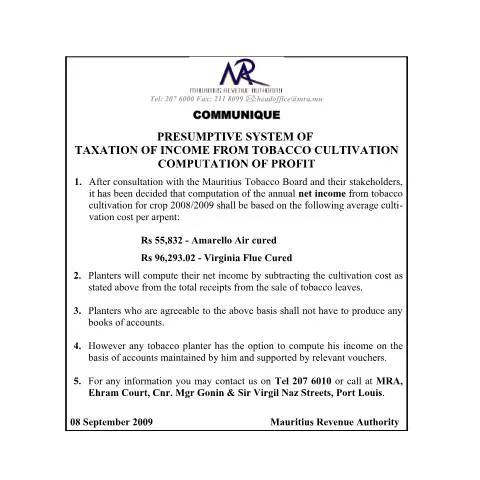
The Presumptive System of Taxation of Income from Tobacco Cultivation, referred to by its code tobaccoCultivation040909, serves as a critical framework for tobacco planters in Mauritius. Introduced on 08 September 2009, this document streamlines the taxation process for individuals engaged in the cultivation of tobacco. It defines how annual net income should be computed, taking into account various cultivation costs associated with different types of tobacco. In essence, it provides a method that simplifies tax obligations for planters, aiming to encourage compliance and transparency in the sector.
Who Needs to Submit the Form?
This document is directed specifically at tobacco planters in Mauritius, including both individual farmers and larger agricultural enterprises. Here’s a detailed breakdown of the profiles that need to engage with this form:
- Individual Planters: Smallholders cultivating tobacco primarily for local markets.
- Commercial Growers: Large-scale farmers who grow tobacco for export and local distribution.
- New Entrants: Farmers entering the tobacco market for the first time, who may seek guidance under this system.
It's crucial for planters to determine whether they will compute their income under this presumptive system or prefer to maintain detailed accounts and submit them for tax purposes. Understanding the implications of each choice is vital.
Historical Context and Regulatory Framework
The establishment of this taxation system stems from a need to regulate an industry that has historically faced scrutiny due to health concerns and economic implications. The Mauritius Tobacco Board, in collaboration with key stakeholders, conducted consultations which highlighted the necessity for a simplified taxation regime. This approach aligns with the larger national goal of improving agricultural productivity while ensuring compliance with public health policies.
The PSC Act 1955 and the principles established by the Constitution of 1968 serve as the legal backbone for this document. They highlight the importance of fair taxation, equitable treatment of all agricultural producers, and the promotion of local agriculture in response to both domestic needs and international trade agreements.
Step-by-Step Process from Submission to Outcome
Initiating the Process
The journey begins with the planters reviewing the prescribed cultivation costs for the relevant fiscal year. For instance, for the crop year of 2008/2009, costs were detailed as follows:
| Tobacco Type | Average Cultivation Cost (Rs) |
|---|---|
| Amarello Air Cured | 55,832 |
| Virginia Flue Cured | 96,293.02 |
Planters are required to compute their net income by deducting these costs from their total receipts from the sale of tobacco leaves. Upon agreement with this methodology, they can proceed without the burden of maintaining detailed accounts.
Submission Channels
Once the computation is complete, planters have several options for submission:
- Online Submission: Planters can utilize the MauPass platform, which provides a user-friendly interface for electronic submissions. This method is encouraged due to its efficiency and reduced processing times.
- Paper Submission: For those preferring traditional methods, submission can be done via hard copy directly to the Mauritius Revenue Authority (MRA). It is recommended to retain copies of all documents submitted.
- In-Person Submission: Planters also have the option to visit the MRA offices located at Ehram Court, Cnr. Mgr Gonin & Sir Virgil Naz Streets, Port Louis, where they can receive assistance if needed.
Understanding the Role of the Document in the Taxation Process
This document plays a pivotal role in the broader taxation framework as it defines clear guidelines for planters regarding their obligations. By adopting a presumptive taxation approach, it alleviates the need for extensive bookkeeping, thus reducing the administrative burden on farmers.
Moreover, it facilitates compliance by providing a straightforward method to compute taxable income based on average cultivation costs rather than actual expenses. This not only aids in transparency but also enhances the likelihood of voluntary compliance among tobacco planters.
Specific Cases and Variations
While the presumptive system is designed to simplify tax obligations, certain scenarios may warrant special attention:
Foreign Planters
Foreign entities or individuals looking to cultivate tobacco in Mauritius must comply with specific regulations set by the Mauritius Tobacco Board. They may also be subject to different taxation rules depending on their operational structure and agreements in place within Mauritius.
Minors and Legal Guardians
In cases where minors are involved in tobacco cultivation, legal guardians must take responsibility for tax submissions. This includes ensuring that the presumptive system is appropriately applied or opting for a full accounting method if necessary.
Complex Situations
Instances of mixed cultivation, where multiple types of tobacco are grown, may require adjustments to calculations. Planters must carefully record their receipts and differentiate between types to ensure precise tax computations.
Timelines Associated with the Submission Process
Planters are advised to adhere to specific timelines to avoid penalties or complications:
- Submission Deadline: Generally, the deadline for submitting the computation under the presumptive system coincides with the end of the fiscal year, which is 30 June.
- Processing Time: Once submitted, the MRA typically processes the documentation within a few weeks, though planters should be prepared for possible delays during peak filing seasons.
- Notification of Assessment: After processing, planters will receive a notification detailing their assessed tax liabilities, which must be settled promptly to avoid fines.
Implications and Next Steps After Submission
Upon successful submission and acceptance of the computation, the planter is required to prepare for potential audits or checks by the MRA. This underscores the importance of accuracy in calculations and maintaining clear records of sales and receipts.
Should any discrepancies arise, planters will be notified, and they may need to provide further documentation or clarify their calculations. In contrast, those who maintain accurate records and comply with the guidelines will experience a seamless process.
Furthermore, the MRA encourages ongoing communication with planters to provide support and ensure adherence to regulatory standards. For any inquiries or clarifications, planters can contact the MRA directly at Tel: 207 6000 or Email: [email protected].
Final Considerations for Tobacco Planters
Engaging with the Presumptive System of Taxation of Income from Tobacco Cultivation is more than just a regulatory obligation; it’s an opportunity for sustainable agricultural practices within Mauritius. By simplifying the taxation landscape for tobacco growers, the authorities aim to foster growth in this sector while maintaining compliance with health and economic policies.
As the agricultural landscape continues to evolve, it’s essential for planters to stay informed about changes in regulations and taxation practices. Regularly consulting with the Mauritius Revenue Authority and participating in industry discussions can provide valuable insights and guidance to navigate the complexities of tobacco cultivation and taxation.
Understanding the Presumptive Taxation System for Tobacco Cultivation
The Presumptive System of Taxation for income derived from tobacco cultivation was officially introduced in Mauritius on September 8, 2009. This framework aims to simplify the tax compliance process for tobacco farmers by estimating their taxable income based on predetermined criteria rather than requiring detailed record-keeping of actual income and expenses. The key benefit here is the reduction of the administrative burden on farmers, allowing them to focus more on their agricultural activities while still meeting their tax obligations.
Under this system, the Mauritius Revenue Authority (MRA) plays a pivotal role in determining the presumptive income for tobacco cultivators. This income is primarily calculated based on the area of land cultivated and the average yield per hectare. Farmers must provide documentation of their land holdings, typically through land title deeds or lease agreements, to the MRA. The crucial factor in this scenario is that the MRA periodically adjusts the presumptive income rates to reflect changes in agricultural practices and market conditions. Therefore, staying informed about these adjustments is vital for compliance.
Farmers are generally categorized based on the size of their operation, with different presumptive rates applied to various tiers of cultivation sizes. This tiered structure means that smaller farmers may benefit from lower presumptive tax rates, which are designed to encourage small-scale tobacco cultivation and alleviate some of the financial pressures they may face. Additionally, it's important to highlight that farmers operating outside the prescribed thresholds may be subjected to different taxation rules and should consult with MRA representatives for guidance.
Compliance and Record-Keeping Requirements
While the presumptive taxation system is designed to simplify the tax process, it is crucial for tobacco farmers to maintain a basic level of compliance and record-keeping. Farmers are not entirely exempt from documenting their activities; rather, they are required to keep essential records that can substantiate their land area, crop yield, and any relevant agricultural practices employed during cultivation. Such records must be readily available for inspection by MRA officials if needed.
Farmers should also be aware of the importance of submitting their tax returns on time. Even though the taxation system is presumptive, failure to submit returns may lead to penalties or other enforcement actions by the MRA. The tax return should typically be submitted electronically through the MRA’s e-filing system, which aligns with the Mauritius government's push for digitalization of tax services. This system allows farmers to complete their returns efficiently and ensures that they receive timely acknowledgments upon submission.
Moreover, understanding the fiscal year in Mauritius, which runs from July 1 to June 30, is pivotal. Farmers must ensure that their income calculations and submissions align with this timeline to avoid complications. Awareness of the tax calendar allows farmers to prepare adequately, collect the necessary documents, and allocate time for any consultations with tax advisors or MRA officials.
Implications of Non-Compliance and Appeals Process
Non-compliance with the presumptive taxation system can have serious ramifications for tobacco farmers in Mauritius. If a farmer fails to adhere to the guidelines set forth by the MRA, they may be subjected to a range of penalties, including fines, additional assessments, or even more severe legal consequences. It's imperative to recognize that the MRA has the authority to re-evaluate a farmer’s income if they suspect discrepancies or have reason to believe that the presumptive calculations do not align with actual farming activities.
In the event of a dispute regarding the presumptive tax calculations, farmers have the right to appeal decisions made by the MRA. The appeal process involves submitting a formal written request to the MRA, highlighting the reasons for the appeal, along with any supporting documents that may strengthen their case. Farmers should act promptly since there are specific timelines established for filing appeals. Engaging with a tax advisor or legal representative during this process may enhance the chances of a favorable outcome.
Furthermore, it is beneficial for farmers to stay informed about any changes in tax legislation or administrative practices that may affect their obligations under the presumptive taxation system. Regularly attending workshops or seminars organized by agricultural cooperatives or the MRA can provide valuable insights into compliance strategies, recent developments, and best practices in tax management.