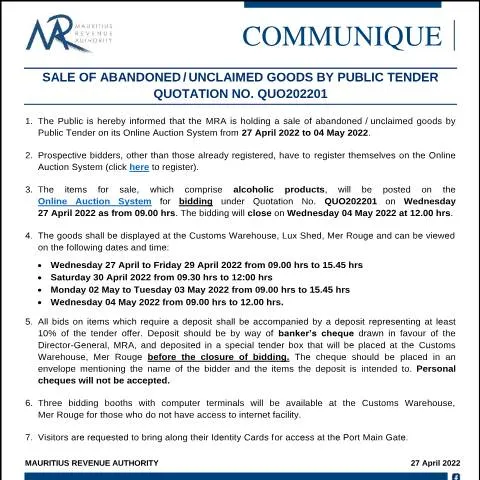
Navigating the Sale of Abandoned or Unclaimed Goods: Insights into Quotation No. QUO202201
Imagine a scenario where you come across unique and valuable items that have been left behind or gone unclaimed. As a citizen interested in potentially acquiring such goods, your first step towards a successful bid relies on understanding the intricacies of the Sale of Abandoned/Unclaimed Goods by Public Tender, specifically under Quotation No. QUO202201. This document serves as the foundation for participating in this public sale facilitated by the Mauritius Revenue Authority (MRA). Below, we explore the various aspects of this important form, ensuring prospective bidders are well-equipped to engage in the tender process.
Understanding the Role of the MRA in Public Tenders
The MRA, established under the Mauritius Revenue Authority Act, oversees the administration of various taxes and the management of public tenders for unclaimed goods. Such sales not only help clear the inventory of unclaimed articles but also provide an opportunity for the public to acquire items at competitive prices. The Public Tender process allows for fair competition among bidders, ensuring transparency and accountability in the disposal of unclaimed goods.
What Goods Are Being Sold?
This tender primarily features alcoholic products among other potential items. As stipulated in the MRA's announcement, the goods will be showcased on an online auction system, promoting wider participation and accessibility. Bidders are encouraged to review the list of items available for sale, which will be updated on the system starting from 27 April 2022.
Steps to Engage in the Public Tender Process
Participating in the tender process involves several crucial steps, each designed to facilitate a smooth experience for bidders. Here’s a breakdown of the procedure:
- Registration on the Online Auction System: Prospective bidders, especially those not previously registered, need to create an account on the MRA’s Online Auction System. This step is essential to access the bidding platform and view available items.
- Viewing the Goods: The items for sale will be displayed at the Customs Warehouse, Lux Shed, Mer Rouge. Bidders can inspect these goods on specified dates:
- 27 April to 29 April 2022 from 09:00 hrs to 15:45 hrs
- 30 April 2022 from 09:30 hrs to 12:00 hrs
- 02 May to 03 May 2022 from 09:00 hrs to 15:45 hrs
- 04 May 2022 from 09:00 hrs to 12:00 hrs
- Submitting Your Bid: Bids must be submitted online before the deadline of 04 May 2022 at 12:00 hrs. If bidding on items requiring a deposit, ensure that a banker’s cheque is prepared, as personal cheques will not be accepted. The deposit should be at least 10% of the bid amount.
- Utilizing Bidding Booths: For individuals without internet access, the MRA will provide bidding booths equipped with computer terminals at the Customs Warehouse. This ensures that all interested parties have the opportunity to participate.
Key Requirements for Bidders
Understanding the requirements for participation is crucial. As a bidder, here are the essential documents and actions needed:
- Identity Verification: It is mandatory to present an Identity Card upon entering the Customs Warehouse. This allows for secure access and helps the MRA track attendance during the viewing and bidding process.
- Deposit Submission: Ensure that your deposit cheque, clearly indicating your name and the items intended for, is placed in the designated tender box before the bidding closes.
- Online Preparation: Familiarize yourself with the online auction system to navigate it effectively on the bidding day.
Understanding the Bidding Process
The bidding period from 27 April to 04 May 2022 is crucial for potential bidders. Each participant must carefully monitor their bids and be prepared for competitive pricing on the items of interest. Bidders can strategize by:
- Setting a maximum budget to avoid overspending.
- Being present during the last hours of bidding to make any last-minute adjustments or competitive bids.
Post-Bid Procedures: What Happens Next?
Once the bidding period closes, the MRA processes all bids and evaluates them based on the established criteria. Successful bidders will receive notifications regarding their winning bids along with instructions on how to proceed with payment and the collection of their items.
Handling Payment for Winning Bids
Successful bidders must formally accept their bids and adhere to payment guidelines as outlined by the MRA. Payments must be made promptly to avoid forfeiting the winning item. Here are the steps to follow:
- Confirm Winning Bid: After notification, confirm your acceptance of the bid.
- Complete Payment: Payment details will be provided, including methods of payment accepted.
- Arrange Item Collection: Coordinate with the MRA for collection details, ensuring you have all required documentation.
Special Considerations for Unique Situations
While the public tender process is structured, there may be unique situations that bidders encounter. Here are specific cases to consider:
Foreign Bidders
International bidders may participate in the tender, but they must comply with additional documentation requirements, such as presenting valid identification and possible compliance checks. It is advisable to contact the MRA in advance to clarify any procedures applicable to foreign participation.
Minors and Legal Guardians
Minors wishing to bid must have their legal guardians present during the process. Legal guardians must provide consent and identification to facilitate the minor's participation in the auction.
What to Do in Case of Discrepancies
Errors or discrepancies can occur at various stages of the bidding process. Here’s how to address potential issues:
In Case of Missing Documents
If a bidder discovers that a required document is missing when attempting to register or place a bid, it is crucial to act swiftly:
- Gather all necessary documents as per the bidding requirements.
- Contact the MRA's customer service hotline at +230 202 0500 for assistance.
- Prepare to resubmit your bid once the necessary documents are in order.
Dealing with Bid Refusals
Should your bid be refused or rejected, the MRA will provide a reason for the decision. Follow these steps to address the situation:
- Review the feedback provided by the MRA.
- If applicable, rectify any issues and consider resubmitting your bid in future tender opportunities.
- Maintain communication with the MRA for clarity on any points of contention.
Final Thoughts on Engaging with the Public Tender
Engaging in the Sale of Abandoned/Unclaimed Goods through the Public Tender system is a viable opportunity for individuals seeking unique purchases while supporting the government in resource management. By familiarizing yourself with the process outlined in Quotation No. QUO202201, adhering to the guidelines, and staying organized, you can navigate the auction effectively. Whether you are a seasoned bidder or a first-time participant, understanding these steps will enhance your experience and potentially lead to successful acquisitions.
For further inquiries or assistance, contact the MRA at:
Mauritius Revenue Authority Custom House, Mer Rouge, Port Louis, Mauritius T: +230 202 0500 F: +230 216 5946 E: [email protected] W: www.mra.mu
Understanding the Process of Public Tender for Abandoned Goods
The sale of abandoned or unclaimed goods by public tender in Mauritius is an intricate process designed to ensure transparency and fairness. Under the regulations stipulated in Qu. 01 of 2022, individuals and entities interested in participating in these tenders must first understand the framework laid out by the relevant authorities. The process generally begins with the identification of goods that have remained unclaimed for a specified duration, which may vary based on the nature of the goods and the regulations governing their custody.
Fill in your form directly online
No printing: type your details into the boxes of the official form, tick, then download the PDF ready to send.
- 1Type into the form boxes
- 2Tick in one click
- 3Save and download the PDF
Typically, the Public Service Commission (PSC) and the Local Government Service Commission (LGSC) oversee these tenders, ensuring compliance with local laws. The tender notice is published on official platforms such as govmu.org and includes vital information such as the deadline for submission, the location of the auction, and detailed descriptions of the goods available for sale. Participants must ensure they meet the eligibility criteria, which usually require them to possess a valid National ID and to be registered in the Central Population Database, utilizing the MauPass single-sign-on system for applications.
Conditions for Bidding on Abandoned Goods
Bidding on abandoned goods is not merely about participating in an auction; it involves adhering to specific conditions set forth by the tendering authorities. First and foremost, bidders must submit a completed application using the official form, typically identified as the "Tender Application Form." This document must clearly outline the bidder’s details, the goods they are interested in, and their proposed bid amount. In some cases, a deposit may be required as part of the application; this serves as a financial commitment and is often non-refundable if the bidder fails to complete the purchase after winning.
In addition, bidders should familiarize themselves with the evaluation criteria employed by the authorities, which may include the bidder's financial standing, experience in handling similar goods, and any previous dealings with government tenders. It's also crucial for bidders to inspect the goods beforehand, as tenders are usually sold “as is,” meaning that the condition of the goods is the buyer's responsibility once purchased. Failure to adhere to these conditions can result in disqualification from the tender process or legal repercussions.
Post-Tender Procedures and Responsibilities
Once the tender process concludes, the winning bidder is obligated to complete the transaction within the timeline specified in the tender notice. This phase includes making the necessary payment and arranging for the collection of goods. The payment process is generally facilitated through the MRA’s electronic payment system, ensuring a streamlined and secure transaction. Bidders must also consider any additional costs that may arise, such as transportation or handling fees, which are typically not included in the tender price.
It is important for winning bidders to keep all documentation related to the purchase, including receipts and any correspondence with tendering authorities, as these may be required for future reference or for tax purposes. Additionally, once the goods are collected, the responsibility for their condition and any legal implications arising from their ownership falls entirely on the bidder. Therefore, thorough due diligence prior to bidding cannot be overstated, especially in cases where the nature of the goods could invoke specific regulatory or compliance considerations.
Potential Legal Implications and Responsibilities
Engagement in the public tender for the sale of abandoned goods does not come without its share of legal responsibilities. Bidders must be acutely aware of the potential implications relating to ownership and liability. Any goods purchased from the tender may have implications if they are found to infringe on existing patents, trademarks, or copyrights. Therefore, it is advisable for bidders to conduct comprehensive research on the goods and their previous ownership history, if available.
Moreover, in cases where the goods pertain to sensitive categories, such as hazardous materials or items with potential environmental impacts, bidders should ensure compliance with the relevant environmental regulations. This may involve acquiring the necessary permits for disposal or resale and understanding the legal ramifications of mishandling such items.
In addition to compliance with laws governing the nature of the goods, bidders must also be cognizant of their obligations under Mauritius’s anti-money laundering and anti-terrorism financing laws. This means that any large transactions must be conducted transparently, and due diligence may be required to prove the legitimacy of funds used in the transaction.