Skip to content
Government & admin

Guide to Bidding on Abandoned Goods in Mauritius

Official documentGovernment & admin
PreviewDocument preview: Guide to Bidding on Abandoned Goods in Mauritius — Government & admin (CommuniqueQuo202220)
Official document

What would you like to do?

After payment, download your document or edit it in your account.

After payment, download your document or edit it in your account.

Understanding the Abandoned Goods Tender Process in Mauritius

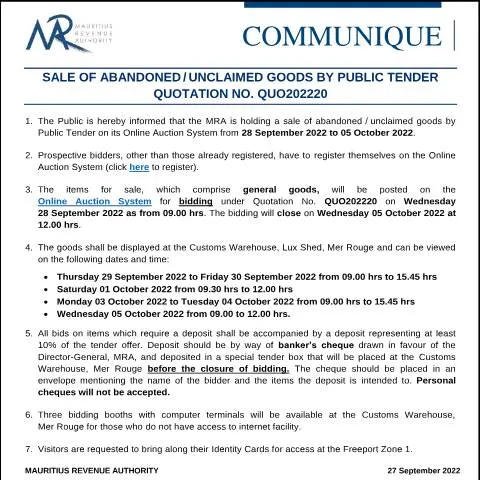
In the vibrant economy of Mauritius, the sale of abandoned or unclaimed goods offers an intriguing opportunity for both individual bidders and enterprises seeking unique items. Conducted by the Mauritius Revenue Authority (MRA), these sales are regulated through a structured process, outlined in the Public Tender Quotation No. QUO202220. This document serves as your essential guide, detailing every facet of the bidding process, from registration to the final auction day, ensuring a seamless experience for prospective bidders.

Key Dates: Mark Your Calendar

The timeline is crucial when participating in the bidding process for abandoned goods. Here's the detailed schedule:

Event Date Time
Online Bidding Opens 28 September 2022 09:00 hrs
Online Bidding Closes 05 October 2022 12:00 hrs
Viewing of Goods 29-30 September 2022 09:00 - 15:45 hrs
Viewing of Goods 01 October 2022 09:30 - 12:00 hrs
Viewing of Goods 03-04 October 2022 09:00 - 15:45 hrs
Last Viewing Day 05 October 2022 09:00 - 12:00 hrs

It's imperative to adhere to the specified dates to avoid missing out on both the viewing and bidding opportunities.

Registration: The First Step to Bidding

Before you can place a bid, registration on the MRA's Online Auction System is mandatory. If you are a new bidder, follow these steps:

  1. Visit the Online Auction System.
  2. Complete the registration form with your personal details.
  3. Submit your application and await confirmation of your registration.

Ensure that your registration is completed ahead of time to prevent any last-minute issues. Existing bidders should verify their registration status to ensure all details are current.

Preparing to Bid: Documentation and Deposits

Each bid on an item that requires a monetary deposit demands specific preliminary steps. The deposit, constituting at least 10% of the tender offer, must be prepared in the form of a banker’s cheque. Here’s what you need to know:

  • The cheque must be drawn in favour of the Director-General, MRA.
  • Deposits should be placed in a clearly labeled envelope with your name and the respective item listed.
  • Personal cheques will not be accepted, ensuring a streamlined and secure bidding process.

Depositing these cheques into the designated tender box at the Customs Warehouse before the bidding closure is essential, as failure to do so will result in disqualification from the bidding process for those items.

Understanding the Auction: What to Expect

During the bidding timeframe, items for sale will be displayed on the Online Auction System, accessible from the registration date until the closing date. The items comprise a wide array of general goods that have gone unclaimed, providing bidders with opportunities to acquire diverse products.

For those who lack access to the internet, the MRA has established three bidding booths equipped with computer terminals at the Customs Warehouse, ensuring inclusivity and access for all interested parties.

Viewing Days: An In-Person Experience

The viewing dates are critical for all potential bidders. Attending the viewing allows you to inspect the items physically, fostering informed bidding decisions. Here’s a recap of the viewing schedule:

  1. 29 September 2022: 09:00 - 15:45 hrs
  2. 30 September 2022: 09:00 - 15:45 hrs
  3. 01 October 2022: 09:30 - 12:00 hrs
  4. 03 October 2022: 09:00 - 15:45 hrs
  5. 04 October 2022: 09:00 - 15:45 hrs
  6. 05 October 2022: 09:00 - 12:00 hrs

Identification is essential; ensure you carry your Identity Card for access to the Freeport Zone 1 on viewing days, as security measures are in place for the protection of both the goods and the attendees.

After the Bidding: The Next Steps

Upon the closure of the bidding process, the MRA will evaluate all submissions based on the bids and deposits provided. Successful bidders will receive notifications detailing the next steps, which may include payment instructions and collection of items won. Understanding what happens after the auction is pivotal:

Online editing included

Fill in your form directly online

No printing: type your details into the boxes of the official form, tick, then download the PDF ready to send.

  1. 1Type into the form boxes
  2. 2Tick in one click
  3. 3Save and download the PDF
Get started for Rs 47.16
  • Notifications of successful bids will be sent out promptly.
  • Payment must be completed as per the instructions provided.
  • Once payment is confirmed, arrangements for item collection will be communicated.

This phase is where you need to be vigilant; ensure that you adhere to all instructions to avoid forfeiting your items or deposits.

Implications of Participation: Rights and Obligations

Participating in the bidding process entails certain rights and obligations that all bidders must be aware of. Understanding these implications not only helps in compliance but also safeguards your interests:

  • Rights:
    • The right to participate in the bidding process upon registration.
    • The right to receive accurate information regarding the bidding items.
    • The right to a fair evaluation of bids without bias.
  • Obligations:
    • To register and ensure all details are accurate and complete.
    • To adhere to submission deadlines and payment processes.
    • To respect the bidding terms and conditions laid out by the MRA.

    Failure to comply with these obligations may result in disqualification from future bidding processes and loss of any deposits made.

    Conclusion: A Step Towards Acquiring Unique Goods

    The process of bidding for abandoned or unclaimed goods via public tender holds opportunities akin to a treasure hunt, where each bidder embarks on a journey of discovery. By understanding the nuances of the Public Tender Quotation No. QUO202220 and adhering to the outlined steps, you position yourself for a rewarding experience. From registration to successful bid acceptance, each stage is an integral part of the auction process, culminating in the potential acquisition of unique items that could serve personal or business needs. Ensure you are well-prepared, informed, and ready to engage in this exciting process.

    The sale of abandoned or unclaimed goods in Mauritius is governed by specific legal provisions that ensure transparency and fairness in the process. The relevant legal framework is primarily established under the General Law Reform Act and supplemented by various regulations regarding public tenders. According to the provisions outlined in Qu. 20 of 2022, a clear definition of what constitutes abandoned goods is provided, including a detailed explanation of the criteria used to determine if goods are indeed unclaimed. It is essential to differentiate between various categories of goods that may fall under this regulation. For instance, personal property left behind in public places, unclaimed cargo at ports, and items not retrieved from storage facilities all qualify as abandoned goods, provided they meet the statutory conditions. In practice, this means that authorities must first conduct an exhaustive effort to locate the rightful owners or heirs before proceeding with the sale of these items. Authorities such as the Ministry of Public Infrastructure and Land Transport play a crucial role in overseeing the identification and classification of abandoned goods. This process also involves the issuance of public notices, ensuring that potential claimants have ample opportunity to respond before goods are declared for sale. The timeline for these notices is typically set by the relevant authorities, allowing for a period of at least 30 days for any claims to be validated. Furthermore, understanding the obligations of both the authorities handling the goods and the potential buyers is vital. Buyers are expected to conduct due diligence prior to participating in tenders, as goods sold often come without warranties or guarantees. The lack of ownership history can pose risks, making thorough investigations necessary to avoid future liabilities.

    Participation in Public Tenders for Abandoned Goods

    Engaging in public tenders for the purchase of abandoned or unclaimed goods is an opportunity for both individuals and businesses. However, potential bidders should be aware of the specific protocols and requirements involved in the tendering process under Qu. 20 of 2022. The first step involves registration on the relevant government portals, such as govmu.org, where prospective bidders must create an account linked to their National ID Card through the MauPass single-sign-on system. Once registered, bidders can access relevant tender notices, which include details like the description of goods, inspection dates, and submission deadlines. It is imperative to thoroughly review these documents, as they provide insights into the valuation and conditions of the goods being tendered. Additionally, each tender typically specifies a set of documents that bidders must submit, including but not limited to proof of identity and any necessary financial guarantees. Moreover, during the tender opening process, transparency is upheld with representatives from both the bidding community and the relevant authorities present. This process not only ensures fairness but also allows for immediate clarification of any discrepancies regarding bids. Successful bidders will then receive formal notifications and must adhere to specific payment timelines, typically within a designated period of 14 days, to finalize the transactions. The successful buyer's responsibilities extend beyond the acquisition of goods; they must also arrange for the collection of items within a stipulated timeframe to avoid additional charges or penalties. It is advisable for buyers to inspect the goods on site prior to tender submission to ascertain their condition and value, as this can significantly influence their bidding strategy.

    Implications of the Sale of Abandoned Goods on Local Economy

    The sale of abandoned or unclaimed goods can have substantial implications for the local economy in Mauritius. One of the most notable aspects is the potential for resource recovery and waste minimization. By facilitating the sale of such goods, authorities can turn potentially wasted items into economic opportunities, fostering an environment of sustainability and responsible consumption. For individuals, participating in the purchase of these goods can offer significant financial benefits. Often, abandoned items are sold at lower costs compared to market prices, enabling buyers to acquire valuable products at a fraction of their retail value. This practice can subsequently stimulate local business activities as buyers resell these goods, creating a ripple effect that benefits the economy. Moreover, from a broader perspective, the management of abandoned goods through public tenders can enhance government revenue streams. The funds generated from these sales contribute to local fiscal budgets, which can then be allocated towards public services such as education, health care, and infrastructure development. This enhances the overall quality of life for residents and supports community development initiatives. Additionally, promoting the sale of abandoned items via public tender aligns with global sustainability goals by encouraging the reuse and recycling of products. As more individuals and businesses engage in these transactions, there is a growing community awareness around waste reduction efforts, leading to a cultural shift toward more sustainable consumption practices. In conclusion, while the sale of abandoned or unclaimed goods through public tender may seem like a straightforward process, it encompasses a range of legal, economic, and social implications that warrant careful consideration by all stakeholders involved. By understanding these facets, individuals and businesses can make informed decisions that positively impact their own circumstances as well as contribute to the broader economic landscape of Mauritius.

Frequently asked questions

What is the abandoned goods tender process?

It is a structured auction process regulated by the Mauritius Revenue Authority for unclaimed items.

Who can participate in the tender?

Both individuals and businesses can bid on abandoned or unclaimed goods.

How do I register for the auction?

Registration details are provided in the Public Tender Quotation No. QUO202220.

What happens on auction day?

Bidders present their bids, and the highest bid wins the item being auctioned.

Are there any fees associated with bidding?

Yes, there may be registration and bidding fees outlined in the tender document.

How can I find more information?

Refer to the Mauritius Revenue Authority's official website or the tender document for details.

Similar documents