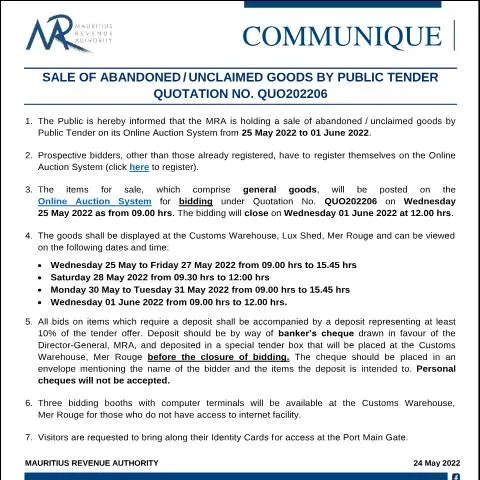
Navigating the Landscape of Abandoned Goods: Understanding Quotation No. QUO202206
The sale of abandoned or unclaimed goods by public tender is not merely an administrative formality; it encapsulates an intricate interplay between public interest, legal obligations, and economic opportunity. Under the Mauritius Revenue Authority (MRA), Quotation No. QUO202206 serves as a crucial gateway for prospective bidders eager to engage in the auction of goods that have lain dormant within the confines of customs warehouses. This situation arises when items, be it general goods or otherwise, remain unclaimed for an extended period, prompting the need for the government to reclaim space and facilitate new ownership through public tender.
Chronological Pathway: From Auction Announcement to Bidding Closure
Each stage within the auction process is meticulously crafted to ensure transparency and fairness, necessitating a step-by-step approach for bidders.
- Announcement of Sale (May 24, 2022): The MRA formally informs the public of the upcoming auction, providing essential details such as timeline and registration requirements.
- Registration Phase (May 25, 2022): Prospective bidders not already registered with the Online Auction System must complete their registration before participating.
- Viewing Period (May 25 - June 1, 2022): Interested bidders have the opportunity to physically inspect the goods available for bidding at the Customs Warehouse in Mer Rouge, ensuring informed decisions.
- Bidding Window (May 25 - June 1, 2022): Online bidding commences, with items posted on the auction system. Bidders can place their offers until the closure on June 1, 2022.
- Deposit Submission: For items requiring a deposit, bidders must submit a banker’s cheque of at least 10% of their tender offer, ensuring financial commitment.
Interface with Administration: Monitoring Your Bid's Progress
Understanding the administrative processing of bids is paramount for bidders seeking to maximize their chances of success. The MRA operates with a structured follow-up protocol:
- Notification of Bid Status: Bidders typically receive updates regarding their bid status through the Online Auction System.
- Engagement with MRA Officials: In the event of questions or concerns about bidding processes, bidders can directly reach out to MRA officials via email or phone.
- Real-time Tracking: The auction platform allows bidders to monitor their bids against others, fostering competition and strategic bidding.
Dealing with Challenges: What Happens in Case of Bid Issues?
In the dynamic world of public tenders, complications can arise. Whether it’s a missing document, an incorrect bid, or a failed deposit submission, being prepared is key to navigating these challenges:
- Missing Documents: If a bidder discovers after submission that documentation is incomplete, they should promptly contact MRA to inquire whether corrections can be made before the bidding deadline.
- Bid Rejections: In cases of bid rejection, bidders have the right to request clarification from the MRA. Understanding the basis for rejection can inform future bidding strategies.
- Deposit Issues: If there is confusion regarding deposit requirements, it is essential to consult the bidding guidelines provided by the MRA well in advance of the deadline.
Rights and Responsibilities: The Bidder's Perspective
Engaging in the bidding process of abandoned goods carries certain rights and responsibilities that every participant should acknowledge:
- Transparency in Bidding: Bidders have a right to transparent communication regarding auction procedures and item specifications.
- Commitment to Honesty: It is vital that all bids accurately reflect the bidder's intentions and capabilities, avoiding fraudulent behaviour.
- Awareness of Consequences: Failure to comply with bidding rules or submission requirements may result in disqualification from future auctions, highlighting the importance of meticulous preparation.
Submission Channels: Online Versus In-Person Bidding
While the shift towards digital bidding offers convenience, understanding the nuances of submission channels is essential for bidders:
| Submission Channel | Description | Pros | Cons |
|---|---|---|---|
| Online Bidding | Bids are placed through the MRA's Online Auction System. | Convenience; Real-time updates; Accessibility from anywhere. | Requires internet access; Potential for technical issues during bidding. |
| In-Person Bidding | Bidders can bid through designated booths at the Customs Warehouse. | Opportunity for hands-on interaction; No internet issues. | Limited to specific locations; Time constraints based on viewing hours. |
The Legal Framework: Understanding the Context of the Auction
The auction of abandoned goods is anchored in a robust legal framework that incorporates both local customs laws and public tender regulations. The Constitution of 1968 and the provisions established under the MRA provide a comprehensive legal backdrop:
- Customs Act Compliance: All items auctioned must adhere to local customs regulations, ensuring legality in acquisition and sale.
- Public Tender Transparency: The legal framework mandates that all auctions are conducted in a manner that promotes competitive bidding and fairness.
- Protection of Public Interests: Ensuring that unclaimed goods are properly auctioned helps maintain order and use of public space.
Distinguishing QUO202206 from Similar Documentation
When navigating public tenders, it is crucial to distinguish between the various forms and processes, particularly when engaging with abandoned goods. QUO202206 has its distinct characteristics:
- Specificity of Purpose: Unlike general application forms, this particular document is solely dedicated to the auction of abandoned goods, providing a focused framework for bidding.
- Time-Sensitive Nature: The form has a defined timeline, emphasizing urgency, which may not be present in other forms.
- Deposit Requirements: The necessity for a deposit sets QUO202206 apart from other forms that may not impose such financial prerequisites.
The Impact of Non-Compliance: Understanding the Ramifications
Non-compliance with the stipulations outlined in Quotation No. QUO202206 can lead to significant repercussions:
- Bidding Disqualification: Failure to adhere to the deposit requirements or documentation can disqualify a bidder from participating.
- Loss of Financial Investment: If a bidder's offer is denied and they have made a deposit without meeting conditions, the financial repercussions may be significant.
- Impact on Future Bidding Opportunities: Non-compliance may diminish a bidder's credibility, affecting their chances in future auctions.
Conclusion: Embracing Opportunities Through Informed Bidding
The sale of abandoned and unclaimed goods through public tender as outlined in Quotation No. QUO202206 presents a unique opportunity for bidders to acquire items while navigating a structured yet complex process. By understanding the administrative pathways, rights, and responsibilities, bidders can engage effectively with the MRA to make informed decisions and potentially secure valuable goods. The key lies in thorough preparation, timely submission, and awareness of the legal context driving these auctions.
Understanding the Process and Legal Framework for Sale of Abandoned Goods
The sale of abandoned or unclaimed goods in Mauritius is conducted under specific legal frameworks established by the government. This process is governed primarily by the Public Procurement Act and relevant regulations set forth by the Ministry of Finance. The aim of the legislation is to ensure that the disposal of such goods is transparent, fair, and efficient, while maximizing public revenue.
When goods are deemed abandoned or unclaimed, they are typically held by various governmental departments, including customs, police, and other regulatory bodies. The classification of goods often involves a period during which owners can reclaim their property. For instance, police seized goods may need to be stored for a legally defined period before they are eligible for sale.
Once the retention period passes without any claims, these goods are compiled into a list known as 'Unclaimed Goods List'. This list is then published publicly, allowing interested parties to understand what items are available for tender. The legal processes ensure that ownership rights are respected by providing adequate notice to original owners prior to the disposal of goods.
Key Procedures for Participating in the Public Tender
For individuals or businesses interested in acquiring unclaimed goods, participating in a public tender is the primary route. The tender process includes several key procedures that must be followed to ensure compliance with legal and administrative requirements.
1. Registration: Prospective bidders must first register on the relevant government portal, ensuring they have a valid National ID and that their registration is linked to the Central Population Database. This check helps maintain transparency in the bidding process.
2. Accessing Tender Documents: Once registered, bidders can access the tender documents published on the official government portal. These documents include detailed descriptions of the goods, terms of sale, and specific bidding instructions, including the required forms, such as the Tender Submission Form.
3. Submission of Bids: Bidders must complete the necessary forms, including PSC Form 7 for submission of their offers. It is critical to pay attention to the deadline set in the tender advertisement to ensure that bids are considered valid. Late submissions are typically disqualified. Bids can be submitted electronically via the government portal, allowing for streamlined processing and quick confirmation of receipt.
4. Deposit Requirement: A deposit is often required as part of the bidding process. This deposit demonstrates the bidder's commitment and is usually a percentage of the estimated value of the goods. The submission of this deposit must be accompanied by official proof of payment.
Fill in your form directly online
No printing: type your details into the boxes of the official form, tick, then download the PDF ready to send.
- 1Type into the form boxes
- 2Tick in one click
- 3Save and download the PDF
5. Evaluation Process: Once the bids are submitted, an evaluation committee, comprising representatives from various government departments, assesses the submissions against predetermined criteria, which may include financial offers, bidder’s credibility, and historical dealings with government tenders. This process ensures that the awarded bids are in the best interest of the public sector.
6. Awarding of Tender: Successful bidders will receive an official notification, typically through an electronic communication, with instructions on completing the purchase, including any additional requirements that may be needed prior to finalizing the sale. It is imperative for bidders to follow these instructions carefully to ensure a smooth transaction process.
Common Challenges and Considerations in the Tender Process
While the process is structured to facilitate the sale of abandoned goods, bidders may encounter various challenges that require careful navigation. Understanding these potential hurdles can better prepare participants to engage effectively in the tender process.
1. Regulatory Compliance: Bidders must be aware of and comply with all regulations governing the tender process. Failure to meet these requirements can result in disqualification. Keeping abreast of updates to legislation and procurement guidelines is essential for prospective bidders.
2. Market Value Assessment: One of the challenges faced by bidders is accurately assessing the market value of abandoned goods. Without prior experience in auctions or government tenders, potential buyers may inadvertently overvalue or undervalue items, leading to financial losses or missed opportunities. Engaging with professionals or conducting research on similar goods can be beneficial.
3. Competition: The public nature of the tender means that bids from multiple participants can drive prices up. Bidders should be prepared for intense competition and strategize their bidding approaches, taking into account both their budget and the potential resale value of the goods.
4. Logistical Considerations: Once goods are won at tender, bidders must arrange for transportation and storage of the items acquired. These logistical aspects can introduce additional costs and require planning, particularly for larger items or bulk purchases.
5. Post-Tender Compliance: After successfully winning a tender, it is vital for bidders to fulfill all post-tender obligations, including payment and timely pickup of goods. Non-compliance can lead to penalties or the forfeiture of the tender, as stipulated in the terms and conditions outlined in the bid documents.