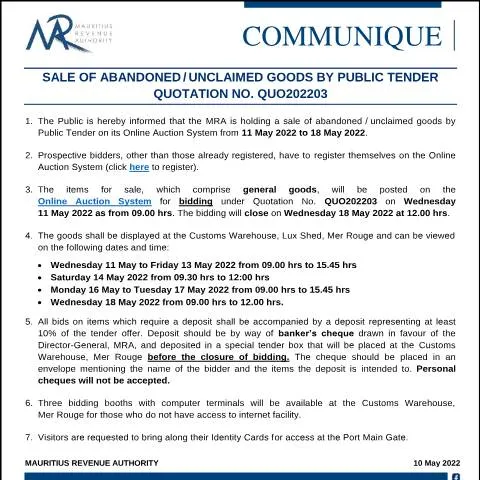
Unlocking Opportunities: The Sale of Abandoned and Unclaimed Goods
Imagine stumbling upon a hidden gem at a public auction. The Sale of Abandoned/Unclaimed Goods by Public Tender offers an exciting opportunity for both individuals and businesses to acquire items that have been left behind. This official process, overseen by the Mauritius Revenue Authority (MRA), is designed to streamline the sale of goods that have not been claimed, turning what could be wasted items into valuable assets for prospective bidders.
Timeline: Key Dates to Keep in Mind
The timeline for this auction is crucial for potential bidders. The sale takes place over a week, from May 11, 2022, to May 18, 2022. Here’s a breakdown of the essential dates:
- May 11, 2022: Auction opens at 09:00 hrs.
- May 18, 2022: Auction closes at 12:00 hrs.
Additionally, prospective bidders can view the items in the Customs Warehouse during specific hours:
| Date | Visiting Hours |
|---|---|
| May 11 to May 13, 2022 | 09:00 hrs to 15:45 hrs |
| May 14, 2022 | 09:30 hrs to 12:00 hrs |
| May 16 to May 17, 2022 | 09:00 hrs to 15:45 hrs |
| May 18, 2022 | 09:00 hrs to 12:00 hrs |
Staying informed about these dates ensures you don’t miss out on what could be a fantastic opportunity. After the auction concludes, successful bidders will receive notifications about their purchases and further instructions on payment and collection.
Navigating the Registration Process: Essential Steps
To participate in the auction, prospective bidders must navigate the registration process. Here’s how to ensure you’re registered properly:
- Visit the Online Auction System, which can be found on the MRA website.
- Complete the registration form, providing all necessary identification details.
- Ensure that you have your National Identity Card ready for verification.
- Submit your registration well before the auction begins to avoid any last-minute complications.
Registration is mandatory, especially for those who are not already part of the MRA’s system. Remember, timing is crucial, so don’t delay!
Completing the Tender Form: Detailed Guidance
Once registered, prospective bidders must complete the tender form accurately to avoid disqualification. The tender form is the key document that outlines your bid for specific items. Here’s a detailed look at the sections of the form:
- Bidder Information: Fill in your full name, address, and contact information correctly.
- Item Details: Specify the items you wish to bid on. Ensure that you reference the correct item numbers listed on the auction site.
- Bid Amount: Clearly state your bid amount. Remember, it should meet or exceed the minimum bid requirements.
- Deposit Information: Include the details of your deposit, a minimum of 10% of your bid amount, which must be in the form of a banker’s cheque.
When completing the tender form, double-check for typographical errors and ensure that all information is accurate. Incomplete or incorrect forms will lead to disqualification from the bidding process.
Understanding Deposit Requirements: The Financial Commitment
Every bid must be accompanied by a deposit, which is a non-negotiable requirement for bidding on certain items. The deposit is meant to secure your bid and serve as a commitment to follow through in the event of a successful bid. The deposit rules are as follows:
- The deposit must be at least 10% of your tender offer.
- It can only be paid via a banker’s cheque made out to the Director-General of the MRA.
- Personal cheques will not be accepted; only banker’s cheques are valid.
Ensure that the cheque is placed in an envelope addressed with your name and the corresponding items for which the deposit is intended. This will facilitate the administrative process and avoid confusion on auction day.
Post-Bid Process: What Comes Next?
After submitting your bid, it’s essential to understand the post-bid process. Here’s what to expect:
- If your bid is successful, you will be notified via the contact information provided on your tender form.
- Further instructions regarding payment and collection of your items will be communicated to you.
- In the event that your bid is unsuccessful, you will also receive a notification, and your deposit will be returned promptly.
Following up on your bid status is advisable, especially if you do not receive a notification within a reasonable timeframe post-auction closure.
Common Pitfalls: Ensuring a Smooth Process
While participating in the auction, bidders may encounter several pitfalls. Familiarizing yourself with these can help you avoid common mistakes:
- Ensure your tender form is filled out in full. Omitting details can result in disqualification.
- Double-check the item numbers and descriptions before submitting your bid. Errors can lead to confusion.
- Be mindful of submission deadlines for both your tender form and deposit.
- If using the Online Auction System, ensure you have a stable internet connection during the bidding period.
Being proactive and thorough in your approach will significantly enhance your experience during the auction.
Addressing Issues: What to Do If Challenges Arise
In the event of encountering problems—such as a refusal of your bid, missing documents, or errors on your tender form—there are steps you can take:
- Refusal of Bid: If your bid is not accepted, review the reasons provided. If you believe there has been an error, reach out to the MRA for clarification.
- Missing Documents: Ensure all documents are prepared in advance. If you notice something is missing, contact the MRA immediately to see if late submissions can be accommodated.
- Errors on the Tender Form: Notify the MRA promptly if you discover an error after submission. Depending on the circumstances, they may allow for corrections.
Staying in touch with the MRA and being proactive in resolving issues can save you time and ensure a smoother bidding experience.
Conclusion: Seizing the Opportunity
The Sale of Abandoned/Unclaimed Goods by Public Tender presents a unique opportunity to acquire valuable items while supporting the efficient operation of public goods management. By understanding the timeline, registration process, tender requirements, and post-bid procedures, prospective bidders can navigate the auction smoothly and maximize their chances for success. Remember, thorough preparation and prompt action are key to seizing the opportunity that this auction provides.
Understanding the Process of Public Tender for Abandoned Goods
The sale of abandoned or unclaimed goods in Mauritius through public tender is governed by specific rules and procedures established under the relevant legislative framework. The process aims to ensure transparency, fairness, and accountability while maximizing government revenue from items that have been left unclaimed for a significant period.
Initially, it's crucial to understand the definition of abandoned goods. These are items that have been left unclaimed for a specified duration, typically identified in the respective tender notice. The responsible authority must first ascertain that these goods can indeed be categorized as abandoned or unclaimed according to the criteria defined by the Ministry of Finance and the Public Procurement Office.
Once the categorization is confirmed, the authority will proceed to prepare a public tender notice. This notice should include essential details such as the description of the goods, their location, condition, and the minimum bidding price, which must reflect their estimated market value. The tender notice is then published on the official government portals, allowing potential bidders adequate time to assess the items and submit their bids.
Fill in your form directly online
No printing: type your details into the boxes of the official form, tick, then download the PDF ready to send.
- 1Type into the form boxes
- 2Tick in one click
- 3Save and download the PDF
Bidders are required to complete the relevant tender forms, including Form 1A for Bid Submission and Form 2 for Price Offer. All submissions must include necessary documentation such as a copy of the bidder's National ID Card and any other identification requested in the tender notice. The deadline for submission is strictly enforced, and late applications are typically rejected to uphold the principles of fairness.
Legal Framework and Compliance Requirements
The sale of abandoned or unclaimed goods through public tender in Mauritius operates within a legal framework that emphasizes compliance with the Public Procurement Act 2006 and subsequent amendments. It is vital for both sellers and bidders to be aware of their obligations under this legislation. This compliance extends to how the listings are created, advertised, and the processes for receiving bids.
Prior to the tendering process, an inventory list of the goods must be prepared. This list should be detailed, including specifications that may affect the bidding process, such as the condition of the goods and any necessary repairs. Interested bidders must be provided access to inspect the goods before the tender closing date, which can influence their bidding decisions significantly.
Moreover, any public tender must be managed by a designated procurement committee that is responsible for evaluating the bids. This evaluation must adhere to established criteria such as the assessed value of the goods, the credibility of the bidders, and adherence to the submission guidelines. The procurement committee is also tasked with ensuring that the entire process remains transparent and free from any conflict of interest.
After evaluating the bids, the committee will recommend the most suitable bid to the relevant authority, which will then issue an award notice to the winning bidder. It's important to note that the successful bidder may have to comply with specific terms and conditions outlined in the tender agreement, including payment schedules and collection timelines for the goods.
Post-Award Considerations and Responsibilities for Winning Bidders
Winning a public tender for abandoned goods comes with its own set of responsibilities. Successful bidders must fulfill all conditions stipulated in the tender notice and the subsequent award agreement. This typically includes making the payment within a specified timeframe, which is usually indicated in the award notice or the tender documents.
Upon payment, the bidder will receive instructions on how to collect the goods. It is critical for bidders to adhere to these collection instructions meticulously, as failure to do so can lead to penalties, including potential forfeiture of the goods. Additionally, bidders must ensure that they have the appropriate means to transport the goods securely and safely from the designated collection site.
Furthermore, winning bidders should also be aware of the implications of reselling the acquired goods. Depending on the nature of the items, there may be additional regulatory requirements for resale, including licensing and compliance with local business regulations. Bidders should conduct their due diligence to ensure they comply with these laws to avoid any legal repercussions.
Finally, it’s beneficial for bidders to keep records of their transactions, including copies of their bids, receipts of payment, and any related correspondence. This documentation can be essential for resolving any disputes that arise and will serve as proof of the legitimacy of the acquisition.