The Mechanics of Unclaimed Goods: Understanding Form Quo202226
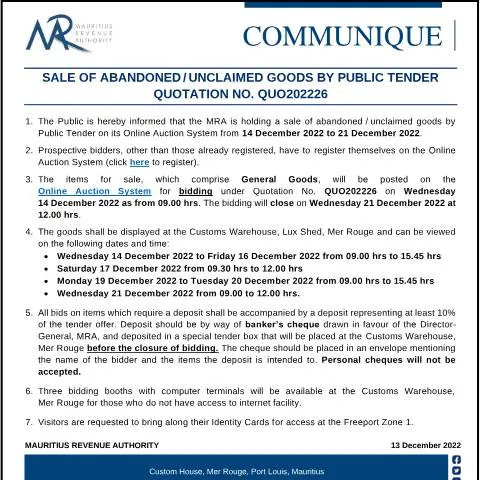
Engaging with the process of acquiring abandoned or unclaimed goods through public tender can be a unique opportunity for individuals and businesses alike. The Sale of Abandoned/Unclaimed Goods by Public Tender—specifically outlined in Quotation No. Quo202226—provides the framework under which these transactions occur. This initiative by the Mauritius Revenue Authority (MRA) aims to efficiently clear out goods that have remained unclaimed while offering the public a chance to acquire potentially valuable items.
Key Dates: A Window for Bidding
The timeline for participating in this public tender is crucial. Bidding begins on 14 December 2022 at 09:00 hrs and concludes on 21 December 2022 at 12:00 hrs. This short period demands that prospective bidders act swiftly to register and place their bids. Here’s a breakdown of the important dates:
- Bid Opening: 14 December 2022, 09:00 hrs
- Bid Closing: 21 December 2022, 12:00 hrs
- View Goods:
- 14-16 December 2022: 09:00-15:45 hrs
- 17 December 2022: 09:30-12:00 hrs
- 19-20 December 2022: 09:00-15:45 hrs
- 21 December 2022: 09:00-12:00 hrs
Who Can Participate: Bidders’ Eligibility
Participation is open to the general public, with specific conditions set for registration. Bidders who are not already registered on the MRA's Online Auction System must take proactive steps to create an account. The eligibility criteria emphasize the need for valid identification, as prospective bidders must present their Identity Cards upon accessing the auction site located within the Freeport Zone 1.
Registration Process: Steps to Get Started
For those looking to participate, the registration process is straightforward but requires attention to detail. Here are the essential steps:
- Visit the MRA Online Auction System portal.
- Fill in the required details in the registration form.
- Provide a valid email address and ensure you have access to it, as confirmation will be sent there.
- Secure your registration by following the instructions emailed to you.
Understanding the Bidding Process: What to Expect
Once registered, bidders can start placing bids on the items listed under Quotation No. Quo202226. However, it is essential to be aware of the bidding requirements:
- Each bid should be accompanied by a deposit of at least 10% of the total tender offer.
- Deposits must be made via a banker’s cheque made out to the Director-General, MRA.
- Personal cheques are strictly not accepted.
- Deposits need to be placed in a special tender box at the Customs Warehouse before the bidding closes.
This framework ensures that only serious bidders engage in the tender process, adding a layer of commitment and financial responsibility.
Viewing the Goods: Maximizing Your Bidding Potential
Before placing bids, it is advisable for bidders to view the items physically. Goods will be displayed at the Customs Warehouse, allowing bidders to assess their condition and value. The scheduled viewing times are essential:
| Date | Time |
|---|---|
| 14-16 December 2022 | 09:00 - 15:45 hrs |
| 17 December 2022 | 09:30 - 12:00 hrs |
| 19-20 December 2022 | 09:00 - 15:45 hrs |
| 21 December 2022 | 09:00 - 12:00 hrs |
Bringing your Identity Card is necessary for access to the Freeport Zone 1, where the auction takes place.
Post-Bid Outcomes: What Happens After Bidding
Once the bidding concludes, the successful bidders will be notified accordingly. It is important to maintain contact with the MRA to ensure smooth processing. Successful bidders should expect to:
- Confirm their payment of the remaining balance on their successful bid.
- Collect their purchased items, adhering to any timelines provided by the MRA.
- Follow any additional instructions for item retrieval, which may involve further verification of identity and payment confirmation.
Failure to comply with these procedures might lead to forfeiture of the items and any deposits made.
Challenges and Solutions: Addressing Common Issues
While engaging in the bidding process is generally straightforward, prospective bidders might encounter challenges such as:
- Incomplete Documentation: Failing to provide the necessary deposit can disqualify a bid. Hence, verifying all components of your submission is critical.
- Technical Difficulties: Bidders without internet access can utilize the available computer terminals at the Customs Warehouse. It is advisable to prepare in advance and allow for potential delays.
- Questions or Clarifications: Bidders are encouraged to contact the MRA directly via their dedicated communication channels if they have inquiries regarding the bidding process.
The Regulatory Framework: Historical Context and Legal Basis
The authority to conduct auctions of abandoned and unclaimed goods stems from the provisions set by the Mauritius Revenue Authority. This practice not only adheres to financial regulations but also aligns with the principles of transparency and public engagement. The legal foundation of this initiative lies in the combined frameworks of French civil law and English common law as established by the Constitution of 1968 and the PSC Act of 1955.
The Role of the MRA in Public Auctions
The MRA operates under strict regulations to ensure that the process of selling unclaimed goods is fair and transparent. This includes:
- Public notifications of sales and auctions.
- Clear guidelines on bidding requirements and processes.
- Oversight to ensure that all goods auctioned meet legal standards.
This level of organization helps to instill confidence in the auctioning process, allowing bidders to engage with assurance in the legitimacy of their transactions.
Distinct Features of Quo202226: A Comparative Analysis
It’s essential to recognize the unique aspects of this public tender in contrast to similar forms that might confuse potential bidders. Quo202226 specifically focuses on:
- The auctioning of goods that are specifically categorized as abandoned or unclaimed.
- The requirement of a deposit to participate, which is not always found in other tender forms.
- The structured bidding period that facilitates a competitive marketplace for goods.
Strategies for Successful Bidding
Given the unique nature of Quo202226, prospective bidders should consider the following strategies to maximize their chances of securing desired items:
- Research the Goods: Familiarize yourself with the categories of goods typically auctioned to orient your interests.
- Set a Budget: Determine beforehand how much you are willing to spend, including potential bidding increments.
- Attend Viewings: Make the most of the viewing period to inspect items physically and interact with MRA staff for clarifications.
Through thorough preparation and understanding of the stipulated processes outlined in Form Quo202226, bidders can navigate the public tender landscape effectively. This form not only serves a regulatory purpose but also facilitates an engaging platform for the community to acquire valuable goods.
Understanding the Process of Public Tender for Abandoned Goods
The sale of abandoned or unclaimed goods through public tender in Mauritius is a structured process governed by the provisions outlined in Qu. 26 of 2022. This process is particularly relevant for individuals and enterprises interested in acquiring goods that have been deemed unclaimed or abandoned, offering a unique opportunity to procure items at potentially reduced prices. Understanding the underlying procedures is essential for interested bidders to ensure compliance and successful participation.
Firstly, it is important to note that the term 'abandoned goods' refers to items that have been left without ownership claims, while 'unclaimed goods' are items that have been held for a specific duration without the rightful owner's retrieval. The Public Procurement Act, along with regulations set forth by relevant authorities such as the Ministry of Finance and Economic Development, ensures that these goods are sold transparently and efficiently.
The public tender process typically begins with the identification of goods by authorized entities, which may include government departments, local councils, and other public sector organizations. Once identified, these goods are cataloged, and an inventory is prepared, outlining the key details of each item, including condition, estimated value, and any applicable warranties or guarantees. This inventory is subsequently published on the official government website and may also be advertised in local newspapers to reach a wider audience.
Interested bidders are required to submit their bids in accordance with the guidelines provided in the tender notice. This includes completing the appropriate forms, such as the Bid Submission Form, and adhering to the specified deadlines for submission. Bidders must also ensure they have the necessary documentation, which may include a copy of their National ID for verification purposes and proof of any required deposits or fees.
Following the submission period, a tender opening session is convened, during which all submitted bids are publicly opened and recorded. Bidder representatives may attend this session to witness the proceedings. The evaluation of bids is conducted by a committee appointed by the relevant authority, which assesses the bids based on predetermined criteria, including price competitiveness and compliance with submission requirements. The awarded bidder is then notified, and arrangements are made for the payment and collection of the goods.
Legal Framework and Compliance for Bidders
Participating in the public tender process for the sale of abandoned or unclaimed goods necessitates a solid understanding of the legal frameworks that govern such transactions. In Mauritius, the legal landscape is primarily shaped by the Constitution of 1968, the Public Procurement Act, and relevant regulations issued by the Public Service Commission (PSC) and Local Government Service Commission (LGSC).
Fill in your form directly online
No printing: type your details into the boxes of the official form, tick, then download the PDF ready to send.
- 1Type into the form boxes
- 2Tick in one click
- 3Save and download the PDF
As a bidder, it is imperative to familiarize oneself with the specific provisions contained in Qu. 26 of 2022, which details the procedures for the sale of unclaimed goods. This document outlines the rights and obligations of all parties involved, including the necessity for good faith in bid submissions and the stipulation that all bids must be final and non-retractable once submitted. This underscores the importance of thorough preparation and due diligence prior to entering a bid, including comprehensive research on the items being tendered.
Furthermore, bidders should ensure compliance with any conditions set forth in the tender documents, which may include prerequisites for participation, such as financial solvency or experience in similar transactions. Failure to meet these requirements can lead to disqualification, thereby negating any interest in bidding on a desired item.
Another critical aspect of compliance pertains to the adherence to deadlines. The tender schedule is strictly enforced, and late submissions are generally not accepted. Bidders should also keep in mind the importance of maintaining accurate contact information, as all notifications from the tendering authority will be communicated through the provided contact details.
In addition to compliance with submission procedures, bidders should be aware of the obligations that arise post-award. This includes the timely payment for the goods awarded and the collection thereof within specified timelines. Non-compliance may result in forfeiture of the awarded goods and potential legal repercussions.
Post-Tender Procedures and Ownership Transfer
Upon completion of the public tender process for abandoned or unclaimed goods, several significant post-tender procedures must be followed to ensure a smooth transfer of ownership from the government or local authority to the successful bidder. Understanding these procedures is crucial for ensuring compliance and avoiding disputes in the future.
Once a bidder is awarded the contract, they are typically required to sign a formal agreement that outlines the terms and conditions of the purchase, including details about the goods, the purchase price, payment instructions, and timelines for collection. This contract serves as a legal binding document that protects the interests of both parties involved.
Following the signing of the agreement, the successful bidder is generally required to make payment as per the terms stipulated in the contract. Payments are usually made through specified channels, and bidders must retain proof of payment as evidence of their transaction. Once the payment is confirmed, the next step involves arranging for the collection of the goods.
Collection of the purchased items must be carried out within the timeframe set forth in the tender documents. It is essential for bidders to adhere to this timeline, as failure to collect the goods may result in penalties, including forfeiting the purchase or incurring additional storage fees. Typically, the goods are collected from a designated location, and bidders should ensure they have the necessary identification and documentation ready at the time of collection.
Lastly, upon collection of the goods, it is prudent for buyers to conduct a thorough inspection of the items. This includes checking for any discrepancies in the inventory list, assessing the condition of the items, and ensuring that all aspects of the sale are fulfilled. In case of any issues, buyers should address them promptly with the relevant authorities to seek resolutions within the stipulated time frames.
Understanding the intricacies of post-tender procedures can significantly enhance the experience for bidders, ensuring that their acquisition of abandoned or unclaimed goods is both legally sound and satisfactory. By adhering to all required steps and remaining vigilant throughout the process, bidders can effectively navigate the complexities of public tenders in Mauritius.