Understanding the Statement of Estimated Income Tax Payable for 2025/2026
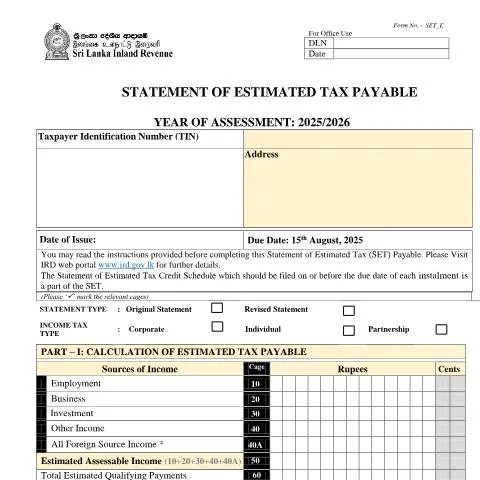
The Statement of Estimated Income Tax Payable, referred to as form SET_E, serves a pivotal role in the tax compliance framework for both individuals and corporations in Sri Lanka. It is crucial for taxpayers to accurately assess their estimated tax liabilities for the year of assessment 2025/2026. This document is not simply a procedural form; it encapsulates your financial standing and anticipated obligations to the government.
The Purpose and Importance of the SET_E Form
The SET_E form is designed to gauge the taxpayer's estimated income tax payable, which is a proactive measure to ensure compliance with the Inland Revenue Act, No.24 of 2017. It is a critical tool that assists the Inland Revenue Department (IRD) in managing fiscal responsibilities effectively.
- Who Needs to Submit? Both corporate entities and individual taxpayers must complete this form if they expect to have tax liabilities within the specified fiscal year.
- When is it Required? The due date for submission is set for the 15th of August, 2025, aligning with the government's fiscal calendar.
Complex Scenarios: Notable Exceptions and Considerations
Special circumstances often arise that may alter the typical process of completing the SET_E form. Here are several scenarios where additional care is required:
1. Foreign Nationals and Income Sources
Foreign nationals earning income in Sri Lanka must declare all relevant income sources, including expatriate income, business revenues, or investments. Specific attention should be paid to the 'All Foreign Source Income' section, where they are required to report this income accurately.
2. Minors and Their Tax Obligations
Minors earning income from investments or business activities are also subject to filing this statement. It is prudent for guardians to understand the tax obligations that apply to unearned income for minors, which may differ from standard tax rates.
3. Complicated Financial Situations
Taxpayers with diverse income streams—such as rental income, dividends, or capital gains—should dissect their earnings meticulously. The form's sections for 'Employment,' 'Business,' 'Investment,' and 'Other Income' must be filled out with precision to avoid discrepancies with the IRD.
Dissecting the Form: A Step-by-Step Approach
Completing the SET_E form requires a detailed understanding of each section. Below, we break down the primary components of the form to elucidate the process:
| Part | Description | Cage |
|---|---|---|
| Employment Income | Report all earnings from employment. | 10 |
| Business Income | Income generated from business activities. | 20 |
| Investment Income | Income derived from investments. | 30 |
| Other Income | Any other forms of income not classified above. | 40 |
| Foreign Source Income | Aggregate income from foreign sources. | 40A |
| Estimated Taxable Income | Calculated as total income minus deductions. | 80 |
| Estimated Tax Payable | Final calculation of tax liability after credits. | 120 |
Navigating the Submission Process
Once the SET_E form is completed, taxpayers have multiple avenues for submission:
- Online Submission: The IRD encourages submissions through its online portal, which provides a streamlined process for e-filing.
- Physical Submission: Alternatively, forms can be submitted at the Central Document Management Unit (CDMU) at the IRD Head Office or any regional office.
It is essential to verify that the form has been submitted before the deadline of August 15, 2025, to avoid penalties associated with late submissions or inaccuracies.
Monitoring Your Submission: What’s Next?
After submission, it’s crucial for taxpayers to track the status of their filings. The IRD allows follow-ups through their online portal or through direct contact with regional offices. Should discrepancies or additional information be required, taxpayers may receive notifications directly.
Key Dates and Deadlines
The timeline for the Statement of Estimated Income Tax Payable is central to ensuring compliance. Here are the salient dates:
Timeline for SET_E for the Assessment Year 2025/2026
| Event | Date |
|---|---|
| Submission Deadline for SET_E | August 15, 2025 |
| Quarterly Payment Deadlines | (TBD based on individual estimates) |
Common Pitfalls and Best Practices for Accurate Filing
While filing, taxpayers should pay attention to common pitfalls that may result in incorrect submissions:
- Inconsistent Income Reporting: Ensure all sources of income are accounted for accurately, as discrepancies can result in penalties.
- Incorrect Calculations: Double-check calculations in the estimated taxable income and tax liability sections.
- Missing Signatures or TIN: Ensure the signed declaration section includes your Taxpayer Identification Number (TIN) to validate the submission.
Taxpayer Profiles: Understanding Your Obligations
The obligations under the SET_E form extend to various taxpayer profiles, each with unique considerations:
1. Corporations
Corporations often have more complex income streams and may require the assistance of an accountant to accurately prepare their estimated tax payable. The declaration must be signed by an authorized officer of the company.
2. Self-employed Individuals
Self-employed individuals need to maintain meticulous records of their earnings and anticipated tax liabilities to ensure compliance. This group often struggles with fluctuating income, making accurate estimations vital.
3. Trusts and Partnerships
Trusts and partnerships must navigate specific legal obligations that affect how their estimated tax is calculated. It is recommended to consult a tax professional to clarify these obligations.
Conclusion: The Importance of Compliance
Filing the Statement of Estimated Income Tax Payable is not merely a bureaucratic requirement; it is an essential part of maintaining transparency and accountability in the fiscal framework of Sri Lanka. Adhering to the guidelines set forth by the IRD will not only facilitate compliance but also foster a culture of responsible financial management. Taxpayers are encouraged to remain vigilant and proactive in meeting their obligations to avoid potential fines or penalties. For further assistance, taxpayers can always access the online resources available at the IRD’s website.
Understanding the Assessment Procedure for Income Tax in Sri Lanka
The process of assessing income tax in Sri Lanka is built upon a structured methodology dictated by the Inland Revenue Department (IRD). Upon submission of your Statement of Estimated Income Tax Payable [Set_E], the IRD undertakes a comprehensive review of your declared income, deductions, and applicable credits.
The assessment procedure begins with the verification of the information provided in your form. It is critical to ensure that all data is accurate and compliant with the prevailing tax regulations. The IRD may require additional documentation to substantiate claims for deductions or exemptions. Common documents may include:
- Proof of income such as bank statements or payslips.
- Receipts for deductible expenses.
- Certificates relating to investment income.
Following the initial review, the IRD will issue an assessment notice indicating the estimated tax liability based on the information provided. This assessment is thus essential for taxpayers wanting to align their financial planning with tax obligations.
Taxpayers should be aware of the rights and obligations under the Income Tax Act. Notably, if a taxpayer disagrees with the assessment, they may appeal within 30 days from the date of the assessment notice. The appeal must be directed to the Commissioner General of Inland Revenue, accompanied by relevant documentation supporting the taxpayer’s position.
The Importance of Accurate Estimation in Tax Planning
Accurate estimation of income tax payable is not merely a statutory requirement; it is a pivotal aspect of effective financial management. Taxpayers who submit a well-calculated Statement of Estimated Income Tax Payable [Set_E] can benefit from several advantages:
- Budgeting: Understanding your tax obligations allows for more effective financial planning and budgeting. By knowing the estimated tax payable, individuals and businesses can allocate resources appropriately, avoiding potential cash flow issues.
- Avoidance of Penalties: Underestimating tax liabilities can lead to significant penalties. If the IRD finds that the actual income exceeds the estimated income by more than 20%, taxpayers may face surcharges and additional interest on unpaid taxes.
- Investment Decisions: Knowledge of tax obligations can influence investment strategies. By understanding the tax implications of gains, citizens can make informed decisions regarding asset allocation and retirement planning.
Moreover, engaging with tax professionals for assistance in preparing the Statement of Estimated Income Tax Payable [Set_E] can further enhance accuracy. Tax consultants can provide insights into allowable deductions and potential tax credits that individuals may not have considered.
Digital Transformation in Tax Administration
The Sri Lankan government has made significant strides in digitalizing tax administration processes, particularly through the implementation of e-services by the ICTA. The introduction of online forms and e-services via the government portal has streamlined the submission process for the Statement of Estimated Income Tax Payable [Set_E]. Taxpayers now have the convenience of submitting their documents electronically, reducing the need to visit tax offices physically.
Utilizing these digital platforms comes with several advantages:
- Efficiency: Electronic submissions are processed faster than traditional paper forms. This means that taxpayers can expect quicker feedback from the IRD regarding their estimated tax liabilities.
- Accessibility: The digital system provides taxpayers with 24/7 access to their tax accounts, allowing for real-time tracking of submissions and payments.
- Environmental Impact: Reducing paper usage aligns with global sustainability goals, contributing to a greener environment.
However, it is essential to keep in mind that with digital submissions, taxpayers must ensure their digital literacy to navigate the systems effectively. The IRD and ICTA provide resources and guidance to assist users in maximizing the benefits of digital forms.