Understanding the Statement of Estimated Income Tax Payable
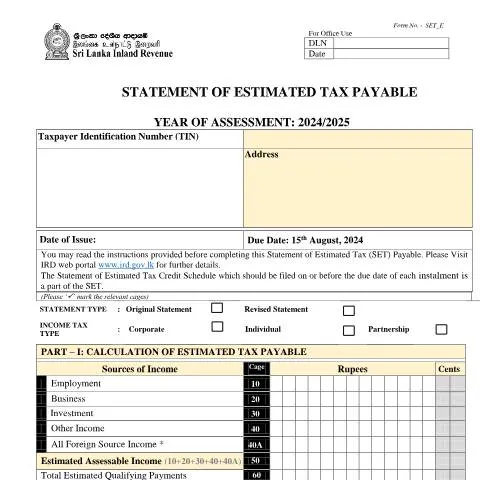
The Statement of Estimated Income Tax Payable, denoted as SET_E, plays a pivotal role in the financial compliance framework of Sri Lanka for the assessment year 2024/2025. It serves as a preemptive declaration of an individual's or entity's expected income tax liability, enabling taxpayers to avoid penalties related to underpayment. Familiarity with this document is essential for both individuals and corporations to navigate the intricacies of the Sri Lankan tax system effectively.
Navigating Key Dates: When to Act
Taxpayers must be acutely aware of the important dates associated with the SET_E filing process. The due date for submission is set for 15th August 2024. This deadline applies to all taxpayers, whether corporate entities or individual taxpayers. Non-compliance can result in significant penalties, making timely submission a critical aspect of tax obligations.
Important milestones include:
- Start of the assessment year: 1st April 2024
- Submission deadline for SET_E: 15th August 2024
- Potential penalties for late submission: Enforced after the due date.
It is advisable to begin preparations well in advance of these dates to ensure all necessary documentation is gathered and calculations are verified.
The Role of the SET_E in Compliance and Tax Planning
The SET_E is not just a formal requirement; it acts as an essential tool for financial planning. By providing an estimate of the tax payable, this form helps individuals and businesses budget for tax liabilities. It sets the stage for calculating quarterly installment payments, known as Advance Personal Income Tax (APIT), which are due throughout the year.
Additionally, the accuracy of this statement can directly affect potential tax credits and deductions. For example, failure to report all sources of income accurately could lead to discrepancies during future audits. The form provides a framework that encourages proactive tax management, reducing the risk of financial penalties and enhancing overall compliance.
Specific Situations and Their Implications
Taxpayers may encounter various scenarios that influence how the SET_E is completed:
- Foreign Residents: Individuals residing outside Sri Lanka but earning income from local sources must ensure they report such income on their SET_E. The form allows for the declaration of foreign-source income which could potentially affect tax liabilities.
- Minors: For taxpayers under the legal age, parental or guardian involvement is mandatory when submitting the form. It is crucial to ensure that any income attributed to minors is calculated accurately.
- Complex Financial Situations: Taxpayers with multiple income sources, investments, or business interests must provide detailed information in specified sections of the SET_E. It may be beneficial to consult with a tax professional to navigate these complexities effectively.
Historical Context: The Regulatory Framework
The regulatory landscape governing the SET_E is entrenched in the Inland Revenue Act, No. 24 of 2017, which stipulates the requirements for income tax declarations in Sri Lanka. This legislative framework aligns with common law principles and emphasizes the necessity for transparency and accuracy in tax reporting.
The establishment of the Statement of Estimated Income Tax Payable underscores the Sri Lankan government's commitment to enhancing tax compliance through structured frameworks that allow taxpayers to fulfill their obligations proactively. The Electronic Transaction Act further facilitates the digital submission of forms, promoting efficiency and accessibility in the tax filing process.
Document Preparation: Ensuring Completeness
To successfully complete the SET_E, taxpayers must gather and verify various pieces of information, including:
- Taxpayer Identification Number (TIN): Essential for identification in all tax-related matters.
- Sources of Income: Detailed enumeration of all income streams including employment, business, and investments.
- Estimated Taxable Income Calculations: Careful calculations are crucial to avoid errors that may lead to penalties.
It is imperative to review the guidelines provided on the form and ensure that all relevant sections are filled out correctly. Any discrepancies or unreported income can lead to severe repercussions during audits by the Inland Revenue Department (IRD).
Step-by-Step Completion of the SET_E
Filling out the SET_E requires methodical attention to detail. Here is a structured approach to completing the form:
- Part I: Calculation of Estimated Tax Payable:
Begin by entering all sources of income in the designated cages:
- Employment income: Cage 10
- Business income: Cage 20
- Investment income: Cage 30
- Other income sources: Cage 40
- Foreign-source income: Cage 40A
The total estimated qualifying payments and reliefs will further guide the calculation of your estimated tax liability.
- Part II: Computation of Estimated Tax Liability:
Here, specify the nature of each activity and assign the estimated taxable income to the appropriate cages while applying the respective tax rates. Accurate calculations are fundamental to arrive at a correct estimated tax liability.
- Part III: Declaration:
Sign and date the declaration, ensuring that all information provided is accurate and truthful. This is a legal affirmation of compliance, and any false statements could incur penalties.
Submission Process: Moving from Preparation to Action
Once completed, the SET_E must be submitted to the Inland Revenue Department. Taxpayers have the option to file through:
- The IRD web portal using E-filing, which simplifies the submission process.
- In-person at the Central Document Management Unit (CDMU) located at the IRD Head Office, or at any IRD Regional Office.
It’s essential to ensure that the submission is made prior to the deadline to avoid any penalties associated with late filings. Failure to submit can lead to adverse outcomes, including the imposition of fines and interest on unpaid taxes.
Consequences of Non-compliance and the Importance of Accuracy
Adhering to the filing requirements of the SET_E is not merely a bureaucratic obligation; it is fundamental to maintaining one's standing with the tax authorities. Non-compliance can lead to:
- Financial penalties for late submission or inaccurate declarations.
- Legal repercussions, potentially including assessments for additional taxes owed.
- Increased scrutiny in future tax filings, putting taxpayers at risk for audits.
Therefore, thoroughness and precision in both the completion and submission of the SET_E are paramount to safeguarding against potential setbacks related to tax compliance.
Considerations for Tax Professionals and Approved Accountants
For taxpayers who engage approved accountants or tax professionals in preparing their SET_E, it is essential to ensure clear communication regarding all income sources and expected tax liabilities. These professionals play a critical role in:
- Ensuring compliance with current tax laws and regulations.
- Providing strategic advice on tax minimization and potential credits.
- Representing the taxpayer in interactions with the Inland Revenue Department if necessary.
Any additional documentation prepared by such professionals must be attached to the SET_E, and the declaration must reflect their involvement accurately.
Understanding the Statement of Estimated Income Tax Payable (SET_E) in Sri Lanka
The Statement of Estimated Income Tax Payable, commonly referred to as SET_E, is a crucial document for individuals and entities in Sri Lanka responsible for income tax obligations. This statement serves as a declaration of the estimated income tax liability for the current assessment year, facilitating tax planning and compliance with local regulations. Understanding the intricacies of SET_E is essential for taxpayers to ensure accurate reporting and to avoid penalties associated with underreporting or late payments.
The requirement to submit a SET_E is mandated by the Sri Lanka Department of Inland Revenue (IRD). Taxpayers must assess their expected income for the year and calculate the corresponding tax liability based on prevailing tax rates. This document is not only fundamental for individual taxpayers but also for businesses, as it helps them manage cash flow and allocate resources effectively.
Key Components of the SET_E
The SET_E comprises several critical elements that taxpayers need to accurately complete to reflect their financial status. These include:
- Estimated Gross Income: Taxpayers must provide a detailed estimate of their expected gross income. This includes salaries, business income, rental income, and any other sources of income that contribute to the total.
- Exemptions and Deductions: Taxpayers are allowed to deduct certain expenses related to their income-generating activities. Understanding the categories of allowable deductions, such as professional fees, investment expenses, and charitable donations, is vital.
- Applicable Tax Rates: Sri Lanka employs a progressive tax rate system. Taxpayers must apply the correct rates to their taxable income after deducting exemptions and allowances. Being familiar with the current tax brackets is essential to accurately calculate the expected tax liability.
- Installment Payments: Depending on the estimated tax liability, taxpayers may be required to make advance payments in installments throughout the year. It is crucial to track these payments to avoid underpayment penalties.
Completing the SET_E accurately requires careful consideration of these components, as any discrepancies can lead to significant complications, including audits or legal repercussions.
Filing Procedures and Deadlines for SET_E
Filing the SET_E involves a structured procedure that taxpayers must adhere to, ensuring compliance with the requirements set forth by the IRD. The process typically includes the following steps:
- Preparation: Taxpayers should compile all necessary financial data, including income statements, expense receipts, and prior tax returns. This preparatory work is essential for accurate estimation.
- Completion of the Form: The SET_E can be completed online via the official e-tax services portal or submitted in person at the local IRD office. It is advisable to utilize digital services for convenience and to ensure that records are automatically saved.
- Submission: The completed SET_E must be filed by the designated deadline, typically within the first quarter of the financial year. Missing this deadline can result in penalties or interest on unpaid taxes.
- Confirmation: After submission, taxpayers should obtain a confirmation receipt. This serves as proof of filing and is crucial for any future references or disputes.
Failing to meet deadlines can have significant financial repercussions, including fines and additional tax liabilities. Thus, taxpayers must remain vigilant and ensure timely compliance with all filing requirements.
Common Mistakes to Avoid When Filing the SET_E
While preparing the Statement of Estimated Income Tax Payable, certain common pitfalls can lead to inaccuracies and potential penalties. Taxpayers should be aware of these issues to avoid complications:
- Underestimating Income: One of the most frequent errors occurs when individuals or businesses underestimate their income. This can lead to insufficient tax payments and subsequent penalties. It is recommended to consider historical income trends and economic conditions while making estimates.
- Neglecting Deductions: Many taxpayers overlook eligible deductions, resulting in a higher taxable income than necessary. A comprehensive review of possible deductions should be conducted to maximize tax efficiency.
- Incorrect Implementation of Tax Rates: Applying incorrect tax rates is another common mistake that could lead to miscalculated tax liabilities. Taxpayers should ensure they are using the latest tax rates and brackets as published by the IRD.
- Failure to Maintain Documentation: Maintaining proper records of income and expenses is crucial. In the event of an audit, lack of documentation can result in denied deductions or additional tax liabilities.
By avoiding these pitfalls, taxpayers can ensure a smoother filing process and reduce the risk of penalties associated with their estimated income tax obligations.