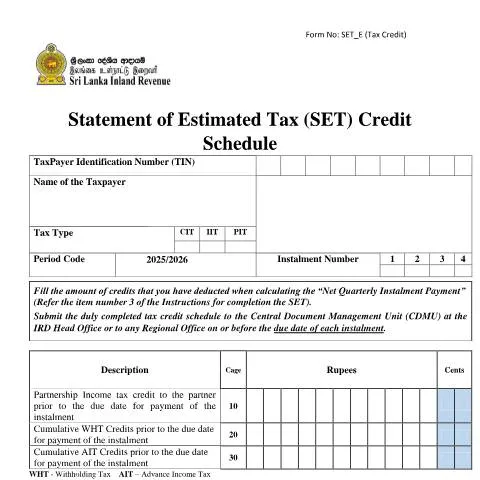
Understanding the Statement of Estimated Tax (SET) - Credit Schedule
Every year, businesses and individuals in Sri Lanka are faced with the task of complying with various tax requirements. One such critical document in this landscape is the Statement of Estimated Tax (SET) Credit Schedule. This essential form plays a pivotal role in managing tax liabilities, particularly concerning estimated income taxes for the Year of Assessment 2025/2026. For taxpayers, understanding this document's intricacies can significantly impact their financial planning and compliance strategy.
Navigating the Tax Landscape: Who Should File the SET Credit Schedule?
The SET Credit Schedule is not a one-size-fits-all document; instead, it applies to various taxpayer profiles, including:
- Companies: Entities operating under Corporate Income Tax (CIT) regulations must accurately report their estimated tax credits.
- Individuals: Those subject to Individual Income Tax (IIT) and Partnership Income Tax (PIT) will also have to file this schedule.
- Partners in Partnerships: Each partner must account for their share of the partnership's income tax credit.
Understanding one’s taxpayer identification number (TIN) is critical for all parties involved, as it ensures accurate filing and correspondence with the Inland Revenue Department (IRD).
Decoding the Sections of the SET Credit Schedule
The SET Credit Schedule consists of several sections, each requiring meticulous attention. Here’s a breakdown of the essential components:
- Taxpayer Identification Number (TIN): This unique number identifies the taxpayer and must be filled in accurately.
- Name of the Taxpayer: The full legal name of the individual or entity filing the schedule.
- Tax Type: This section specifies whether the taxpayer is under CIT, IIT, or PIT.
- Period Code: Indicating the assessment year, in this case, 2025/2026, is crucial for accurate processing.
- Instalment Number: Taxpayers must indicate the relevant instalment number, which can range from 1 to 4.
- Credit Amounts: Taxpayers should detail the amounts of credits accumulated prior to each instalment's due date.
Moreover, failing to complete these sections correctly can lead to delays or complications with one’s tax obligations.
Submission Process: Charting the Path to Compliance
Once the SET Credit Schedule is filled out, submission can be made either online or in-person, making it crucial for taxpayers to understand their options:
- Online Submission: Taxpayers can streamline their process by submitting the form through the forms.gov.lk portal, which supports electronic filing as per the Electronic Transaction Act.
- In-Person Submission: Alternatively, you can submit the completed form at the Central Document Management Unit (CDMU) at the IRD Head Office or at any Regional Office. It is vital to ensure that the document reaches the designated office before the due date of each instalment.
Submission Deadlines and Importance
The deadlines for submitting the SET Credit Schedule are critical. Missing these deadlines could lead to penalties or interest charges. It is advisable to mark these dates on your calendar to ensure compliance.
Common Scenarios: Special Cases and Exceptions
While the submission of the SET Credit Schedule may seem straightforward, special circumstances can complicate matters:
- Foreign Tax Residents: Taxpayers who are not Sri Lankan residents may have different obligations and may need additional documentation to validate their tax status.
- Minors and Dependents: In cases where minors are involved, guardians must file on their behalf, taking care to provide necessary identification and documentation.
- Complex Tax Situations: Taxpayers with diverse income sources or ongoing audits may face unique challenges in accurately reporting and calculating their estimated taxes.
The Ripple Effect of Delays: Consequences of Non-Compliance
Understanding the ramifications of neglecting to file the SET Credit Schedule on time is crucial for all taxpayers:
- Financial Penalties: Late submissions can incur substantial fines, which compound over time.
- Interest Charges: Taxpayers may also face accumulating interest on unpaid taxes if deadlines are missed.
- Legal Complications: Persistent non-compliance may result in legal action from the IRD.
Thus, ensuring timely and accurate submissions protects taxpayers from unnecessary financial strain.
Handling Errors: What to Do If Things Go Awry
If a taxpayer discovers an error after submission, immediate action is required to rectify the situation:
- Contact the IRD: Reach out to the relevant department at the IRD as soon as the error is identified.
- Submit Revised Documents: If necessary, file an amended SET Credit Schedule to correct any inaccuracies.
- Document All Correspondence: Maintain a record of all communications regarding the issue to protect yourself should disputes arise in the future.
Taxpayer Rights and Responsibilities: A Balancing Act
Filing the SET Credit Schedule is not merely an obligation; it also comes with significant taxpayer rights:
- Right to Receive Assistance: Taxpayers have the right to seek help from the IRD or consult with financial advisors to ensure compliance.
- Right to Challenge Decisions: If a taxpayer believes they have been treated unjustly, they may appeal IRD decisions through the appropriate channels.
- Responsibility to Maintain Records: Taxpayers must keep thorough and accurate records of their income and credits, which aids in future filings and compliance efforts.
Resources for Effective Tax Management
To ensure smooth compliance and efficient tax management, various resources are available:
- IRD Website: The official IRD website provides up-to-date information on tax regulations and forms.
- Tax Consultants: Hiring a tax professional can offer tailored advice and support through complex tax situations.
- Workshops and Seminars: The IRD and other organizations occasionally host sessions to educate taxpayers on their obligations and rights.
The Role of the SET Credit Schedule in the Broader Tax Framework
Understanding the role of the SET Credit Schedule within the larger context of Sri Lanka's tax framework is essential. This document not only helps taxpayers manage their estimated tax obligations but also contributes to the country’s fiscal health.
By accurately reporting and paying estimated taxes, taxpayers ensure that the government has the necessary resources to fund public services and infrastructure. This creates a symbiotic relationship between taxpayers and the government.
Conclusion: Taking Charge of Your Tax Obligations
The Statement of Estimated Tax (SET) Credit Schedule is more than just a form; it is a vital tool that enables taxpayers in Sri Lanka to responsibly manage their tax obligations. By understanding the nuances of this schedule, from completion to submission and beyond, individuals and organizations can navigate the complexities of taxation with confidence and clarity.
Understanding the Components of the Statement of Estimated Tax (SET)
The Statement of Estimated Tax (SET) in Sri Lanka is a crucial document for both individual taxpayers and corporations, as it outlines the estimated tax liabilities for the upcoming assessment year. Understanding its components is essential for accurate filing and compliance. The SET consists of several key elements, including:
- Estimated Income: The projected income for the assessment year, which must be based on realistic forecasts. Taxpayers are encouraged to consider their income from various sources, including salaries, investments, and business revenues.
- Applicable Tax Rate: The tax rate applicable to the estimated income, which varies based on whether the taxpayer is an individual or a corporation, and can also change depending on specific allowances and deductions applicable to the taxpayer's profile.
- Tax Credits and Deductions: Any eligible deductions or credits that may reduce the overall tax liability. This can include deductions for specific expenses, contributions to pension schemes, and other allowable deductions as outlined by the Department of Income Tax.
- Payment Schedule: The SET will provide an overview of when estimated tax payments are due, typically in quarterly installments, ensuring that taxpayers are aware of their payment obligations throughout the fiscal year.
By breaking down these components, taxpayers are empowered to make informed decisions regarding their financial planning, ensuring they set aside appropriate funds for tax liabilities as they arise.
Common Mistakes to Avoid When Submitting the SET
The preparation and submission of the Statement of Estimated Tax can be a daunting task for many taxpayers in Sri Lanka. To ensure compliance and avoid penalties, it is important to be aware of the common mistakes that can occur during this process. Here are several pitfalls to be cautious of:
- Inaccurate Income Projections: One of the most frequent errors is the underestimation or overestimation of projected income. It is critical to base projections on realistic figures derived from past performance as well as any expected changes in income streams.
- Omitting Eligible Deductions: Taxpayers often fail to take advantage of allowable deductions. Familiarizing oneself with the range of deductions available can significantly reduce tax liabilities, making it essential to review all potential claims before submission.
- Incorrect Payment Schedules: Misunderstanding the due dates for estimated tax payments can lead to penalties. Taxpayers should maintain a calendar of all deadlines outlined in the SET and ensure timely payments are made to avoid late fees.
- Neglecting Changes in Tax Legislation: The tax landscape in Sri Lanka can shift due to new regulations or amendments to existing laws. It is advisable to stay updated with any changes that may impact the estimated tax calculations.
Taxpayers can benefit from consulting with tax professionals or utilizing the resources available through the Department of Inland Revenue to ensure accuracy and compliance with the SET submission.
The Role of the Department of Inland Revenue in the Tax Estimation Process
The Department of Inland Revenue (DIR) plays a pivotal role in guiding taxpayers through the complexities of the Statement of Estimated Tax process. As the primary authority responsible for tax administration in Sri Lanka, the DIR provides a range of services and resources that can assist taxpayers in their compliance obligations:
- Guidance and Resources: The DIR offers comprehensive guidelines, FAQs, and downloadable resources on their official website, enabling taxpayers to better understand the requirements and processes associated with the SET.
- Online Submission: With the implementation of digital government initiatives, taxpayers can submit their SET electronically through the DIR's online portal. This not only streamlines the process but also allows for quicker feedback and processing times.
- Workshops and Seminars: The DIR frequently conducts educational workshops and seminars aimed at informing taxpayers about their rights and responsibilities. These sessions are invaluable for both new and existing taxpayers seeking clarity on tax regulations.
- Assistance with Disputes: In the case of disagreements regarding estimated tax liabilities, the DIR provides mechanisms for appeals and dispute resolution, ensuring taxpayers have access to fairness in the process.
Through these efforts, the DIR not only facilitates compliance but also fosters a culture of tax responsibility and transparency within the Sri Lankan economy.