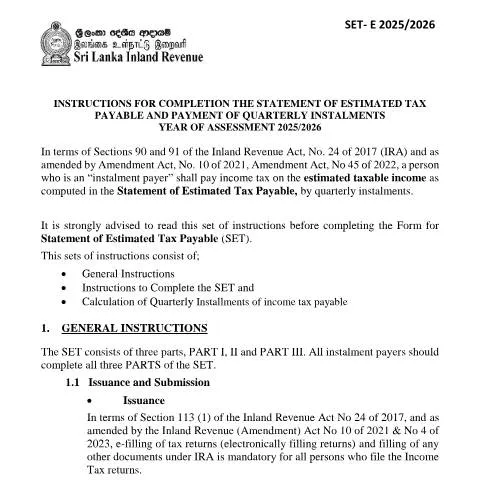
Understanding the Statement of Estimated Income Tax Payable: A Comprehensive Guide
As individuals and businesses navigate through their financial responsibilities, comprehending the Statement of Estimated Income Tax Payable is essential, particularly for the Year of Assessment 2025/2026. This document serves as a crucial roadmap for taxpayers who are classified as "instalment payers," delineating their obligations pertaining to quarterly tax instalments based on their estimated taxable income.
Decoding the Purpose and Structure of the Document
The Statement of Estimated Income Tax Payable is not merely a form but a detailed guide that outlines how taxpayers should compute their income tax liability and remit payments across four quarterly instalments. This document is segmented into three primary parts that facilitate the calculation and payment process.
Part I: General Instructions
- All instalment payers must fill out all three parts of the SET.
- Submission of the SET is mandatory and must be conducted electronically via the Inland Revenue Department (IRD) web portal.
- Taxpayers with an estimated assessable income exceeding Rs. 1,800,000 are particularly urged to obtain and complete the SET.
Part II: Detailed Instructions for Completion
This section provides critical guidance on accurately completing the SET, ensuring that each component aligns with the taxpayer's income sources, whether local or foreign. Notably, taxpayers must identify their tax type—individual or corporate—before proceeding.
Essential Steps for Tax Calculation and Instalment Payments
Following the guidelines established in the initial sections, it's crucial for taxpayers to follow a systematic approach to accurately determine their estimated tax payable and comply with payment schedules.
Quarterly Instalment Due Dates
| Instalment | Due Date | Payment Period Code |
|---|---|---|
| First Instalment | 15th August 2025 | 25261 |
| Second Instalment | 15th November 2025 | 25262 |
| Third Instalment | 15th February 2026 | 25263 |
| Fourth Instalment | 15th May 2026 | 25264 |
Utilizing Online Payment Platforms
The IRD facilitates payments through various channels, including an Online Tax Payments Platform (OTPP). Taxpayers are encouraged to leverage digital solutions for efficiency and record-keeping. Access to detailed user guides on the payment processes is available via the IRD’s web portal, ensuring taxpayers can navigate the system smoothly.
Key Concepts to Grasp for Accurate Reporting
Several pivotal concepts underpin the estimated tax calculation process. Understanding these elements will enhance taxpayers' ability to submit accurate statements and avoid potential pitfalls.
Income Types and Their Implications
- Local Income: Taxpayers must report all estimated income derived from local sources, ensuring that they capture all potential revenues.
- Foreign Income: Aggregating foreign income from various sources, such as employment or investments, is necessary for a complete financial picture.
Estimating Assessable Income
The aggregation of both local and foreign income is critical in determining the estimated assessable income. Taxpayers must remember to exclude final withholding payments and exempt amounts from this calculation, as these figures do not contribute to the taxable base.
When and Why to Utilize a Revised Statement
In certain circumstances, it may become necessary to submit a revised Statement of Estimated Tax Payable. This can occur due to fluctuations in income or changes in financial circumstances that affect estimated tax liability.
Indicators for Submitting a Revised Statement
- Notable increases or decreases in projected income.
- Changes in business operations that impact revenue streams.
- Adjustments due to significant one-time earnings or investment gains.
Submission Process for Revised Statements
When submitting a revised statement, it’s imperative to mark the appropriate box indicating that it is a “Revised Statement.” This clarity ensures that the IRD can accurately process the update and adjust any future instalment payments accordingly.
Engaging with Authorities and Additional Resources
Taxpayers who encounter complexities or have queries regarding their tax obligations should not hesitate to reach out to the IRD. Various avenues exist for obtaining assistance, from digital resources on the IRD website to direct communication with customer service representatives.
Key Contacts and Resources
- Visit the IRD website for e-filing and payment guidelines.
- Contact the Customer Supporting and Promotion Unit at the IRD for inquiries about the SET.
Acknowledging Limitations and Responsibilities
While the Statement of Estimated Income Tax Payable outlines crucial duties for taxpayers, it is equally important to understand the limitations and responsibilities that come with it. Taxpayers are expected to maintain accurate records of their income and expenses, ensuring that all filings are truthful and submitted in a timely manner.
The Importance of Diligence and Compliance
Remaining diligent in financial reporting not only aids in fulfilling legal obligations but also fosters a transparent relationship with tax authorities. Non-compliance can result in penalties, interest, and potential legal repercussions, making adherence to outlined processes and deadlines paramount.
In summary, understanding the intricacies of the Statement of Estimated Income Tax Payable is imperative for taxpayers in Sri Lanka for the Year of Assessment 2025/2026. By following the established guidelines, engaging with available resources, and remaining proactive in their financial management, taxpayers can effectively navigate their tax responsibilities.
Understanding the Components of the Statement of Estimated Tax Payable
The Statement of Estimated Tax Payable (SET) form is a comprehensive document that requires meticulous attention to detail. To accurately complete the SET, you must understand its key components. This form typically includes sections such as:
- Personal Information: Fill in your National Identity Card (NIC) number, name, address, and contact information. Ensure that the name matches exactly as it appears on your NIC.
- Estimated Income: This section requires you to estimate your total income for the financial year. Include all sources of income such as salary, business profits, rental income, and any other relevant earnings. Be prepared to justify your estimations with supporting documents if required.
- Allowable Deductions: List any deductions you are eligible for, including contributions to registered pension schemes and allowable business expenses. It is vital to stay updated on the current tax laws to maximize your allowable deductions.
- Tax Calculation: After inputting your estimated income and deductions, calculate your estimated tax liability based on the applicable tax rates. Familiarize yourself with the current tax brackets and rates set by the Department of Inland Revenue (DIR) for the relevant financial year.
- Quarterly Instalment Payment Schedule: The SET also includes a section to indicate your preferred schedule for quarterly payments. Understanding the deadlines for each instalment is crucial to avoid potential penalties.
It is advisable to consult with a tax professional or refer to the latest guidelines from the DIR to ensure compliance with current taxation regulations.
Common Challenges and How to Overcome Them When Completing the SET
Completing the Statement of Estimated Tax Payable can present several challenges, particularly for those unfamiliar with tax regulations. Here are some common issues and strategies to mitigate them:
- Estimating Income Accurately: One of the primary challenges is estimating future income, especially if it fluctuates significantly. To overcome this, review your income from previous years and consider any changes that may affect your earnings, such as new contracts or changes in employment.
- Understanding Deductions: Many taxpayers miss out on allowable deductions simply because they are unaware of them. Make sure to conduct thorough research or seek guidance from a tax consultant to identify all eligible deductions that apply to your situation.
- Incorrect Calculations: Errors in mathematical calculations can lead to inaccuracies in your estimated tax liability. Utilize online calculators provided by the DIR or employ accounting software to ensure accuracy. Double-check your figures before submission to avoid any discrepancies.
- Meeting Deadlines: Failure to submit your SET form or make quarterly payments on time can incur penalties. To avoid this, maintain a calendar with important tax deadlines and set reminders well in advance. The fiscal calendar for Sri Lanka generally runs from April 1 to March 31, which should be noted for future reference.
By being proactive and aware of these challenges, you can streamline the completion of your Statement of Estimated Tax Payable and mitigate any potential issues.
The Importance of Professional Advice in Tax Planning
While the SET form can be completed independently, engaging a tax advisor can provide invaluable assistance in ensuring compliance and optimizing your tax strategy. Here are several reasons why professional advice is essential:
- Expertise in Current Tax Laws: Tax regulations are subject to frequent changes. A qualified tax consultant will be updated on the latest laws and can offer insights into how these changes may impact your tax situation.
- Strategic Tax Planning: A tax advisor can help you develop a comprehensive tax planning strategy, allowing you to legally minimize your tax liabilities through effective planning and utilization of available deductions and credits.
- Time and Stress Management: Completing the SET and managing your tax obligations can be time-consuming and stressful. A professional can take this burden off your shoulders, allowing you to focus on other areas of your life or business.
- Representation in Case of Audits: In the unfortunate event of a tax audit, having a knowledgeable advisor to represent you can make a significant difference. They will be equipped to handle inquiries and ensure that your interests are protected.
While there is a cost associated with hiring a tax consultant, the potential savings and peace of mind they provide can outweigh the initial investment. Engaging in professional advice is a proactive step towards effective tax management and compliance.