Navigating the Statement of Estimated Tax: A Pragmatic Approach
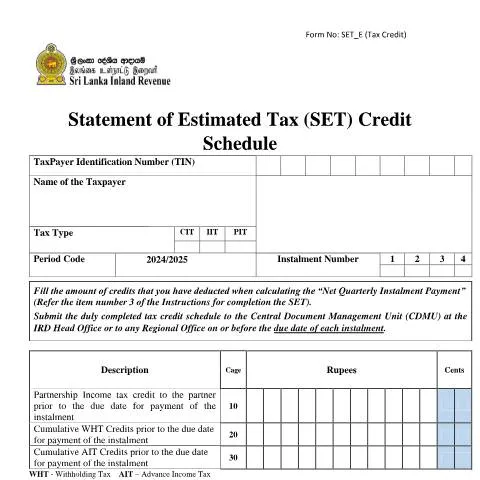
The Statement of Estimated Tax (SET) Credit Schedule, designated as SET_E, represents a pivotal component in the administrative landscape of Sri Lanka's income tax system. For the Year of Assessment 2024/2025, understanding the nuances of this document is crucial not just for compliance, but for optimizing your tax obligations and benefits. As taxpayers prepare their estimates, grasping the essential elements of this form can significantly influence the financial outcomes for individuals and businesses alike.
Unpacking the Taxpayer's Identification: Who Needs This Document?
The requirements for the Statement of Estimated Income Tax Payable extend beyond mere individuals; they encompass a diverse array of taxpayers including:
- Resident Individuals: Those earning income within Sri Lanka or from sources outside the country.
- Corporations: Entities liable for Corporate Income Tax (CIT).
- Partnerships: Taxpayers representing multiple stakeholders in business operations.
- Non-Residents: Foreign nationals owing tax obligations in Sri Lanka based on their income sources.
Each taxpayer must possess a Taxpayer Identification Number (TIN), serving as an integral step in completing the SET Credit Schedule accurately. Without this identifier, the submission can encounter significant hurdles.
Establishing Compliance: The Regulatory Framework Behind the SET
The necessity of the SET arises from the Income Tax Ordinance and the principles outlined within Sri Lanka’s tax regime. The Electronic Transaction Act further supports the shift towards digital processing of tax documents, facilitating taxpayers' interactions with the tax authorities through platforms such as forms.gov.lk.
The SET Credit Schedule specifically aligns with the government’s push for enhanced efficiency in tax collection and management. By mandating taxpayers to estimate their income tax liabilities, the government ensures a steady cash flow while providing taxpayers the opportunity to manage their financial responsibilities effectively.
Detailed Breakdown: Filling Out the SET Credit Schedule
Completing the SET Credit Schedule requires methodical attention to detail. Below are the key sections of the form and insights into common pitfalls:
| Field | Description | Common Mistakes |
|---|---|---|
| Taxpayer Identification Number (TIN) | Your unique identifier for tax purposes. | Entering an incorrect TIN can lead to processing delays. |
| Name of the Taxpayer | The legal name as registered with the tax authorities. | Misspelling can cause discrepancies in records. |
| Tax Type | Select either CIT, IIT, or PIT as applicable. | Incorrect selection may result in improper tax calculations. |
| Period Code | This should reflect the assessment year, i.e., 2024/2025. | Omitting or misidentifying the period can invalidate submissions. |
| Instalment Number | Indicate the appropriate instalment. | Failing to track which instalment you are completing can lead to confusion. |
Every section requires attention, and when filling out the Tax Credit portion, taxpayers should ensure they refer to the item number 3 of the completion instructions to correctly calculate their “Net Quarterly Instalment Payment.”
Key Dates and Submission Protocols: Staying on Track
Timeliness is paramount in the submission of the SET Credit Schedule. Each instalment must be submitted to the Central Document Management Unit (CDMU) at the IRD Head Office or any Regional Office before the specified due date of each instalment. Typically, these dates align with the quarterly tax payment schedule, which is structured as follows:
- First Instalment: Due by the end of May.
- Second Instalment: Due by the end of August.
- Third Instalment: Due by the end of November.
- Fourth Instalment: Due by the end of February.
Failure to meet these deadlines can incur penalties, including interest on overdue amounts, which underlines the importance of a proactive approach to tax management.
Understanding the Consequences: What Happens If You Forget?
The implications of neglecting to submit the SET Credit Schedule are significant. Taxpayers may face:
- Financial Penalties: Fines may accumulate, increasing the total amount owed.
- Legal Repercussions: Continuous non-compliance can lead to legal actions by the tax authorities.
- Loss of Tax Credits: Failing to submit on time means missing out on potential tax credits, which can enhance your financial burden.
Thus, understanding the stakes involved in this process is essential for all taxpayers.
Strategies for Efficient Tax Planning: Beyond the SET
The SET Credit Schedule is not an isolated form but rather part of a broader tax compliance framework. Taxpayers are encouraged to consider their entire financial situation when preparing their SET. Here are a few strategies:
- Annual Tax Planning: Review your income, expenses, and potential tax liabilities annually to estimate your SET more accurately.
- Seek Professional Advice: Engaging a tax consultant can provide personalized insights that enhance your tax strategy.
- Utilize Digital Tools: Take advantage of online tax calculators or resources available through the IRD's digitized platforms for better accuracy.
These strategies not only assist in completing the SET but also promote a more comprehensive understanding of one’s tax responsibilities.
Addressing Unique Scenarios: Special Cases in Tax Filing
Taxpayers may encounter unique circumstances that can complicate their filing of the SET Credit Schedule. Notable exceptions include:
- Foreign Nationals: Different rules may apply regarding tax credits and liabilities, particularly for non-resident taxpayers.
- Minors: Special considerations and possibly guardianship requirements must be adhered to for tax filings.
- Business Partnerships: In cases of partnerships, each partner must be diligent in their individual filings while considering shared credits.
Each of these scenarios warrants careful evaluation to ensure compliance and accuracy.
Practical Tools and Resources for Effective Submission
The IRD provides various resources to assist taxpayers in navigating their obligations. Some recommended tools include:
- Official IRD Website: Contains the latest updates on tax policies, deadlines, and forms.
- Guidance Documents: The IRD often releases guides that elucidate the completion of forms and general tax obligations.
- Workshops and Webinars: Participating in these educational opportunities can offer clarity and enhance understanding.
Employing these resources can significantly reduce the complexity associated with tax compliance.
Keeping Track of Your Submission: Follow-Up Procedures
After the SET Credit Schedule is submitted, maintaining a record of the submission is critical. Taxpayers should:
- Request Confirmation: Always seek a confirmation receipt upon submission to verify that your documents have been received.
- Monitor Your TIN: Regularly check your tax status using your TIN on the IRD’s online portal to ensure that your submission has been processed.
- Direct Communication: If no confirmation is received, or if there are discrepancies noted, proactively reach out to the IRD for clarification.
These follow-up steps ensure that taxpayers remain informed and can address any issues that may arise promptly.
Conclusion: Empowering Yourself with Knowledge About SET
The Statement of Estimated Tax Credit Schedule serves as a cornerstone for effective tax management in Sri Lanka’s complex financial landscape. By understanding the intricacies of this form, taxpayers can navigate their obligations with confidence, ultimately fostering better financial health and compliance.
Understanding the Statement of Estimated Tax (SET) in Sri Lanka
The Statement of Estimated Tax (SET) is a crucial document for taxpayers in Sri Lanka, particularly for those engaged in business activities or who expect to have a taxable income. This document helps taxpayers calculate their estimated tax liability for the upcoming financial year based on anticipated income. It is particularly important for businesses that are required to prepay a portion of their income tax liability. The SET ensures that taxpayers remain compliant with the requirements set forth by the Inland Revenue Department (IRD).
The process begins with taxpayers estimating their income for the year, considering any anticipated fluctuations in revenue due to market conditions or operational changes. It is advisable for taxpayers to review previous years’ tax returns and financial statements to create an accurate estimate. The completed SET must be submitted to the IRD along with any required payments by the specified deadline, usually the last day of the month following the end of each quarter.
Taxpayers must also provide specific details about their income sources, including profits from business activities, dividends, and other revenue streams. This level of transparency is designed to ensure that taxpayers are accurately reporting their income and paying their fair share of taxes. The IRD has made significant efforts to streamline this process through the use of digital platforms, allowing taxpayers to complete and submit their SET electronically through the official website.
Credit Schedule Overview - SET_E (Tax Credit)
The Credit Schedule, specifically the SET_E (Tax Credit), is an essential component of the SET process. This schedule allows taxpayers to claim various tax credits they are entitled to, which can significantly reduce their overall tax liability. The credits available can vary based on several factors, including the nature of the business, investments made during the financial year, and any specific incentives offered by the government.
Some common tax credits include those for capital investments in certain sectors, research and development expenditures, and credits for taxes paid to foreign jurisdictions. Taxpayers should carefully document all expenses and investments that qualify for tax credits, as the IRD may request supporting documentation during audits or reviews. This documentation must be organized and readily accessible to facilitate any inquiries from the IRD.
The Credit Schedule must be completed accurately and submitted alongside the SET. Failure to include eligible credits can lead to an unnecessarily high tax bill, while incorrectly claiming credits can result in penalties. Thus, taxpayers are encouraged to seek the assistance of a qualified tax consultant if they are unsure about their eligibility for specific credits or how to document them properly.
Furthermore, taxpayers must be aware of any changes to tax credit regulations that may occur during the fiscal year. The IRD regularly updates its guidelines, and it is essential for taxpayers to stay informed to maximize their potential savings.
Common Pitfalls to Avoid When Filing the SET
Filing the Statement of Estimated Tax (SET) can be a complex process, and it is essential for taxpayers to be aware of common pitfalls that could lead to penalties or tax liabilities. One of the most frequent issues is the underestimation of expected income, which can lead to insufficient tax payments throughout the year. Taxpayers are encouraged to perform a thorough analysis of their financial situation and consider any potential changes that might affect their income.
Another common pitfall is failing to keep accurate records of income and expenses. Effective record-keeping is vital for supporting the figures reported in the SET. Taxpayers should maintain organized financial records, and keep receipts and documentation for all income sources and deductions. Inadequate record-keeping can complicate the filing process and pose challenges in the event of an audit.
Taxpayers should also be aware of the deadlines associated with the SET. Missing a deadline can result in penalties and interest on unpaid taxes. To avoid this, it is advisable for taxpayers to create a tax calendar that tracks all important dates, including the due date for the SET and the deadlines for any associated payments.
Lastly, taxpayers should not overlook the importance of reviewing their SET before submission. Errors in calculations, incorrect personal information, or missing signatures can result in delays or rejections by the IRD. It is always prudent to double-check all entries and ensure compliance with the latest tax regulations.