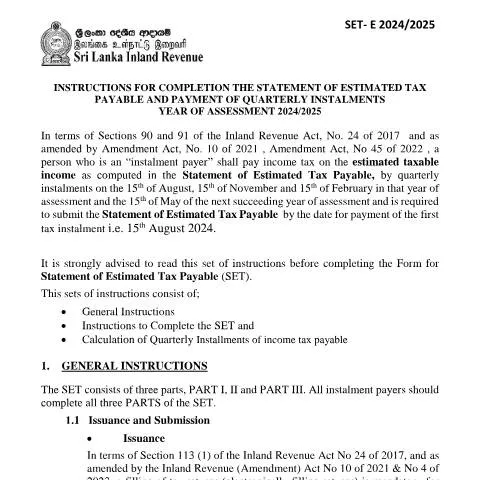
Unveiling the Statement of Estimated Income Tax Payable for 2024/2025
In the realm of taxation in Sri Lanka, understanding the nuances of income tax obligations is crucial for both individual taxpayers and corporate entities. The Statement of Estimated Income Tax Payable, coded as SET_24_25, emerges as an essential document in this process, providing detailed instructions on how to estimate tax liabilities and make quarterly payments. This guide not only streamlines compliance but also aids taxpayers in avoiding pitfalls associated with income tax estimation.
Bridging the Gap: The Interplay with Other Tax Documents
The SET document does not exist in isolation; it intertwines with several other tax-related documents and regulations. Notably, the Inland Revenue Act, No. 24 of 2017 serves as the legal framework governing income tax in Sri Lanka. Amendments, such as the Amendment Act, No. 10 of 2021 and No. 45 of 2022, further refine the parameters within which taxpayers must operate.
Taxpayers classified as “instalment payers” are mandated to adhere to quarterly payment schedules, as specified in the SET document. The due dates for these payments are as follows:
| Tax Instalment | Due Date | Period Code |
|---|---|---|
| First Instalment | 15th August 2024 | 24251 |
| Second Instalment | 15th November 2024 | 24252 |
| Third Instalment | 15th February 2025 | 24253 |
| Fourth Instalment | 15th May 2025 | 24254 |
Understanding this interplay is vital for effective tax management, as missing these deadlines can lead to penalties and interest on unpaid amounts. Moreover, the Electronic Transaction Act facilitates the digital filing of tax documents, further enhancing accessibility and efficiency.
Step-by-Step Utilisation of the SET Document
Utilising the SET effectively requires a structured approach. Here’s a practical breakdown of how to navigate the document and implement its directives:
- Familiarisation with the Document: Before proceeding with estimations, thoroughly read the instructions. Understanding the sections and requirements is fundamental.
- Gather Required Information: Collect necessary documentation relating to your income sources, including local and foreign income details. This will form the basis of your estimations.
- Complete All Parts: The SET comprises three parts (PART I, II, and III). Ensure all sections are filled accurately, as incomplete submissions can lead to complications.
- Choose Between Original and Revised Statement: Indicate whether the submission is an original estimate or a revised one. A revised estimate must be marked clearly if changes occur in your income projections.
- Calculate Total Estimated Income: Sum local income and any foreign income to derive your total estimated assessable income. This is crucial for determining the appropriate tax liability.
- Payment Preparation: Prepare to make payments as outlined in the document. Utilize the additional payment methods provided, such as online platforms or bank drafts.
- Submission: Submit the completed SET via the recommended channels, whether electronically or via postal service, to ensure compliance with submission deadlines.
Understanding Coverage and Limitations
The SET outlines specific obligations for those classified as "instalment payers," which typically includes individuals or entities with an estimated assessable income exceeding LKR 1,200,000. However, clarity regarding the limitations of this document is equally important.
Taxpayers should be aware that the SET primarily serves to estimate tax liabilities based on projected income; it does not encompass all possible deductions or exemptions available under the law. For instance, taxpayers must separately consider any qualifying deductions such as investment allowances or business expenses, which may not be reflected in the initial estimation.
Furthermore, entities must maintain accurate records and documentation to substantiate their income claims and deductions. Failure to do so can result in additional scrutiny from the Inland Revenue Department (IRD) during audits.
Key Concepts for Accurate Estimates
To navigate the complexities of the SET effectively, certain key concepts must be understood:
- Instalment Payer: This term refers to taxpayers required to make payments based on estimated income rather than actual income, which is typically applied to self-employed individuals and companies.
- Estimated Assessable Income: This encompasses all sources of income, including wages, business income, and investment returns, and is critical for calculating tax liabilities.
- Revised Estimate: Should circumstances change, such as a significant increase or decrease in income, submitting a revised estimate is essential to ensure the tax obligations align with actual income.
- Quarterly Instalments: Understanding the importance of timely payments cannot be overstated, as late payments can incur penalties and interest, compounding the financial obligation.
Avoiding Common Misinterpretations
Despite the clear guidelines presented in the SET, misinterpretations can arise. Being aware of these potential pitfalls can help mitigate issues:
- Assuming All Income is Taxable: Taxpayers may mistakenly assume all income types are taxable. It is vital to differentiate between taxable and non-taxable income streams.
- Neglecting to Account for Deductions: Many taxpayers fail to consider deductions available in the tax regime, which can significantly alter the taxable income calculation.
- Filing Late: The deadlines for submission and payment are absolute. Filing late can lead to penalties, making it essential to adhere to the specified dates.
- Incorrect Use of Payment Methods: Ensure that the payment methods utilized are in accordance with IRD guidelines to avoid payment failures.
Practical Recommendations for Effective Tax Management
Beyond understanding the SET document, implementing practical strategies can enhance tax management:
- Maintain Accurate Records: Keep meticulous records of all income sources and deductible expenses to make the estimation process smoother.
- Consult Tax Professionals: Engaging with tax consultants or accountants can provide personalized guidance, especially for complex financial situations.
- Utilize Digital Tools: Leverage the IRD’s online platforms for e-filing, which can streamline the process and ensure timely submissions.
- Stay Informed: Regularly update yourself with changes in tax laws and regulations to ensure compliance and optimize your tax obligations.
- Plan for Changes: Be proactive in adjusting your estimates if you anticipate changes in income; this can prevent overpayments or underpayments down the line.
By integrating these recommendations, taxpayers can navigate the complexities of the Sri Lankan tax system more effectively, ensuring compliance and minimizing financial liabilities. The Statement of Estimated Income Tax Payable is not merely a document; it is a pivotal component of financial planning for the year ahead.
Understanding the Statement of Estimated Tax Payable (SET-E) for the Financial Year 2024/2025
The Statement of Estimated Tax Payable (SET-E) is a crucial document for taxpayers in Sri Lanka, particularly for businesses and self-employed individuals. For the financial year 2024/2025, it is essential to comprehend its components, significance, and the associated obligations. This document enables you to estimate the income tax payable based on expected income and allowable deductions. The ICTA has facilitated a digital platform for easy access to relevant forms and guidelines, ensuring taxpayers can efficiently fulfill their obligations.
To complete the SET-E accurately, you must first gather all relevant financial data, including historical income, projected earnings, and applicable deductions or exemptions. Each of these elements will form the basis of your estimation. If your business is seasonal or subject to fluctuations, consider past performance and market conditions to forecast income realistically. The information collated will not only aid in calculating your estimated tax but also in planning your quarterly payments.
Another aspect to consider is the tax rate applicable to your business category. Knowing whether you qualify for lower rates or special exemptions, like those for small and medium enterprises (SMEs), can significantly impact your estimated tax. Always refer to the latest tax guidelines issued by the Department of Inland Revenue (DIR) to ensure compliance.
Filing and Payment Procedures for Quarterly Instalments
Once the Statement of Estimated Tax Payable is completed, the next crucial step involves understanding the payment procedures for the quarterly instalments. Sri Lanka mandates that taxpayers make tax payments in four equal instalments throughout the financial year. The due dates for these payments are typically established by the DIR, and it is essential to adhere to them to avoid incurring penalties or interest for late payment.
The quarterly instalment payments are calculated based on the estimated tax from the SET-E. For the financial year 2024/2025, taxpayers should keep track of the specific due dates, which usually fall on the last working day of each quarter. These dates can vary slightly, so it's prudent to confirm with the DIR's official announcements.
Payments can be submitted through various channels, including bank branches authorized by the DIR or via the online payment portal established under the Electronic Transaction Act. When opting for digital payments, ensure that you have all necessary information ready for a smooth transaction, including your National Identity Card (NIC) details and the reference number provided on the SET-E form.
Additionally, maintaining accurate records of all payments made is essential. This documentation will not only help in reconciling your accounts but will also serve as proof in the event of an audit by the DIR. Understanding your rights and obligations regarding quarterly payments ensures that you remain compliant while optimizing your financial planning.
Common Errors to Avoid When Completing the SET-E
Completing the Statement of Estimated Tax Payable can be a daunting task, and several common errors can lead to complications, including fines or underpayment. To ensure accuracy and compliance, here are some prevalent mistakes to avoid:
- Misestimating Income: One of the most frequent errors is underestimating the income for the year. Accurate estimations are vital, and relying on past performance while adjusting for current market trends can help avoid this mistake.
- Ignoring Deductions: Taxpayers often fail to account for all eligible deductions. Familiarize yourself with the deductions applicable to your income category, as missing these can result in a higher tax liability.
- Incorrect Personal Information: Ensure that all personal information, including your NIC number, is correct. Errors in identification can lead to significant delays in processing and potential complications during audits.
- Late Submission of SET-E: Not adhering to the submission deadlines can incur penalties. Always mark your calendar with submission deadlines to maintain compliance.
- Failure to Keep Records: Many taxpayers do not keep comprehensive records of their calculations and payments. Maintain meticulous records, as these are crucial during audits or if discrepancies arise.
By being aware of these common pitfalls and carefully reviewing your SET-E submission, you can enhance compliance and smoothen the tax payment process for the financial year 2024/2025.