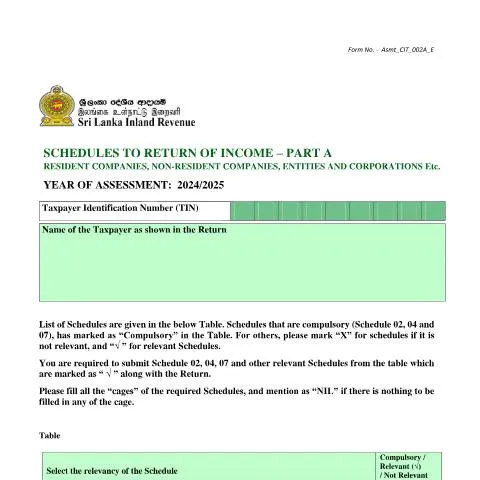
Understanding the Schedules to Return of Income – Part A: A Practical Approach
The Schedules to Return of Income – Part A, referenced as Form No. Asmt_CIT_002A_E, is crucial for both resident and non-resident companies, entities, and corporations operating in Sri Lanka. This document serves as the foundation for reporting various types of income, detailing obligations for tax compliance and providing essential insights into the company's financial standing. Filing this form accurately is not merely a bureaucratic exercise; it shapes the financial landscape for businesses, influencing tax liabilities and fiscal responsibilities. Understanding the nuances of this form is key to effective corporate management.
Timeline for Submission: Key Dates and Procedural Steps
The timeline for submitting the Schedules to Return of Income is essential for ensuring compliance. The deadlines are typically aligned with the fiscal year, which runs from April 1 to March 31 in Sri Lanka. Here’s a breakdown of critical dates:
- Year of Assessment: For the fiscal year 2024/2025, the assessments occur starting from April 1, 2024.
- Submission Deadline: Returns must be submitted by the deadline specified by the Inland Revenue Department (IRD). Historically, this deadline is set for November 30 following the end of the assessment year.
- Post-Submission Phase: Following submission, the IRD allows a grace period for any amendments or additional submissions, typically lasting until the end of the calendar year.
Failure to adhere to these deadlines can result in significant penalties, highlighting the importance of meticulous planning and execution in completing the return.
Preparing the Necessary Documentation: A Detailed Guide
Completing the Schedules requires a comprehensive understanding of the documentation needed. Depending on the specific circumstances of the entity filing the return, various forms and records may need to be prepared. Below is a categorization of typical documentation:
1. Standard Financial Records
- Profit and Loss Statements: A detailed account of income generated and expenses incurred during the assessment year.
- Balance Sheets: Summary showing the company’s financial position at the end of the fiscal year.
2. Schedules Specific to Income Types
- Assessable Income Summary: This includes breakdowns of business, investment, and other income as required in Schedule 02.
- Exempt Income Documentation: Any claims for exempt amounts must be supported by relevant schedules (Schedule 01).
3. Additional Schedules Depending on Circumstances
- Loss Deductions: Submission of Schedule 02B for documenting any losses incurred that can be deducted.
- Other Specific Schedules: Depending on the company’s activities, schedules related to different types of income (Schedule 06, Schedule 07, etc.) must also be completed.
Gathering these documents well in advance allows for a smoother filing process and reduces the risk of errors in the submission.
Understanding the Filing Process: Steps to Compliance
Filing the Schedules to Return of Income involves several structured steps, ensuring that businesses adhere to local regulations while minimizing the risk of audits or penalties.
1. Select Relevant Schedules
Each business must identify which schedules are applicable to its activities. Start by reviewing the table of required schedules outlined in the form. Mandatory schedules such as Schedule 02, Schedule 04, and Schedule 07 must be filled out and submitted.
2. Complete Mandatory Sections Accurately
Every 'cage' (or field) within the mandatory schedules needs to be filled accurately. If no data exists for a particular cage, enter "NIL" to indicate that the entry is intentionally left empty:
- Schedule 02: Summary of Assessable Income must be filled with precise figures reflecting total income and allowable deductions.
- Schedule 04: Document tax liabilities accurately based on assessed income.
- Schedule 07: Required for reporting any tax credits claimed.
3. Submission Process
Once all schedules are prepared and verified, the next step is submission. The Inland Revenue Department provides online services through their platform, which facilitates electronic submissions. Physical submissions can also be made at designated IRD offices:
- Online Submission: Log into the IRD portal, navigate to the e-Services section, and follow the instructions for uploading the completed schedules.
- Physical Submission: Ensure that copies of all submitted documents are retained for future reference.
Post-Submission: Tracking and Managing Your Filing
After submission, it is crucial to stay informed about the status of your filing. The IRD offers mechanisms for tracking submitted documents:
1. Acknowledgment of Receipt
Once the submission is successful, you should receive an acknowledgment receipt. Keep this document safe as it serves as proof of compliance.
2. Monitoring Assessment Status
Regularly check on the status of your submitted return through the IRD portal. Any discrepancies or requests for additional information will typically be communicated through this platform.
3. Addressing Queries from IRD
If the IRD raises queries or issues regarding your submission, respond promptly with accurate additional information or documentation. Delays can result in increased scrutiny or penalties.
Implications of Non-compliance: Understanding Risks and Obligations
Filing the Schedules to Return of Income is not just a regulatory obligation; it carries significant repercussions for businesses that fail to comply:
1. Financial Penalties
Failure to file on time can attract hefty penalties, which are typically a percentage of the total tax owed. Such penalties can escalate if the IRD perceives a pattern of non-compliance.
2. Increase in Tax Audit Risk
Non-compliance or discrepancies in filings may trigger a tax audit. This increased scrutiny can lead to further penalties and a requirement to produce various financial documents.
3. Impact on Business Reputation
Consistent compliance is crucial for maintaining a good standing with regulatory authorities. Non-compliance can damage a company's reputation, affecting relationships with stakeholders.
Navigating the Intricacies: Detailed Flow of the Filing Process
To ensure a comprehensive understanding, here is a detailed flow of the filing process, from initiation to submission:
- Initial Preparation: Gather all financial records, including profit and loss statements and balance sheets.
- Identify Applicable Schedules: Review the list of schedules and select the mandatory ones based on your business activities.
- Complete Schedules: Fill in accurate figures, ensuring each cage is completed or marked as NIL where applicable.
- Review and Verification: Have a financial officer or accountant review the submitted schedules to ensure accuracy.
- Submit the Form: Either electronically or physically, ensuring that confirmation of receipt is obtained.
- Monitor the Assessment: Regularly check for updates on the status of your submission through the IRD portal or follow up with the department directly.
Additional Considerations: Unique Situations and Variations
Businesses must remain aware of unique situations that may affect their filing obligations:
1. Special Economic Zones and BOI Agreements
Entities operating under the Board of Investment (BOI) agreements may have different obligations, including tax holidays or exemptions. It is critical to integrate information from these agreements into the relevant schedules, such as Schedule 01.
2. Changes in Corporate Structure
In cases of mergers, acquisitions, or structural changes, there may be additional reporting requirements or considerations that need to be documented. Seek advice from tax professionals to navigate these complexities.
3. Adjustments for Past Losses
Companies with ongoing losses must be meticulous about how these losses are documented and claimed. Schedule 02B is mandatory for reporting loss deductions, and all relevant financial information must be accurately reported to utilize these deductions effectively.
By understanding the various components and implications of the Schedules to Return of Income – Part A, businesses can navigate the complexities of tax compliance in Sri Lanka effectively, minimizing risks and ensuring adherence to local regulations.
Understanding the Schedules to Return of Income - Part A
The Schedules to Return of Income - Part A, designated as [Asmt_CIT_002A_E], is a crucial document for both resident and non-resident entities operating in Sri Lanka. This form is part of the annual income tax filing process mandated by the Department of Inland Revenue (DIR). It serves to collect comprehensive financial information from entities to ensure accurate tax assessment. Understanding the various components of this return is essential for compliance and to avoid penalties.
Part A particularly focuses on summarizing the financial performance of the entity, including gross income, deductible expenses, and other allowances as prescribed under the Income Tax Ordinance. Key details to be provided include:
- Gross Income: A detailed breakdown of all income sources including operational income, capital gains, and any other revenue streams.
- Allowable Deductions: Items such as salaries, rent, interest payments, and depreciation that can be claimed to reduce taxable income.
- Tax Computation: A section dedicated to calculating the final tax liability based on the net profit after allowable deductions.
It's imperative for taxpayers to maintain accurate records throughout the financial year, as the DIR may request supporting documentation for any claims made in Part A. Failure to provide adequate documentation can lead to audits and reassessments, resulting in additional taxes owed and interest penalties.
Filing Procedures and Important Deadlines
Filing the Schedules to Return of Income - Part A is not only a compliance requirement but also a critical aspect of strategic financial management for companies operating in Sri Lanka. Companies must adhere to specific filing procedures and deadlines to ensure the smooth processing of their tax returns.
The annual return must be filed by the 30th of November following the end of the relevant financial year (which runs from April 1st to March 31st). For instance, for the financial year ending on March 31, 2024, the return should be submitted by November 30, 2024. It is advisable that companies initiate the filing process well before the deadline to alleviate the potential for errors and to allow sufficient time for any necessary corrections.
In addition to the final deadline, it is important to note that the DIR may offer extensions under certain circumstances. Companies seeking an extension must formally apply to the DIR before the original deadline, providing justifiable reasons for the request. This can be particularly relevant for companies experiencing significant changes in their operations or financial reporting requirements.
Furthermore, electronic filing of the return is highly encouraged as it facilitates quicker processing and enhances transparency. The ICTA promotes digital government forms and e-services, enabling companies to submit their returns via the official portal at forms.gov.lk. Utilizing this platform not only speeds up the submission process but also allows for tracking the status of the return.
Common Pitfalls and Best Practices for Compliance
While filing the Schedules to Return of Income - Part A, there are several common pitfalls that companies should be aware of to avoid complications and ensure compliance with tax regulations in Sri Lanka.
One prevalent issue is the improper classification of income and expenses. Companies often misreport income due to lack of clarity regarding taxable versus non-taxable income. It is essential to consult with tax professionals and refer to the guidelines provided by the DIR to correctly categorize all financial transactions.
Another common error involves the calculation of allowable deductions. Businesses should have clear documentation supporting each deduction claimed, as the DIR requires records of expenses to validate claims. It is advisable to maintain a well-organized accounting system that documents all transactions, making it easier to retrieve information during the filing process.
Moreover, companies should remain updated on any changes in tax legislation or regulations that may affect their filings. The DIR periodically releases updates or amendments to the tax code, which could alter the requirements for what can be claimed or how income is assessed. Regularly reviewing these updates can aid in avoiding unintentional non-compliance.
Best practices for compliance include engaging in regular internal audits and employing accounting software that is specifically designed to handle tax calculations and reporting. This not only minimizes the risk of errors but also assists in fostering a proactive approach to tax compliance.
Lastly, it is beneficial for companies to seek professional advice or engage with registered tax agents who have expertise in Sri Lankan taxation. This can provide significant advantages in navigating the complexities of the tax system and ensuring that all submissions are accurate and complete.