Understanding the Schedules to Return of Income – Part A
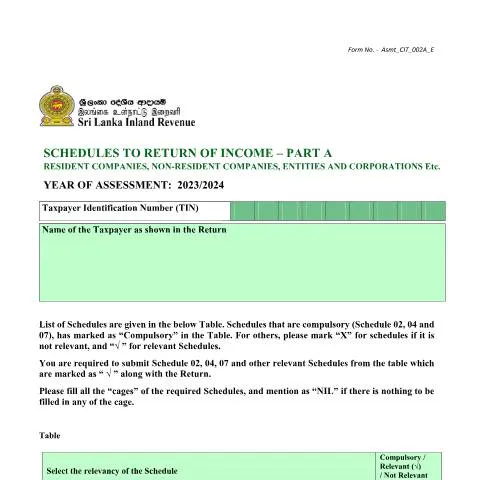
The Schedules to Return of Income – Part A, documented under the reference Asmt_CIT_002A_2023, is an essential component for resident and non-resident companies, entities, and corporations operating within Sri Lanka. It plays a pivotal role in the tax filing process, ensuring compliance with the Inland Revenue Act and facilitating the assessment of the taxpayer's income during the year of assessment 2023/2024.
The Importance of Timely Submission
Filing the Schedules in a timely manner is not merely a bureaucratic obligation; it directly impacts the financial standing of companies and entities. A delay in submission could lead to penalties or interest on outstanding tax liabilities, which may complicate the business environment for companies attempting to adhere to regulatory frameworks. Consequently, understanding the proper procedures and timelines for submission becomes indispensable.
Submission Channels Explained
The Schedules to Return of Income can be filed through various channels, each with its own advantages and nuances:
- Online Submission: Utilizing the digital platform available at www.ird.gov.lk, companies can conveniently complete and submit their forms online. This method is increasingly encouraged by the Inland Revenue Department (IRD), as it streamlines the process and minimizes data entry errors.
- Paper Submission: For those who prefer traditional methods, a printed version of the forms can be completed and submitted directly to the local IRD office. However, this may involve longer processing times and does not offer immediate acknowledgment of receipt.
- In-Person at IRD Offices: Applicants can also choose to submit their forms in person, which allows for direct interaction with IRD officials. This can be advantageous for complex cases requiring clarification or additional documentation.
It is crucial to choose the most appropriate submission method based on individual circumstances, considering factors such as urgency, availability of resources, and the complexity of the tax situation.
Decoding the Components of the Schedules
The Schedules contain several sections that must be filled accurately to reflect the taxpayer's financial activities within the assessment year. Each section has its specific requirements and implications. Understanding these components is essential for accurate reporting.
Exempt Amounts, Gains, and Profits
Schedule 01 outlines exempt amounts, gains, and profits, providing a valuable opportunity for taxpayers to report income that may not be subject to taxation. Companies must carefully assess the exemptions applicable under the Inland Revenue Act, No. 24 of 2017 and No. 10 of 2006.
- Exemption Categories: Taxpayers must categorize their exempt income appropriately, distinguishing between exemptions related to the Third Schedule and those linked to specific BOI agreements.
- Total Reporting: Accurate totals must be calculated and reported in the designated cages, ensuring all relevant amounts are included to avoid discrepancies.
Summary of Assessable Income in Schedule 02
Schedule 02 is compulsory and summarizes assessable income. This is a critical section where taxpayers must compile data from various sources of income, including business, investment, and other income types.
| Type of Income | Gross Amount (Rs. Cents) | Taxable Loss (Rs. Cents) | Assessable Income (Rs. Cents) |
|---|---|---|---|
| Business Income | 20.A.3 | 20.B | 20.0 |
| Investment Income | 30.A.3 | 30.B | 30.0 |
| Other Income | 40.A.3 | N/A | 40.0 |
It is imperative that companies ensure all figures are accurate and reflect the true nature of their income generation activities. Misreporting at this stage can lead to significant tax implications.
Filing Workflow: From Initiation to Outcome
The process of filing the Schedules to Return of Income involves several critical steps, each requiring attention to detail:
- Preparation: Gather all relevant financial documents, including reports on business income, investment income, and other income sources.
- Completion: Fill out the required schedules, ensuring that all relevant cages are completed accurately, marking “NIL” where applicable.
- Review: Conduct thorough checks to ensure that all entries are correct and that no information is missing. This may involve cross-referencing with accounting records.
- Submission: Choose the preferred submission channel and file the completed schedules before the deadline, ensuring that all compulsory schedules (02, 04, and 07) are included.
- Post-Submission Follow-Up: After submitting, keep an eye on any communication from the IRD, including acknowledgments or requests for additional information.
Adherence to this workflow will facilitate a smoother filing experience and help mitigate potential issues that could arise from incomplete or inaccurate submissions.
Addressing Challenges: Errors and Missing Documents
In the course of preparing and submitting the Schedules, taxpayers may encounter challenges such as missing documents or errors in reporting. Understanding the protocols for addressing these issues is critical.
Steps for Rectification
- Identify the Issue: Review the submission to pinpoint the exact nature of the error or missing information.
- Gather Required Documents: Collect any additional paperwork or information needed to correct the filing.
- Communicate with the IRD: Contact the relevant department at the IRD to discuss the issue and seek guidance on the corrective process.
- File a Revised Return: If necessary, submit a revised return that includes the corrected information, ensuring it is completed accurately and submitted through the appropriate channel.
Failure to adequately address these challenges may result in penalties or further complications, underscoring the importance of vigilance throughout the filing process.
Who Are the Key Stakeholders?
The Schedules to Return of Income serve a variety of stakeholders, each with unique considerations:
Resident Companies
Companies that are incorporated in Sri Lanka are classified as resident companies and have specific obligations under the Inland Revenue regulations. They must diligently report all income generated within the country.
Non-Resident Companies
Non-resident companies subject to taxation on Sri Lankan-source income must understand the nuances of their reporting requirements, including any tax treaties that may influence their obligations.
Entities and Corporations
Various entities, including partnerships, charities, and corporations, must also comply with the filing requirements. Each entity type may have different exemptions and filing methodologies, necessitating careful consideration of their specific tax positions.
Tax Advisors and Accountants
Many companies rely on tax advisors or certified accountants for assistance in preparing these schedules. These professionals are crucial in interpreting tax laws and ensuring accurate compliance.
The Impact of Non-Compliance
Understanding the ramifications of non-compliance with the Schedules to Return of Income is critical for companies and entities operating in Sri Lanka. Key consequences may include:
- Financial Penalties: Companies may incur fines or additional tax liabilities if they fail to file their returns on time or if incorrect information is reported.
- Legal Repercussions: Persistent non-compliance can lead to legal action from tax authorities, which can have severe implications for business operations.
- Loss of Business Reputation: Companies with poor compliance records may face reputational damage, impacting their relationships with clients, partners, and financial institutions.
Therefore, maintaining compliance with these schedules is not merely an administrative task but a fundamental element of responsible business management within Sri Lanka.
Final Notes on Filing the Schedules
As companies prepare to file their Schedules to Return of Income for the year 2023/2024, it is essential to remain informed of any updates to tax regulations and filing procedures through the IRD's official communications. Building a structured process for filing, informed by previous experiences and current best practices, will promote effective compliance and ultimately enhance the financial health of businesses operating in Sri Lanka.
Understanding the Obligation: Who Must File the Schedules to Return of Income
In Sri Lanka, the obligation to file the Schedules to Return of Income, specifically Part A of the form [Asmt_CIT_002A_E], primarily targets corporate entities and companies registered under the Companies Act No. 7 of 2007. This requirement also extends to public corporations, foreign companies registered in Sri Lanka, and any resident companies that derive income from a trade or business carried out in the country. Furthermore, non-resident companies that earn income sourced from Sri Lanka are also obligated to file this return, ensuring compliance with local tax legislation. The comprehensive nature of the obligation emphasizes the necessity for entities to gather accurate financial data and prepare for timely submissions to avoid penalties.
It is critical for the companies to assess their specific situations to determine the necessity to file the schedules. For instance, a company with an annual turnover exceeding the prescribed threshold must comply with the filing requirements even if it operates at a loss. Conversely, exemptions may apply to certain entities engaged in specific sectors or activities, thereby necessitating a careful evaluation of the nature of business operations and applicable laws.
Key Components of the Schedules to Return of Income: Detailed Breakdown
The Schedules to Return of Income, particularly Part A - [Asmt_CIT_002A_E], comprises several key components that require meticulous attention to detail. Understanding each element is essential for corporate entities to ensure accurate reporting and compliance. The primary sections of this schedule include:
- Company Information: This section mandates the disclosure of the entity's registration details, including the Company Registration Number (CRN), the registered address, and contact information. Ensuring this data is precise is crucial as discrepancies can lead to processing delays.
- Income Sources: Entities must categorize their income sources, which include but are not limited to sales, services rendered, investment income, and other forms of revenue. Each source must be broken down with supporting documentation to substantiate the reported figures, including invoices, contracts, and financial statements.
- Deductible Expenses: This part requires a detailed enumeration of expenses eligible for deduction. It encompasses operational costs, employee salaries, utility expenses, and any other costs directly associated with the generation of income. Proper documentation and justification for each expense claimed are imperative to ensure compliance and prevent challenges from tax authorities.
- Tax Computation: The calculation of taxable income must be evident, demonstrating the calculation methodology used to arrive at the final tax liability. This section should include an overview of the applicable tax rates based on the income brackets defined in the current income tax legislation.
- Signatory Declaration: A formal declaration at the end of the schedule is necessary, signifying that the information provided is true and accurate to the best of the signatory's knowledge. This section must be signed by the company's authorized personnel, usually the Chief Financial Officer (CFO) or equivalent, demonstrating corporate accountability in reporting.
Filing this schedule accurately and timely is paramount, as it directly impacts the entity's overall tax compliance status and credibility. Any errors or omissions can lead to significant legal repercussions, including fines or penalties. Therefore, companies are advised to maintain comprehensive records and engage tax professionals when preparing their returns.
Filing Process and Deadlines: Ensuring Compliance
The filing of the Schedules to Return of Income is governed by specific deadlines as dictated by the Department of Inland Revenue (DIR) in Sri Lanka. Typically, the due date for submission aligns with the end of the financial year, which runs from April 1 to March 31 of the following year. Companies are required to submit their returns within six months following the end of the financial year to remain compliant with the tax obligations.
To facilitate the filing process, entities should consider the following procedural steps:
- Gather Necessary Documentation: Compile all relevant financial records, including income statements, balance sheets, and supporting documents for deductions. It is advisable to maintain organized files to streamline the preparation process.
- Complete the Schedule Accurately: Fill out the [Asmt_CIT_002A_E] form as per the instructions provided by the DIR, ensuring all information is accurate and reflective of the company's financial status.
- Submit via Digital Platform: The DIR encourages the use of digital submission through the e-filing portal available on forms.gov.lk. This method simplifies the process and reduces the chances of postal delays or errors.
- Retain Confirmation: Upon submission, ensure to save or print the confirmation receipt as proof of filing. This document may be essential for future reference or in case of inquiries from the tax authorities.
Moreover, companies should keep abreast of any changes in tax legislation or filing requirements, as annual amendments can affect the preparation of the Schedules to Return of Income. Engaging with tax consultants familiar with Sri Lankan taxation can provide significant advantages in navigating the complexities of compliance and optimizing tax obligations.