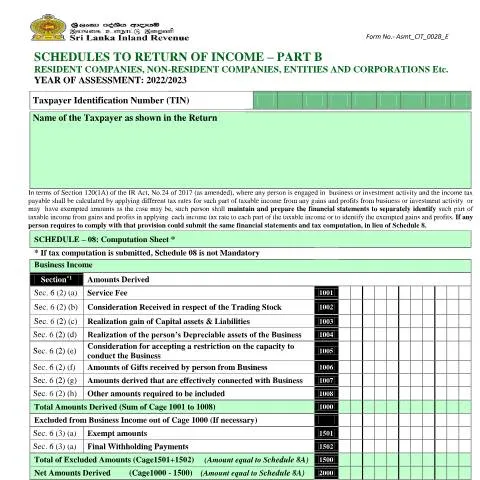
Understanding the Role of Asmt_CIT_002B_2022 in Tax Compliance for Companies
In the landscape of Sri Lankan tax administration, the requirement for businesses to comply with income tax submissions is paramount. One crucial document that stands at the center of this compliance process is the Schedules to Return of Income – Part B, known by its code Asmt_CIT_002B_2022. This official form is integral for both Resident and Non-Resident Companies, as well as various Entities and Corporations operating within Sri Lanka. Its primary function is to facilitate the accurate reporting of income, expenses, and other financial particulars that determine tax obligations in accordance with the Income Tax Act No. 24 of 2017.
Understanding the intricate details surrounding this form is essential for businesses to avoid penalties and ensure they leverage any potential tax benefits effectively. This guide provides a comprehensive overview of the key aspects of Asmt_CIT_002B_2022, including who should file it, the essential timelines, completion guidelines, and the consequences of neglecting this obligation.
Timelines: Key Dates for Filing and Compliance
Navigating the timelines associated with the Asmt_CIT_002B_2022 is crucial for maintaining compliance. The submission deadline generally follows the fiscal year-end, which aligns with the Sri Lankan tax year running from April 1st to March 31st. Here’s an outline of the pertinent dates to consider:
- Filing Period: The completed form must typically be submitted by the end of July following the conclusion of the tax year. For instance, for the year of assessment 2022/2023, businesses must submit their forms by July 31, 2023.
- Extensions: In certain cases, taxpayers can apply for extensions through the Inland Revenue Department (IRD). However, such requests must be substantiated and submitted in advance of the original due date.
- Tax Payment Due Date: Payments related to assessed taxes should be made concurrently with filing, or as stipulated by the IRD following their review of submissions.
After submission, businesses should expect to receive feedback from the IRD regarding their tax liabilities, which may include opportunities to contest any discrepancies noted during the evaluation process.
Obligations and Rights of Taxpayers: Navigating Compliance
Filing the Asmt_CIT_002B_2022 is not just a bureaucratic task; it entails significant responsibilities for the taxpayer. It is designed to ensure that businesses transparently report their income and associated expenditures, adequately reflecting their economic activities.
Rights of Taxpayers:
- Right to Information: Taxpayers have the right to receive clear guidelines and support from the IRD regarding the completion and submission of this form.
- Right to Appeal: Should there be any discrepancies or disputes regarding tax assessments, taxpayers have the right to appeal decisions made by the IRD.
Obligations of Taxpayers:
- Accurate Reporting: Companies are required to provide accurate financial statements and any supplementary documentation that reflects all streams of income and allowable deductions.
- Timely Submission: Failing to submit the Asmt_CIT_002B_2022 within the stipulated time frames can lead to penalties, which may include fines or, in severe cases, legal repercussions.
Overall, compliance translates to providing a complete picture of a company's financial health, which the authorities rely on for revenue collection purposes.
Integration with Wider Tax Compliance Framework
The submission of the Asmt_CIT_002B_2022 does not occur in isolation; it is part of a broader tax compliance framework that includes various schedules and additional documentation necessary for a complete return.
- Interconnected Forms: The Asmt_CIT_002B_2022 is often accompanied by other relevant schedules, such as Schedule 8, which outlines detailed computations of taxable income. These schedules are critical for a comprehensive overview of your tax position.
- Financial Statements: Companies must prepare and submit financial statements that segregate different types of income, especially for those engaged in diverse activities—ensuring compliance with Section 120(1A) of the IR Act.
- Electronic Submission: The ICTA (Information and Communication Technology Agency of Sri Lanka) promotes the use of digital platforms for submission, which enhances efficiency and reduces processing times for taxpayers.
Understanding these interconnected elements is vital for businesses as they navigate through their tax obligations, ensuring that they remain compliant while optimizing their tax positions.
Unique Characteristics of Asmt_CIT_002B_2022: Differentiation from Similar Forms
While there are various forms and schedules associated with income tax returns in Sri Lanka, the Asmt_CIT_002B_2022 has distinct characteristics that set it apart.
Key Distinctions:
- Scope of Income Reporting: Unlike other forms that may target specific income types or sectors, the Asmt_CIT_002B_2022 is comprehensive, requiring the reporting of all income types, including business, investment, and other sources.
- Applicable Entities: This form is specific to both resident and non-resident companies, thereby recognizing the operational complexities faced by international businesses in compliance with local tax laws.
- Tax Computation Flexibility: As stated in the provision, if a taxpayer complies with maintaining separate records of income and deductions, they may submit consolidated financial statements in lieu of detailed schedules.
These unique attributes necessitate careful consideration when preparing the form, ensuring that businesses do not confuse it with less comprehensive or sector-specific tax forms.
Completing Asmt_CIT_002B_2022: A Step-by-Step Approach
Completing the Asmt_CIT_002B_2022 requires meticulous attention to detail, ensuring that all financial data is accurately reflected. Below is a structured approach to effectively complete the form:
1. Gather Financial Records
Before beginning the completion of the form, it is essential to gather all relevant financial statements, including profit and loss statements, balance sheets, and any documentation relating to income sources. This documentation will serve as the foundation for accurate reporting.
2. Identify Income Streams
Clearly outline all income streams for the year, categorizing them as business income, investment income, and other income. Each category has specific requirements under the relevant sections of the form.
3. Fill Out the Form
The form consists of several sections that require careful completion:
- Taxpayer Identification Number (TIN): Ensure that your TIN is accurately recorded at the top of the form.
- Detailed Income Reporting: For each income category, fill in the corresponding amounts derived, ensuring that all figures are supported by the documentation gathered.
- Deductions and Exemptions: Clearly outline any deductions applicable to your income, such as capital allowances or other business expenses, maintaining compliance with the relevant sections of the tax law.
4. Review for Accuracy
After filling out the form, it is critical to review all entries for accuracy. Any discrepancies or errors could lead to challenges during the review process by the IRD.
5. Submission
Finalize the submission through the designated platform or in person at the local IRD office. Ensure you retain a copy of the submitted form and any confirmation received.
Consequences of Non-Compliance: The Importance of Adhering to Deadlines
Ignoring the requirements associated with the Asmt_CIT_002B_2022 can result in significant consequences for businesses, ranging from financial penalties to reputational damage.
- Financial Penalties: The IRD imposes late filing fees, which increase progressively with delays. Persistent non-compliance can lead to elevated scrutiny and potential audits.
- Legal Consequences: In severe cases, companies may face legal repercussions, including prosecution for tax evasion, which can have lasting effects on their operations.
- Loss of Credibility: Non-compliance may damage a company’s standing with stakeholders, including creditors and investors, who rely on accurate financial disclosures.
Given these implications, it is of utmost importance for companies to prioritize their tax obligations and maintain open lines of communication with the IRD.
Final Thoughts: Navigating the Intricacies of Tax Compliance in Sri Lanka
Understanding and completing the Asmt_CIT_002B_2022 is imperative for businesses operating in Sri Lanka, whether they are local entities or foreign companies. The complexities surrounding tax compliance necessitate a proactive approach, ensuring that all reports are thorough, accurate, and submitted in a timely manner.
Through diligent record-keeping, understanding of obligations, and adherence to deadlines, businesses can navigate the tax landscape effectively, ultimately contributing to their sustainability and growth in the competitive Sri Lankan market.
This detailed exploration of the Asmt_CIT_002B_2022 assists businesses in recognizing the significance of this form and the broader context of tax compliance, thereby empowering them to fulfill their obligations with confidence and clarity.
Understanding the Schedules to Return of Income – Part B
The Schedules to Return of Income – Part B, identified by the form code [Asmt_CIT_002B_E], are essential documentation for corporate entities operating in Sri Lanka. This form is particularly relevant for resident companies, as it facilitates the declaration of income, deductions, and any tax obligations, ensuring compliance with the regulations established by the Department of Inland Revenue (DIR). The structure of this form is designed to capture various financial aspects of a business's operations. It is critical that companies accurately complete each section to avoid penalties related to underreporting income or misrepresenting financial information.
Companies must prepare this schedule by gathering their financial statements for the relevant assessment year, which is typically the financial year ending on March 31. It is essential to ensure that all figures are derived from accurate accounting records, and adjustments must be made for any non-deductible expenses or tax-exempt income. Furthermore, corporations should be aware of any specific incentives or tax reliefs applicable to their sector, as these can significantly influence overall tax liability.
Common Pitfalls in Completing Part B of the Income Return
When filling out the Schedules for Return of Income – Part B, there are several common pitfalls that companies often encounter, leading to complications in tax filings. These issues can stem from both knowledge gaps and oversight in data representation. Understanding these pitfalls is crucial for ensuring a smooth and compliant filing process.
1. Incorrect Income Declaration: Companies sometimes fail to report all sources of income. For instance, if a business engages in multiple streams of revenue, it is vital to include each source in the income declaration, failing which can lead to significant penalties. Entities should meticulously review financial records to ensure completeness.
2. Mistakes in Deductions: A common error involves miscalculating allowable deductions. Many companies are unaware of specific allowable expenses or may mistakenly classify expenses that are not tax-deductible. Businesses should consult with tax professionals or refer to the DIR guidelines to identify legitimate deductions applicable to their situation.
3. Omission of Relevant Adjustments: The Income Return Form requires adjustments for items such as capital allowances and any provisions made for doubtful debts. Neglecting to include these adjustments can misstate taxable income, leading to either overpayment or underpayment of tax liabilities.
4. Failure to Attach Required Documents: Part B requires the submission of various supporting documents, such as financial statements and audits. Companies often overlook this requirement, which can result in delayed processing of their tax returns. Ensuring that all documents are correctly labelled and submitted in compliance with DIR's requirements is crucial.
Submission and Compliance Deadlines for Part B of the Income Return
For corporate entities in Sri Lanka, adhering to submission deadlines is non-negotiable. The deadlines for submitting Part B of the Return of Income are typically aligned with the overall deadlines set by the Department of Inland Revenue, which can vary annually based on legislative updates. Generally, the deadline falls on the specified date in the fiscal year immediately following the end of the applicable financial year.
For example, if a company’s financial year ends on March 31, the completed Schedules to Return of Income – Part B must be submitted by the date stipulated by the DIR, which is often June 30 of the same year. However, companies are encouraged to submit their returns well in advance of the deadline to account for any potential issues that may arise during the submission process.
Additionally, companies must be vigilant about any notices from the DIR regarding changes in submission timelines or requirements, which can be communicated through various channels including official announcements on their website. Failure to comply with these deadlines can result in late submission penalties, which may further complicate a company’s tax situation.