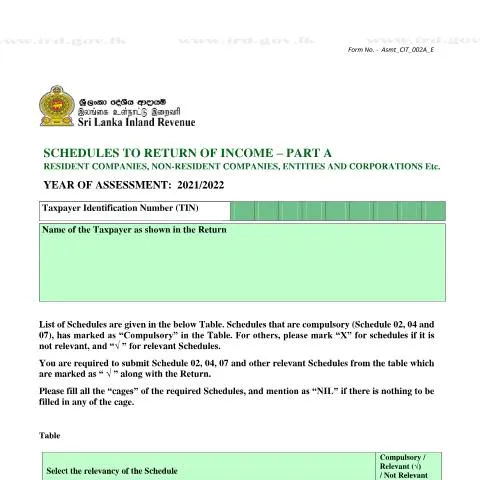
Navigating the Schedules to Return of Income – Part A: A Deep Dive
In the intricate world of taxation, the Schedules to Return of Income – Part A, designated as Asmt_CIT_002A_E, stands as a crucial element for various businesses and entities operating within Sri Lanka. This document encapsulates the necessary requirements for both resident and non-resident companies, along with other entities and corporations, to accurately report their income for the year of assessment 2021/2022. This article will illustrate the vital roles of this document, the stakeholders involved, and the procedural intricacies that users must navigate.
The Integral Role of the Schedules
Understanding the importance of the Schedules to Return of Income is paramount for compliance with Sri Lanka's Inland Revenue regulations. This document serves as a foundational tool that facilitates the declaration of assessable income, ensuring that entities fulfill their tax obligations effectively.
Composing the Income Narrative
The primary purpose of the schedules is to summarize various income streams, including business income, investment income, and other financial gains. Each schedule within this document provides specific sections where taxpayers can input their data, enabling the Inland Revenue Department (IRD) to compute tax liabilities accurately. The compulsory schedules—namely Schedule 02, Schedule 04, and Schedule 07—must be meticulously filled out, with ‘NIL’ entries specified where applicable.
Contextualizing the Document within Taxation Framework
The legal backbone of the Schedules to Return of Income is established under the Inland Revenue Act, No. 24 of 2017, along with its amendments. This regulatory framework mandates the documentation of income streams and the submission of relevant details to the IRD, thereby creating a transparent taxation environment.
Engagement with the Tax System: Obligations and Rights
Compliance with the schedules entails both responsibilities and entitlements for the taxpayer. Neglecting to submit the required forms, or inaccuracies in reporting, can lead to penalties, delayed assessments, or even legal repercussions. The IRS emphasizes the need for complete honesty in declarations to maintain credibility within the tax system.
Consequences of Non-Compliance
- The imposition of fines or penalties for late submissions.
- Potential audits conducted by the IRD to verify reported figures.
- Loss of eligibility for certain tax credits or deductions if not properly documented.
In contrast, compliance opens avenues for various benefits, such as tax relief under specified conditions outlined within the schedules, as well as eligibility for rebates and credits that can reduce overall tax burden.
Filling Out the Schedules: A Step-by-Step Approach
Filling out the Schedules to Return of Income can seem daunting, but a structured approach can ease the process significantly. Here’s a chronological walkthrough that taxpayers can follow to navigate this documentation landscape.
Step 1: Gathering Necessary Information
Before starting the application process, it is essential to collect all pertinent financial documents, including:
- Financial statements (balance sheets, income statements, etc.)
- Details on previous tax returns to ensure consistency and accuracy.
- Records of any exempt amounts, gains, or profits derived from specific activities.
Step 2: Downloading Forms and Schedules
Taxpayers can access the required schedules from the official IRD website, which hosts all necessary forms for download. It is advisable to ensure that you are using the most current version of the forms to avoid discrepancies.
Step 3: Completing the Relevant Schedules
Once the forms are in hand, proceed to fill out the relevant sections as follows:
- Schedule 01: Document any exempt amounts, gains, or profits, as this can influence overall tax calculations.
- Schedule 02: This is the Summary of Assessable Income—ensure to detail business, investment, and other income accurately.
- Schedule 04: Include tax on taxable income, providing clear and concise financial reporting.
- Schedule 07: Report any tax credits, which are critically important for understanding your overall tax position.
It is imperative to mark the relevant schedules with a tick (√) and those that do not apply with a cross (X) as instructed within the documentation guidelines.
Step 4: Reviewing and Finalizing the Submission
After completing the schedules, review them for accuracy and completeness. Mistakes or omissions can lead to complications or reassessments by the IRD.
Submission Guidelines: Timing and Method
Following the completion of the schedules, the next step involves submission to the IRD. The fiscal calendar sets crucial deadlines, so attention to timing is vital.
Key Deadlines and Submission Process
The deadlines for submitting the schedules are stipulated by the IRD. Typically, the annual submission period aligns with the fiscal year-end, with an emphasis on timely filings.
- Submissions must be made directly to the IRD, either through electronic channels or physical delivery.
- Ensure to keep copies of all submitted documentation for your records.
Post-Submission Outcomes
After submission, taxpayers can expect the following processes:
- The IRD will initiate a review process, which may involve further inquiries or requests for additional information.
- Upon satisfactory review, the IRD will communicate the outcome, including any tax liabilities, refunds, or further compliance requirements.
Special Cases and Exemptions
Specific scenarios may necessitate different approaches when filling out the schedules. For foreign entities, minors, and other unique circumstances, additional provisions apply.
Foreign Entities and Non-Residents
For non-resident companies operating within Sri Lanka, the reporting requirements may differ, often necessitating the inclusion of additional documentation to validate income sources. These entities must remain vigilant regarding their tax obligations, which may include withholding tax considerations on repatriated earnings.
Minors and Special Circumstances
In cases where minors are involved or where there are complex ownership structures within a corporation, guidance from tax professionals may be warranted. The IRD often requires additional documentation to substantiate claims of exemption or deductions.
Continuous Updates: The Evolving Tax Landscape
Tax regulations in Sri Lanka, shaped by the ICTA's digital initiatives, are progressively shifting towards a more user-friendly electronic framework. The transition to digital forms aligns with the Electronic Transaction Act, promoting efficiency and reducing administrative burdens.
Taxpayers are encouraged to stay informed about any changes in the regulations related to the Schedules to Return of Income, as these updates can significantly impact filing procedures and requirements.
The Role of ICTA in Tax Compliance
As the main agency driving online services in Sri Lanka, the ICTA continuously enhances the processes surrounding tax compliance. This includes ensuring that digital forms are updated regularly, reflecting the most current legal mandates as defined by the Inland Revenue Act.
Conclusion: Embracing Compliance as a Business Essential
For companies operating in Sri Lanka, especially those identified as either resident or non-resident, understanding and complying with the Schedules to Return of Income – Part A is not just a statutory requirement but a crucial aspect of sound corporate governance. By meticulously adhering to these protocols, entities not only safeguard themselves against potential penalties but also pave the way for long-term sustainability and growth within the Sri Lankan market.
Through proactive engagement, informed decisions, and continual education about the evolving landscape of taxation, stakeholders can ensure that they navigate this complex terrain with confidence and accuracy.
Understanding the Schedules to Return of Income – Part A
The Schedules to Return of Income – Part A (Asmt_CIT_002A_E) are essential components of the income tax filing process for corporate entities in Sri Lanka. These schedules provide a structured format for companies to report their income, deductions, and tax computations to the Inland Revenue Department (IRD). Understanding the intricacies of these schedules is vital for ensuring compliance with the Income Tax Act and avoiding any potential penalties. Each section of the schedule addresses different aspects of a company’s financials, including revenue sources, allowable deductions, and tax calculations based on prevailing rates.
Key Components of the Schedules
Within the Schedules to Return of Income – Part A, there are several critical components that taxpayers must accurately complete:
- Revenue Reporting: This section requires detailed disclosure of the company's gross income from various sources. Companies must categorize their revenues based on their operational activities, whether it be trading, professional services, or investment income.
- Deductible Expenses: Taxpayers must provide a comprehensive list of allowable deductions that may include administrative costs, salary expenses, and other operational outlays necessary for generating revenue. It's crucial to ensure that only permissible expenses are claimed to prevent future audits.
- Tax Computation: The final computation of tax liabilities is a critical aspect of the schedules, where companies apply the applicable corporate tax rate to their assessable income after deducting allowable expenses. This section often requires careful verification to ensure accurate tax payment estimates.
Filing Procedures and Deadlines
The submission of the Schedules to Return of Income – Part A must adhere to specific deadlines set forth by the Inland Revenue Department. Corporations in Sri Lanka must submit their income tax returns annually, and the deadlines may vary based on the company’s accounting year-end. Typically, companies have to file their returns within three months following the end of their financial year. It is essential for businesses to keep track of these deadlines, as late submissions may incur penalties, which can substantially increase the tax liability due.
Additionally, companies engaging in digital filing through the IRD's online portal must ensure they are registered for e-filing. This registration process enables companies to submit their schedules electronically, facilitating a more efficient filing experience. The IRD provides comprehensive guidelines and support for companies navigating the digital submission process, ensuring that all electronic submissions comply with the Electronic Transactions Act.
Common Challenges and Solutions in Completing Schedules
Many companies encounter challenges when completing the Schedules to Return of Income – Part A. Common issues include misclassification of income, improper documentation of deductible expenses, and errors in tax computations. To mitigate these challenges, it is advisable for corporations to maintain meticulous financial records throughout the year. By doing so, companies can easily retrieve necessary documentation during the tax filing season.
Another solution is to engage the services of a qualified tax consultant or legal practitioner who specializes in Sri Lankan tax law. These professionals can provide valuable insights and assist in the preparation and submission of the income tax returns. They can also advise on tax planning strategies to optimize tax liabilities and ensure compliance with local regulations.
To further enhance understanding, companies are encouraged to participate in workshops and seminars organized by the Inland Revenue Department and the Chamber of Commerce, which focus on tax compliance and best practices in financial reporting. Engaging with peers and experts can facilitate the sharing of knowledge and experiences, ultimately benefiting the company's overall tax compliance efforts.