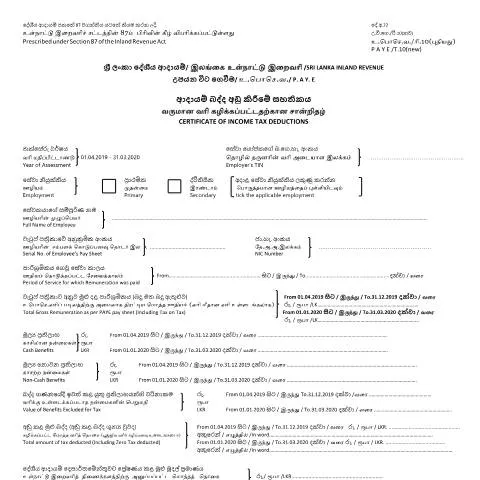
The Significance of the Certificate of Income Tax Deductions (P.A.Y.E./T.10 (new))
The Certificate of Income Tax Deductions, formally known as P.A.Y.E./T.10 (new), holds paramount importance for employees in Sri Lanka. This certificate is issued under the Advance Personal Income Tax (APIT) framework and is particularly relevant for the assessment year 2019/2020. It serves as an official document confirming the amount of income tax that has been deducted at the source from an employee's remuneration. The legal standing of this certificate stems from Section 87 of the Inland Revenue Act, which outlines the obligations of employers regarding tax deductions.
Understanding the Document's Legal Value
Legally, the Certificate of Income Tax Deductions is not merely a summary of tax deductions; it is a vital piece of evidence in the realm of taxation. It substantiates the amounts deducted and remitted to the Department of Inland Revenue (DIR), thus playing a crucial role in the verifiability of tax compliance.
Furthermore, the document is beneficial for various purposes:
- Filing annual income tax returns accurately.
- Providing proof to financial institutions when applying for loans or credits.
- Serving as evidence in case of disputes regarding tax liabilities.
In essence, the legal value of the certificate cannot be overstated; it is a cornerstone for ensuring transparency and accountability within the taxation framework.
Step-by-Step Process for Obtaining the Certificate
Securing the Certificate of Income Tax Deductions involves a structured approach, primarily revolving around the employer's responsibilities. Here’s how the process unfolds:
- Employer Registration: The employer must be registered with the Department of Inland Revenue and possess a valid Tax Identification Number (TIN).
- Payment of Employee Salaries: The employer pays salaries and deducts the appropriate amount of tax as per the PAYE scheme.
- Monthly Filings: The employer is required to submit monthly tax returns to the DIR detailing the amounts withheld from employees' salaries.
- Issuance of Certificate: At the end of the assessment year (1st April 2019 - 31st March 2020), the employer issues the certificate to employees, summarizing the total tax deducted.
Each step is critical, ensuring that both the employer and employee fulfill their tax obligations. Employees must ensure they receive this certificate promptly after the year-end.
Practical Uses of the Certificate
The Certificate of Income Tax Deductions is not just a piece of paper; it serves multiple practical purposes in an employee's financial life:
- Tax Filing: Employees use this certificate when filing their annual income tax returns, as it provides a clear record of what has been deducted and submitted to the DIR.
- Loan Applications: For individuals seeking loans, especially home or vehicle loans, banks and financial institutions often require proof of income, for which this certificate is essential.
- Tax Refunds: If an employee has overpaid tax during the assessment period, presenting this certificate can facilitate the process of claiming a refund from the DIR.
Each of these uses underscores the significance of having accurate and timely documentation of income tax deductions.
Validity Period and Renewal Process
The Certificate of Income Tax Deductions is specifically tied to the assessment year it pertains to, which in this case is the period from 1st April 2019 to 31st March 2020. As such, its validity is limited to this timeframe:
- The certificate is deemed valid for use during the filing period of the corresponding tax year.
- There is no formal renewal process; rather, employees must ensure the receipt of a new certificate for subsequent assessment years, reflecting the latest deductions.
It is advisable for employees to keep the certificate in a secure place, as it serves as crucial documentation for future tax-related queries or audits.
Addressing Issues: Loss or Discrepancies in the Certificate
In the unfortunate event of loss or discrepancies in the Certificate of Income Tax Deductions, employees should take immediate action:
- Report Loss: If the certificate is lost, it must be reported to the employer and the Department of Inland Revenue.
- Request a Reissue: Employees can request their employer to issue a duplicate certificate, which may involve providing details about the original certificate and possibly signing a declaration.
- Rectifying Errors: Should there be any discrepancies in the certificate, such as incorrect amounts or details, employees should contact their employer promptly to rectify the inaccuracies.
Addressing such issues swiftly is crucial to ensure compliance and maintain a clear financial record.
Who is Eligible to Obtain the Certificate?
The eligibility to receive the Certificate of Income Tax Deductions is primarily determined by employment status and tax contribution:
- All employees drawing a salary that is subject to the PAYE tax system are eligible to receive this certificate from their employer.
- Employers are obligated to issue this certificate to all qualifying employees regardless of the total amount of tax deducted, even if it amounts to zero.
This inclusivity ensures that all employees have access to necessary documentation, supporting their rights and obligations within the tax system.
Importance of Keeping Records
Maintaining meticulous records of income tax deductions and associated documents is essential for employees. Here are some best practices:
- Keep Copies: Retain a copy of the Certificate of Income Tax Deductions alongside payslips and tax returns for at least six years, as per the guidelines of the Department of Inland Revenue.
- Regular Updates: Ensure that personal details, including address and TIN, are updated with the employer to avoid discrepancies in documentation.
- Review Deductions: Regularly check the deductions made as indicated on payslips and ensure they align with the certificate issued.
Such practices not only aid in personal financial management but also support compliance during audits or inquiries from the tax authorities.
Final Thoughts on the Certificate's Role within the Tax System
In the intricate fabric of Sri Lanka's tax framework, the Certificate of Income Tax Deductions (P.A.Y.E./T.10 (new)) stands as a testament to the transparency and integrity of the tax collection process. It not only assists employees in maintaining compliance with their tax obligations but also serves as a critical tool in their financial engagements. Understanding the significance, processes, and implications surrounding this certificate is vital for every employee navigating the taxation landscape. Keeping abreast of one’s tax responsibilities, ensuring proper documentation, and addressing discrepancies promptly are essential components of effective financial management.
Understanding the Certificate of Income Tax Deductions (T.10) in Detail
The Certificate of Income Tax Deductions, commonly referred to as T.10, is a crucial document for employees in Sri Lanka who are subject to the Pay As You Earn (P.A.Y.E) taxation system. This self-contained form provides a detailed account of the deductions made from an individual's salary throughout the financial year, which for the period in question is 2019/2020. It's essential to comprehend that this certificate serves not only as a record of tax deductions but also as a fundamental requirement when individuals are filing their annual tax returns with the Inland Revenue Department (IRD).
The T.10 certificate is typically issued by employers and must include specific information, such as the taxpayer's NIC number, the period covered by the deductions, the total amount deducted, and any other relevant payroll details. This transparency enhances the taxpayer's ability to advocate for their rights while ensuring compliance with Sri Lankan tax regulations. For individuals who might have multiple sources of income, acquiring T.10 certificates from each employer is imperative to avoid discrepancies during tax filing.
Additionally, it's important to note that while the employer is responsible for providing this certificate, the employee must also ensure that the deductions reported align with their actual earnings. Any anomalies should be promptly addressed with the employer, as this could lead to overpayment or underpayment of taxes, which may complicate future tax obligations. In cases where an employer fails to issue a T.10 certificate, employees can lodge a complaint with the Department of Labour or seek recourse through the IRD to rectify their tax records.
Implications of Income Tax Deductions on Employment Contracts
Income tax deductions via the P.A.Y.E system have significant implications for employment contracts in Sri Lanka. When entering into an employment agreement, both employers and employees should be cognizant of how these deductions are structured and the subsequent impact on net salary. While gross salaries might appear attractive, the actual take-home pay can be substantially lower due to these mandatory deductions.
Employers are required by law to inform employees about the P.A.Y.E system, including how income tax deductions are calculated based on prevailing tax rates and periodic thresholds set forth by the IRD. It's advisable for employees to review their employment contracts thoroughly to understand the full scope of their taxable income and any allowances or benefits that might be subject to taxation. For example, bonuses, overtime pay, and other forms of compensation may also fall under the tax brackets, thus affecting overall deductions.
Moreover, in circumstances where an employee may receive additional earnings or bonuses outside their regular salary, it becomes paramount that these amounts are disclosed for accurate taxation. Employers are mandated to reflect these additional earnings on the T.10 certificate. Failure to do so may result in disputes, necessitating further clarification with the IRD or legal counsel, particularly if the employee faces penalties for underreporting income during tax filing. Furthermore, the distinction between tax-exempt allowances and taxable income should be clearly defined in employment contracts to avoid future misunderstandings regarding salary deductions.
Steps for Rectifying Errors on T.10 Certificates
Errors on the T.10 Certificate can occur for various reasons, ranging from clerical mistakes to miscalculations of taxable income. The process for rectifying these errors is essential for ensuring compliance with Sri Lanka’s tax regulations and safeguarding an employee's tax position. To begin, employees should carefully review their T.10 certificate upon receipt to verify that all details are accurate, including personal information, the total amount of tax deducted, and the period covered.
In the event that discrepancies are identified, the first step is to bring these to the attention of the employer or the payroll department immediately. A written request, accompanied by supporting documentation, should be submitted to facilitate the correction process. Employers are obligated to maintain accurate payroll records and address any legitimate mistakes promptly, which might involve issuing an amended T.10 certificate. This document must be properly signed and re-issued to ensure its validity for tax filing purposes.
If an employer fails to rectify the error or is unresponsive, employees can escalate the matter to the Inland Revenue Department by providing copies of the original T.10 certificate, the written notice sent to the employer, and any other pertinent documentation. The IRD may then investigate the issue, which can take time but is crucial for ensuring that the correct tax is reported. It’s also advisable to keep a personal record of all correspondence with the employer and the IRD in case of future reference.
Understanding the implications of errors on the T.10 certificate is vital, as mistakes can lead to undue financial burdens, including penalty fees or interest on unpaid taxes. Therefore, vigilance in tracking income and deductions throughout the fiscal year is essential to minimize the risk of errors and ensure a smooth tax filing experience.