Navigating the Advance Personal Income Tax Certificate: A Comprehensive Guide
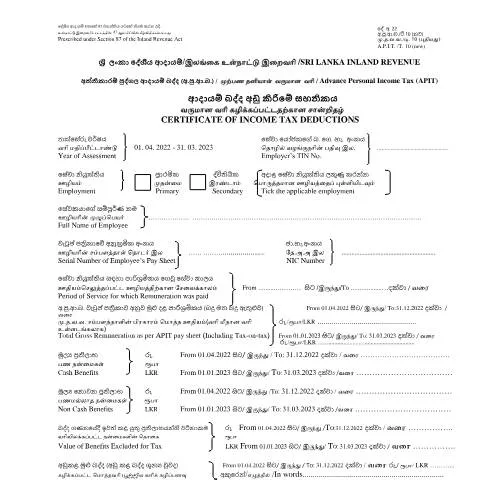
The Advance Personal Income Tax (APIT) Certificate of Income Tax Deductions for the assessment year 2022/2023, known officially as APIT_T10_2223, serves as a crucial document in the financial ecosystem of Sri Lanka. This certificate not only reflects the tax payments made by an employee but also validates their employment income, thus holding substantial significance for various financial transactions and compliance obligations.
Understanding the Application Process for the APIT Certificate
Securing the APIT Certificate requires a structured approach, primarily initiated by the employer. The process can be delineated into several steps:
- Employer's Responsibility: The employer must assess the total income and taxes deducted from the employee’s remuneration during the financial year.
- Preparation of Required Information: Employers need to gather specific data, including the employee's full name, NIC number, periods of service, and details of remuneration and benefits.
- Filling Out the Certificate: The employer must accurately complete the APIT T10 form, ensuring all financial figures and periods are correctly reported.
- Submission to the Inland Revenue Department: Once the form is thoroughly completed, it must be submitted to the Inland Revenue Department for verification and processing.
This structured process ensures that the certificate issued is reflective of accurate tax deductions and employment information.
Duration of Validity and Renewal Procedures
The APIT Certificate for the financial year 2022/2023 is valid for the entire assessment period, which typically runs from April 1, 2022, to March 31, 2023. This validity is critical for individuals when filing their annual income tax returns.
In the case of an expired certificate, or when an employee changes jobs, it is the responsibility of the new employer to issue a new certificate based on the income and deductions applicable to the new employment. Renewal is inherently achieved through this transition rather than a formal re-application process.
Key Uses of the APIT Certificate in Sri Lanka
The APIT Certification holds significant value in multiple scenarios:
- Income Tax Returns: It must accompany an employee's annual income tax return submission, even if the tax deducted is zero.
- Loan Applications: Financial institutions often require this certificate as proof of income when assessing loan applications.
- Verification of Tax Payments: This certificate serves as a legal document confirming that the correct taxes have been withheld and remitted to the government, thus protecting the employee from discrepancies during tax assessments.
Overall, the certificate acts as a safeguard for the employee's financial integrity, particularly in dealings requiring proof of income and tax compliance.
Eligibility Criteria for Obtaining the APIT Certificate
Obtaining the APIT Certificate is contingent on a few key eligibility criteria:
Only employees who have had tax deductions made from their monthly salaries by their employers during the assessment year are eligible for this certificate.
Additionally, employers must ensure that they have properly registered with the Inland Revenue Department and are compliant with all tax obligations. Employee status must be verified, including factors like:
- Employment Duration: Employees must have been employed for a period that encompasses the assessment year.
- Tax Deduction Compliance: The deductions reported must align with the actual income received and adhere to the existing tax regulations.
Addressing Issues: Loss, Errors, and Disputes Relating to the Certificate
In cases where the APIT Certificate is lost or contains errors, there are specific protocols that need to be followed:
- Loss of Certificate: If the certificate is lost, the employee should immediately notify their employer, who must then reissue the certificate.
- Errors in the Certificate: Any discrepancies noted on the certificate should be reported to the employer for correction. The employer needs to submit a corrected version to the Inland Revenue Department.
- Disputes Over Tax Deductions: If there is a dispute regarding the amount of tax deducted, the employee should consult their employer with supporting documentation, possibly even engaging the Inland Revenue Department if a resolution cannot be reached.
Analyzing the Financial Implications of the APIT Certificate
Financially, the APIT Certificate influences various aspects of an individual's economic engagement:
| Type of Implication | Description |
|---|---|
| Tax Compliance | Ensures adherence to local tax laws, protecting individuals from potential legal issues. |
| Loan Eligibility | Affects the ability to secure loans through proof of income, impacting personal financial opportunities. |
| Future Employment | May be requested by future employers or for professional verification purposes. |
Thus, the implications of this certificate extend beyond a simple tax document, influencing various facets of financial planning and stability.
Conclusion on the Value of the APIT Certificate
In summary, the Advance Personal Income Tax Certificate plays an integral role in the Sri Lankan financial landscape. Ensuring proper acquisition, correct details, and understanding its implications can significantly affect tax compliance and financial opportunities for employees in Sri Lanka. As such, both employers and employees must approach this document with care and diligence to fully leverage its benefits.
Understanding the Certificate of Income Tax Deductions (A.P.I.T/T.10/D(New))
The Certificate of Income Tax Deductions, designated as A.P.I.T/T.10/D(New), is a vital document for individuals and entities seeking to verify and validate their income tax deductions during the fiscal year 2022/2023 in Sri Lanka. This certificate serves as evidence of tax liabilities and deductions processed by employers or withholding agents. It is essential for both compliance and for individual taxpayers who may wish to claim refunds or carry forward unused credits.
This certificate includes crucial information, such as the taxpayer's National Identity Card (NIC) number, the total income received during the year, the deductions allowed, and the net taxable income. For those engaged in employment, the employer is obligated to issue this certificate to ensure transparency in reporting to the Inland Revenue Department (IRD). Understanding the nuances of this certification can significantly impact one’s tax obligations and financial planning.
Application Process for Certificate of Income Tax Deductions
To obtain the A.P.I.T/T.10/D(New), individuals or entities must follow a structured application process, which is typically managed through the Electronic Tax Filing System facilitated by the IRD. The applicant must first ensure that all income and deduction details are accurately compiled, including relevant documentation such as salary slips, bank statements, and any other evidence of income received during the fiscal year.
The process begins with the taxpayer creating an account on the IRD’s digital platform or accessing the forms available at forms.gov.lk. After logging in, the taxpayer can navigate to the section for tax deduction certificates, fill out the necessary forms, and submit electronic copies of supporting documents. It is crucial to adhere to the deadlines set by the IRD, as any delays may hinder the timely issuance of the certificate. Typically, the deadline for submission aligns with the end of the financial year, which runs from April 1st to March 31st in Sri Lanka.
Once the application is submitted, the IRD will process the request. In cases where additional information is required, the taxpayer will be notified to provide further details. Upon successful validation of the application, the taxpayer will receive the certificate in electronic format, which can then be printed for personal records or must be submitted to relevant financial institutions when required.
The Importance of Accurate Reporting for Employers
For employers and withholding agents, the accuracy of the information reported on the Certificate of Income Tax Deductions is paramount. The IRD mandates that employers must withhold and remit the correct amount of income tax from their employees' salaries, which is calculated based on the progressive tax rates established by the government. Employers are required to keep detailed records of each employee's earnings and deductions, ensuring that all data entered into the A.P.I.T/T.10/D(New) aligns with their actual payroll records.
Failure to accurately report this information can lead to serious repercussions, including penalties imposed by the IRD and potential audits. Employers must also be aware of the various allowances and deductions applicable to their employees, which can vary based on individual circumstances, such as the number of dependents or any specific tax reliefs that may be applicable. Regular training and updates on tax regulations are essential for payroll departments to ensure compliance and mitigate risks associated with income tax reporting.
Furthermore, employers are encouraged to support their employees throughout the process of obtaining their certificates. By providing guidance and necessary documentation in a timely manner, they can facilitate smoother interactions between employees and the IRD, ultimately fostering a compliant and transparent tax reporting culture.