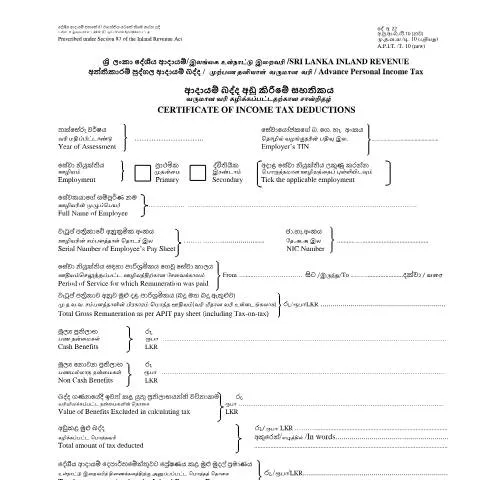
The Significance of the Certificate of Income Tax Deductions (APIT_T10_2324)
In Sri Lanka, the intricacies of tax compliance can often be overwhelming for both employees and employers. One crucial document that embodies the financial integrity of employment within the country is the "Certificate of Income Tax Deductions" (APIT_T10_2324) issued by the Advance Personal Income Tax (APIT). This certificate serves not only as evidence of tax deducted at source but also as a fundamental aspect of maintaining transparent fiscal relationships between employees, employers, and the government.
The legal backbone of this document is rooted in Section 87 of the Inland Revenue Act. It formalizes the processes surrounding personal income tax in a manner that aligns with Sri Lanka’s strong adherence to English common law principles. Understanding the significance of the APIT_T10_2324 is paramount for anyone involved in the Sri Lankan tax system.
Understanding the Juridical Value of the APIT_T10_2324
The Certificate of Income Tax Deductions stands as a legally recognized document that is integral for tax assessments. It bears weight in various administrative procedures, highlighting both the employer’s and the employee’s compliance with tax regulations. Essentially, this certificate affirms the following:
- Verification of Deductions: It attests to the amount of income tax that has been deducted from an employee’s salary during the assessment year of 2023/2024.
- Income Confirmation: The certificate serves as a formal acknowledgment of the employee’s income, thus acting as a reference point for various financial applications, including loan approvals.
- Tax Filing Benefit: Attach this certificate with your annual income return, which simplifies the submission process and validates the income claimed.
Legally, employees can present this document to justify their tax obligations and reported income in case of audits or inquiries from the Inland Revenue Department (IRD).
The Process of Achieving the APIT Certificate
Acquiring the Certificate of Income Tax Deductions requires a systematic approach. The process comprises several phases that ensure both the employer and the employee fulfill their responsibilities under Sri Lankan tax laws.
Step-by-Step Guide to Obtain the Certificate
- Employer's Role: The employer computes the total advance income tax deductions as per the relevant pay scale and necessary tax regulations.
- Document Preparation: The employer must accurately complete the certificate using the prescribed format (APIT/T.10/D(New)), ensuring all details are correct, including the employee’s NIC number and the period of service.
- Submission to the IRD: After verifying the information, the employer submits the deducted amounts to the IRD, ensuring compliance with the reporting guidelines.
- Distribution to Employees: Once approved, the employer hands over the certificates to their employees. Each employee must ensure the information is accurate before acceptance.
It is worth noting that any discrepancies found after issuance may complicate one’s tax filings. Thus, the completeness and accuracy of the APIT_T10_2324 are of utmost importance.
Eligibility Criteria for Certificate Acquisition
Not every individual will automatically qualify for the Certificate of Income Tax Deductions. Specific conditions determine who can obtain this important document.
Criteria for Employers and Employees
- Registered Employers: Only employers registered with the IRD that comply with the tax deduction protocols can issue this certificate.
- Formal Employment: Employees must be formally employed and receive salaries that qualify for tax deductions. This includes both full-time and part-time employees.
- Active Tax Deductions: Employees who have had taxes deducted from their income within the financial year are eligible to receive the APIT certificate.
In essence, both parties must adhere to the legal framework and fulfil their obligations under the Inland Revenue regulations to ensure the provision of this essential document.
What to Do in Case of Errors or Disputes
Errors can occur at any stage of the document preparation and submission process. An incorrect APIT_T10_2324 can lead to considerable complications, including potential disputes with the IRD.
Steps to Resolve Errors
In the event of a mistake or a need for contestation regarding the certificate, the following actions should be taken:
- Immediate Notification: The employee should notify the employer promptly about any discrepancies observed on the issued certificate.
- Documentation Review: The employer should review internal records and confirm the figures before making any adjustments.
- Issuance of a Revised Certificate: If necessary, the employer can issue a corrected certificate, ensuring that both parties are using the most accurate information.
- Contact the IRD: For critical disputes or unresolved issues, the employer or employee may contact the IRD directly for guidance on the steps to be taken.
Resolving discrepancies swiftly is vital as lingering errors can affect tax filings and may lead to penalties or audits.
Duration of Validity and Renewal Conditions
The Certificate of Income Tax Deductions holds a specific validity period relevant to the assessment year in which it is issued.
Understanding Validity and Renewal
- The certificate is valid for the entire duration of the assessment year for which it is issued, specifically from April 1, 2023, to March 31, 2024.
- In cases where tax deductions are adjusted or recalculated, a new certificate may be required to accurately reflect these changes.
- Employers are advised to maintain detailed records of issued certificates to streamline any future renewals or updates.
In conclusion, while the certificate holds validity for a defined period, the information it encapsulates must be maintained rigorously to meet regulatory requirements.
Utilizing the Certificate: Practical Applications
Beyond merely serving as a document of proof, the APIT_T10_2324 facilitates various real-life applications.
Key Uses for the Certificate of Income Tax Deductions
| Application | Description |
|---|---|
| Loan Applications | Banks and financial institutions often require this certificate to assess an applicant's income, thereby aiding in the loan approval process. |
| Income Tax Returns | This document must be attached to your annual income tax return to validate the deductions claimed during the assessment year. |
| Government Benefits | Various government programs may request this certificate to determine eligibility based on income levels. |
| Employment Verification | Employers may request this document as part of the hiring process to verify previous income and tax deductions. |
The diverse applications of the APIT_T10_2324 underscore its importance in maintaining an organized and compliant tax profile for both employees and employers within Sri Lanka’s economic landscape.
Final Thoughts on Navigating Sri Lanka’s Tax Documentation
Navigating the landscape of tax documentation in Sri Lanka, particularly in regard to the Certificate of Income Tax Deductions, is critical for compliance and financial integrity. Understanding its importance, the requisites for obtaining it, and the corrective measures for potential errors creates a robust approach for both employees and employers alike.
The APIT_T10_2324 not only serves as a tax deduction certificate but also as a testament to the relationship built on transparency between the workforce and the financial governance of the country. The management of personal income tax deductions, therefore, is not merely a bureaucratic necessity but an integral part of fostering fiscal responsibility among citizens.
Understanding the Certificate of Income Tax Deductions: Importance and Implications
The Certificate of Income Tax Deductions (A.P.I.T/T.10/D(New)) serves as an essential document for both employees and employers in Sri Lanka. It not only provides a formal acknowledgment of the income tax deducted at source but also plays a pivotal role in the assessment of individual tax liabilities. This certificate supports employees in filing annual income tax returns, as it includes detailed information regarding the amount deducted during the financial year.
For employers, issuing this certificate is a legal obligation under the Income Tax Act. It ensures transparency in the tax deduction process and helps maintain compliant records that can be audited by the Department of Inland Revenue (DIR). Failure to provide this certificate can lead to penalties and complications during tax audits. Furthermore, understanding the implications of the certificate allows both parties to better navigate the taxation system, ensuring that deductions are accurately reflected in their financial reporting.
Application Process for the Certificate of Income Tax Deductions
To obtain the Certificate of Income Tax Deductions (A.P.I.T/T.10/D(New)), individuals and companies must follow a specific application process which ensures that all relevant information is correctly submitted. The first step is to gather the necessary documentation, which includes proof of income, details of previous deductions, and the National Identity Card (NIC) for identification purposes.
Once prepared, applicants must access the electronic application portal hosted by the Information and Communication Technology Agency (ICTA) at forms.gov.lk. It is imperative to ensure that all data entered is accurate, as discrepancies can lead to significant delays in processing. After submission, applicants should monitor the status through the same portal, allowing for timely follow-ups if necessary.
An important aspect to note is the deadlines for application submissions. The fiscal calendar in Sri Lanka runs from April 1 to March 31, with the deadline for submitting applications for the Certificate of Income Tax Deductions set at the end of this period. Late submissions may incur penalties or lead to the inability to claim deductions in the current fiscal year. Thus, proactive engagement with tax obligations is advisable.
Challenges and Common Misconceptions Surrounding Tax Deductions
Despite the clarity sought by the Department of Inland Revenue regarding the Certificate of Income Tax Deductions, various challenges and misconceptions persist among taxpayers. One common myth is that the amount shown on the certificate represents the total tax liability for the financial year. In reality, it only reflects the tax deducted at the source; individuals may still owe additional tax or qualify for refunds based on their overall financial situation.
Another challenge is the lack of awareness regarding the eligibility for deductions. Many taxpayers are unaware of various exemptions and reliefs available, such as those for pension contributions or medical expenses. This can lead to missed opportunities for tax savings. Taxpayers are encouraged to seek guidance from tax consultants or utilize the resources provided by the Department of Inland Revenue to maximize their understanding and mitigate risks.
Furthermore, navigating the digital application process can be daunting for some, particularly those unfamiliar with online platforms. It is essential to utilize available support from the ICTA or consult with colleagues and peers to overcome these barriers. Keeping abreast of updates and changes in tax legislation can also help taxpayers stay compliant and informed.