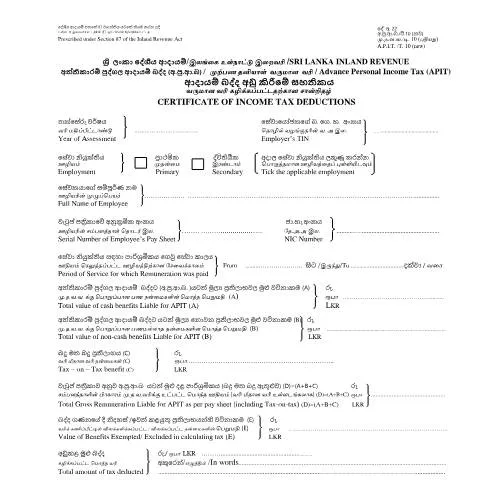
Understanding the Certificate of Income Tax Deductions (APIT_T10_2425)
The Certificate of Income Tax Deductions, designated as APIT_T10_2425, represents a pivotal document in the financial landscape of Sri Lanka for the fiscal year 2024/2025. Issued under the purview of the Advance Personal Income Tax (APIT) scheme, this certificate is primarily aimed at employees who have tax deductions applied to their monthly remunerations. It consolidates various aspects of an employee's taxable income and summarizes the tax deducted over a specified period, thus serving as an essential tool for tax reporting and compliance.
Who is Eligible for the APIT Tax Deduction Certificate?
Eligibility for obtaining the Certificate of Income Tax Deductions is predominantly tied to the employment status and corresponding income of an individual. The following criteria must be met:
- Employment Requirement: Only those who are employed and receive a salary subjected to the APIT framework can apply for this certificate.
- Tax Deduction Status: The employee must have had taxes deducted at source by their employer throughout the assessment period.
- Submission of Pay Sheets: The employee’s pay records, which illustrate income and tax deductions, must be accurately maintained and submitted by the employer.
Individuals, including expatriates who are employed in Sri Lanka, must ensure they fulfill these conditions to be eligible for the certificate.
The Legal Framework of the Certificate
This certificate derives its legal standing from the Inland Revenue Act of Sri Lanka, specifically prescribed under Section 87, which governs tax deductions and compliance. The document serves as an official confirmation of income and tax payments, making it crucial for various legal and financial processes, including:
- Income Tax Returns: This certificate must be attached to an individual's income tax return submitted to the Inland Revenue Department.
- Loan Applications: Financial institutions may require this certificate as part of their documentation to verify income stability and tax compliance.
- Employment Verification: New employers may request this certificate to substantiate an individual's previous income and tax history during hiring processes.
The Obtaining Process for the Certificate
The process to acquire the Certificate of Income Tax Deductions involves several structured steps, ensuring both accuracy and compliance. Here’s a detailed breakdown:
- Employer Preparation: Employers must compute the total income and tax deductions applicable for each employee based on their pay records.
- Completion of Form T-10: Employers are responsible for filling out the T-10 form, ensuring all requisite details regarding the employee's gross remuneration, tax deductions, and corresponding values are accurately reported.
- Submission to the Inland Revenue Department: Once completed, the employer must submit the T-10 form alongside any required documentation to the Inland Revenue Department within the stipulated deadlines.
- Issuance of Certificate: Upon approval, the Inland Revenue Department will issue the Certificate of Income Tax Deductions, which the employer will then provide to the employee.
Practical Applications of the APIT Certificate
The Certificate of Income Tax Deductions is more than just a formal document; it has several practical applications that can significantly impact an individual’s financial dealings:
- Tax Filing: It is essential for accurate tax filing, particularly when submitting the annual income tax return.
- Proof of Income: The certificate acts as a valid proof of income for various applications, including mortgages, personal loans, and rental agreements.
- Tax Refund Claims: In circumstances where excess tax has been deducted, this certificate can facilitate claims for refunds from the Inland Revenue Department.
Validity and Renewal of the Certificate
The validity of the Certificate of Income Tax Deductions pertains to the specific fiscal year for which it is issued. Typically, the certificate is valid until the end of the fiscal year (March 31 for Sri Lanka). It is crucial to note:
- If an individual changes employment during the assessment year, it may be necessary to obtain a new certificate from the new employer for tax reporting purposes.
- Should there be any discrepancies or errors in the details provided in the certificate, the employee must promptly notify their employer for amendments.
- For continued accuracy in reporting, employees are advised to keep abreast of any updates regarding their taxable income and tax laws.
Addressing Issues with the Certificate
In the event of loss, error, or contestation related to the Certificate of Income Tax Deductions, there are several proactive steps that can be undertaken:
- Loss of Certificate: If an employee misplaces the certificate, they should request a reissue from their employer, who must then liaise with the Inland Revenue Department.
- Discrepancies: Should there be inaccuracies in the reported income or tax deductions, employees must address these with their employer, who can submit a rectification request to the tax authority.
- Disputes Over Deductions: If an employee contests the amount of tax deducted, they must provide supporting documentation to their employer and may need to engage with tax officials for resolution.
Additional Considerations and Compliance Requirements
Those navigating the complexities of tax compliance need to take into consideration several additional aspects to enhance their understanding and preparedness:
| Aspect | Details |
|---|---|
| Deadline for Employers | Employers must submit the T-10 form to the Inland Revenue Department by the end of the fiscal year. |
| Documentation Required | Accurate pay records, employee National Identity Card (NIC) details, and any relevant payroll information. |
| Penalties for Non-Compliance | Failure to issue or accurately complete the Certificate of Income Tax Deductions can result in penalties for both employers and employees. |
By adhering to these practices and understanding the intricacies of the Advance Personal Income Tax system, both employers and employees can ensure they remain compliant while maximizing their tax benefits.
Understanding the Advance Personal Income Tax (APIT) Framework
The Advance Personal Income Tax (APIT) serves as a preemptive measure for the collection of income tax in Sri Lanka, allowing the government to secure tax revenue before the actual income tax returns are filed. This system is not only beneficial for fiscal planning but also assists taxpayers in spreading their tax liability over the financial year. Under this framework, individuals and businesses are required to make advance payments based on their estimated annual income, thereby reducing the potential burden of a large tax payment upon filing. The APIT is applicable to a wide array of income sources including salaries, wages, professional fees, and business profits.
Taxpayers are advised to estimate their income accurately to avoid penalties associated with underpayment. The APIT rates are structured progressively, reflecting the earners' capacity to pay, with specific exemptions and deductions available for various sectors. For instance, low-income earners may be entitled to a higher threshold before the tax rates apply. As you prepare for the 2024/2025 tax year, it is essential to stay updated on these rates and any amendments to the tax regulations. The Revenue Department (DRC) provides annual guidelines and updates through published circulars and notices accessible on their official website.
Filing and Payment Procedures for the Certificate of Income Tax Deductions
The process for obtaining the Certificate of Income Tax Deductions for the tax year 2024/2025 involves a systematic approach that begins with the correct compilation of relevant income details. Taxpayers must provide an accurate statement of all income accrued during the year, including salaries, bonuses, and any additional earnings from secondary employment or freelance projects. The documentation must align with the financial records maintained, ensuring consistency and transparency.
To facilitate the online filing process, the Sri Lankan government has implemented a user-friendly digital interface available through the official portal at forms.gov.lk. Here, taxpayers can find the dedicated section for tax filings, including helpful guides and FAQs to assist with common queries. The online submission typically requires the completion of the Application Form A.P.I.T/T.10/D(New), which should be accompanied by a digital submission of the respective income documentation and proof of previous tax payments.
Once submitted, the Department of Inland Revenue (DIR) processes the application, and taxpayers can expect to receive their certificate electronically within a specific timeframe, aiming for efficiency and ease of access. It is recommended to maintain a record of all communications and submissions for future reference and in case of any discrepancies.
Common Challenges and Pitfalls in the APIT System
While the Advance Personal Income Tax system is designed to simplify tax compliance, many taxpayers encounter various challenges that can lead to complications in their filings. One prevalent issue arises from the estimation of income, where individuals or businesses underestimate their potential earnings, often due to fluctuating market conditions or personal circumstances. Underestimating tax liabilities can result in substantial penalties and interest on underpaid taxes, creating a financial burden that could have been mitigated with a more accurate forecast.
Additionally, the complexities of tax regulations can lead to confusion regarding allowable deductions and exemptions. For example, taxpayers may fail to claim deductions on qualifying expenses such as educational expenses, contributions to retirement funds, or medical expenses. It is critical to educate oneself on the specific provisions within the Income Tax Act that detail these allowances. Regular consultation with a tax advisor or attending workshops provided by the DIR or industry organizations can prove invaluable to navigate these complexities.
Lastly, the digital submission process, while streamlined, can still pose challenges for those who may not be technologically adept. Issues such as internet connectivity, website navigation, and digital identity verification can impede timely submissions. To mitigate these challenges, taxpayers should consider visiting local DIR offices for assistance or utilizing the help of tax professionals familiar with the online process. Being proactive in addressing these potential pitfalls will ensure a smoother experience when obtaining the Certificate of Income Tax Deductions for the tax year 2024/2025.