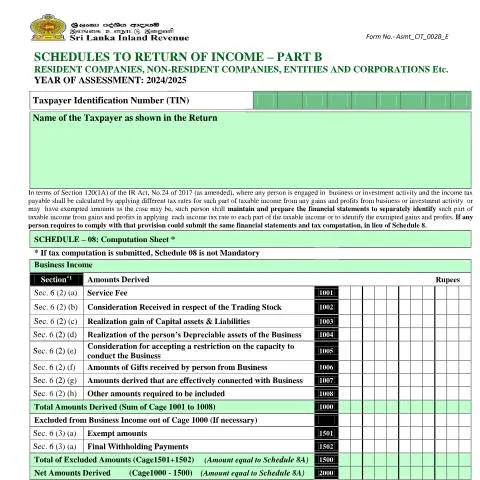
Understanding the Schedules to Return of Income – Part B: A Key Component for Corporations Operating in Sri Lanka
Engaging in business activities in Sri Lanka brings with it the necessity to navigate a complex landscape of tax obligations, particularly regarding the Income Tax Return process. For resident and non-resident companies, entities, and corporations, submitting the Schedules to Return of Income – Part B (Form No. Asmt_CIT_002B_E) is essential. This document is pivotal in calculating taxable income, detailing various income sources, deductions, and exempt amounts. In this article, we will delve into the intricacies of this essential form, clarifying its role, the particulars of its completion, and the broader context in which it operates within Sri Lanka’s tax framework.
Chronological Journey: From Assessment to Filing
Engaging with the Schedules to Return of Income begins well before submission. Understanding the timeline of this process is crucial for compliant and timely filing. Below we outline the stages from the commencement of business activities leading up to the submission of the form:
- Initiation of Business Activities: The journey starts when a business is established, and income-generating activities commence. It is advisable to obtain a Taxpayer Identification Number (TIN) at this stage.
- Financial Year Overview: Sri Lanka’s fiscal year runs from April 1st to March 31st. Businesses must keep detailed records of all financial transactions throughout this period.
- Preparation of Financial Statements: Before completing Form Asmt_CIT_002B_E, businesses must prepare their financial statements which include profit and loss statements, balance sheets, and cash flow statements, complying with Section 120(1A) of the IR Act, No. 24 of 2017.
- Completion of Schedules to Return of Income: This is the critical step where one must meticulously fill out the form, ensuring all income sources and deductions are correctly identified, and calculations are accurately executed.
- Submission Deadline: It is vital to adhere to submission deadlines, typically set by the Department of Inland Revenue (DIR) in Sri Lanka. Late submissions may incur penalties.
By methodically following these stages, businesses can ensure they remain compliant with local tax laws and regulations.
Decoding the Sections: A Comprehensive Look at the Form's Content
Form Asmt_CIT_002B_E is not a mere check-box exercise; its sections demand careful attention as they encapsulate the core of the company’s financial dealings. Each section serves a distinct purpose in the broader taxation framework:
1. Business Income
This section categorically lists various types of income derived from business activities. It is essential to differentiate accurately among service fees, trading stock considerations, and capital gains:
- Service Fee: Indicate the total amount earned through services rendered.
- Consideration Received: It encompasses income from trading stock and other business activities.
- Realization Gains: Report gains from the sale of capital assets.
2. Investment Income
Investment income encompasses earnings from various sources, which may include dividends, interests, and gains from the sale of investments. Any exempt amounts should be distinctly noted, as they can significantly impact the taxable income calculation.
3. Other Income
This section allows taxpayers to list any additional income not categorized elsewhere. Clear documentation of sources and amounts is essential to avoid discrepancies during assessments.
4. Deductions from Business and Investment Income
Deductions play a pivotal role in reducing taxable income, thus requiring meticulous recording. Various sections detail specific deductions such as:
- Allowances for trading stock
- Research and development expenses
- Losses claimed from previous years
Each deduction type has its guidelines, which necessitate proper documentation and justification.
Navigating Common Pitfalls: What Sets This Form Apart?
In the realm of tax forms, the Schedules to Return of Income – Part B has specific nuances that differentiate it from other related documents, such as the simplified tax return forms. Understanding these distinctions is crucial to avoid common pitfalls:
- Complexity of Reporting: Unlike simpler tax filings, Form Asmt_CIT_002B_E demands detailed breakdowns of income sources, requiring a more comprehensive financial understanding.
- Mandatory Sections: Certain businesses may feel tempted to overlook sections deemed non-essential; however, every segment of the form serves a purpose, especially for audits.
- Impact of Exemptions: Misreporting exempt earnings can lead to substantial penalties. Understanding which income is exempt is vital for compliance.
Timelines and Fiscal Calendars: Key Dates to Remember
Staying ahead in the submission game requires an understanding of critical deadlines. Here’s a straightforward timeline to guide taxpayers:
| Action | Date |
|---|---|
| End of Fiscal Year | March 31st |
| Preparation of Financial Statements | April 1st - June 30th |
| Submission Deadline for Form Asmt_CIT_002B_E | July 15th |
| Notification of Assessment | Within 30 days post-submission |
Understanding these dates ensures that businesses do not fall into the traps of late filing and penalties.
Addressing Special Circumstances: Unique Cases and Considerations
Businesses often operate under unique circumstances that can influence how they approach the Schedules to Return of Income. Here are a few scenarios that warrant special attention:
- Foreign Entities: Non-resident companies must familiarize themselves with specific tax rates and reporting requirements that differ from local businesses.
- Minor Corporations: Entities owned by minors may need additional disclosures to validate income sources and interests.
- Complex Ownership Structures: Companies with intricate shareholding scenarios, such as trusts or partnerships, should consult with professionals to navigate reporting appropriately.
Each of these cases presents unique challenges but understanding and addressing them proactively can mitigate future compliance issues.
Document Preparation: Building a Robust Supporting Case
Proper documentation serves as the backbone of the Schedules to Return of Income. Businesses should be diligent in compiling a robust set of supporting documents, including:
- Financial Statements: Comprehensive statements outlining income, expenses, and profit margins.
- Tax Computations: Detailed calculations reflecting how income tax obligations are derived.
- Supporting Invoices and Receipts: All claims made on the form should be backed by authentic documentation to facilitate audits.
Assembling this information in an organized fashion can streamline the process and reduce the likelihood of discrepancies during assessments.
The Legal Framework: Rationale Behind the Form
Understanding the legal context surrounding the Schedules to Return of Income is crucial for comprehending its necessity. Governed by the Income Tax Act No. 24 of 2017 and amendments, the form is integral to meeting statutory obligations. The Electronic Transactions Act further facilitates the digital submission of this form, reflecting Sri Lanka's commitment to modernizing its tax administration.
In compliance with the law, businesses engaging in investment activities are required to maintain detailed financial records that segregate taxable income, exempt amounts, and deducible expenses. The form provides a structured method through which businesses can meet these regulatory requirements efficiently.
As businesses in Sri Lanka continue to evolve and grow, understanding the intricacies of the Schedules to Return of Income – Part B remains fundamental to operating within a compliant and lawful framework.
Understanding Schedules to Return of Income – Part B - [Asmt_CIT_002B_E]
The Schedules to Return of Income – Part B - [Asmt_CIT_002B_E] is a crucial document for entities operating in Sri Lanka, specifically for companies and other tax-resident entities. This part of the return focuses on details pertinent to the computation of income tax liability, including information required under the Income Tax Act. It is essential for tax practitioners and corporate entities to understand the nuances of this schedule in order to ensure compliance and optimize tax positioning.
The Schedule typically requires detailed disclosures of various income streams including but not limited to business income, investment income, and capital gains. Proper categorization of these incomes is vital since each type may be taxed at different rates or subject to specific exemptions. Additionally, entities must substantiate their claims for deductions against these incomes, necessitating adequate record-keeping practices to support any expenses claimed.
It’s noteworthy that the layout of Part B follows a structured format—starting with identification details such as the National Identity Card (NIC) number, business registration details, and fiscal year reference, followed by sections dedicated to income computation and tax liability calculations. Entities are advised to carefully check the alignment of figures as discrepancies may lead to further scrutiny from the Department of Inland Revenue (DIR).
Filing Requirements for Non-Resident Entities
For non-resident entities operating in Sri Lanka, the filing requirements under the Schedules to Return of Income – Part B - [Asmt_CIT_002B_E] present unique challenges. Non-residents are typically subject to withholding tax on Sri Lankan-source income, yet they must still comply with the income tax return filing obligations depending upon the nature of their business activities within the jurisdiction.
Non-residents must provide comprehensive details about income derived from Sri Lanka, including any profits from contracts executed within the country. The Schedule requires a submission of exhaustive explanations regarding the source and nature of the income, along with any allowable deductions. Moreover, it’s crucial for non-resident companies to assert their tax residency in their home country, as tax treaties may provide relief from double taxation, affecting their tax liabilities in Sri Lanka.
In addition, non-resident entities must be cognizant of the ramifications of their operational structure—whether they are functioning through a Permanent Establishment (PE) or purely as an investment entity. The classification can change the compliance landscape significantly, necessitating specialized tax advice to navigate complexities surrounding local laws and international tax treaties.
Common Errors in Completing Schedule Part B
While completing the Schedules to Return of Income – Part B - [Asmt_CIT_002B_E], certain errors are frequently observed, which could lead to administrative penalties or prolonged assessment processes. Common pitfalls include inaccurate reporting of income, misclassifying expenses, and failing to comply with prescribed deadlines.
One major error involves the misreporting of revenue streams. Entities must ensure that all income categories are distinctly recognized and reported in accordance with the definitions outlined by the DIR. Failure to do so may trigger an audit, especially if reported figures appear inconsistent or unrealistic in comparison to past filings.
Another prevalent mistake is in the area of deductions. Certain expenses may not qualify for tax deductions, which can lead to inflated expense claims. For instance, personal expenses mistakenly categorized as business expenses can complicate the return, which may ultimately result in a tax assessment and penalties. Entities are urged to maintain accurate financial records and work closely with tax professionals to validate the eligibility of each expense reported.
Finally, adherence to the filing deadlines cannot be overstated. The Sri Lankan fiscal calendar operates on a fixed schedule, and any delay in filing can lead to both financial penalties and interest charges on unpaid taxes. Entities are encouraged to implement robust compliance systems to monitor and ensure timely submissions of all tax-related documents.