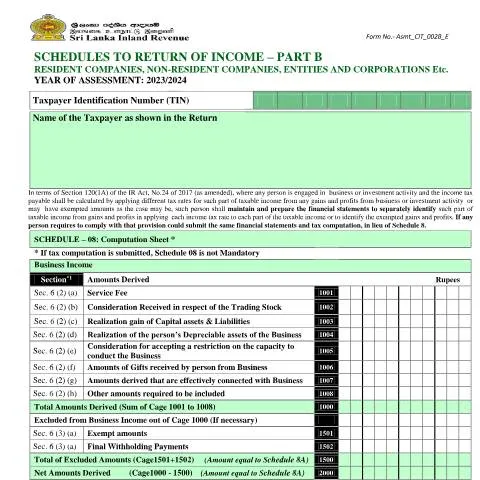
Understanding the Schedule to Return of Income – Part B
The Schedule to Return of Income, specifically Form No. Asmt_CIT_002B_E, represents a crucial component of the tax compliance framework for Resident and Non-Resident Companies, Entities, and Corporations in Sri Lanka. This detailed document serves to accurately declare taxable income, outlining the financial activities of the taxpayer over the assessment year 2023/2024. Failure to correctly file this schedule may lead to significant repercussions, including penalties and interest charges on unpaid taxes.
Historical Context and Regulatory Framework
The introduction of this schedule is rooted in the principles outlined by the Income Tax Act No. 24 of 2017, which aims to regulate the taxation of businesses and investments in Sri Lanka. Amendments to the Act have clarified the obligations of various entities, emphasizing the need for transparent reporting of income. The incorporation of the Electronic Transaction Act enables filers to submit their schedules digitally, promoting efficiency and streamlining the tax administration process.
This regulatory framework necessitates that any individual or entity conducting business or investment activities must maintain accurate financial statements that distinguish between different income sources. Such clarity is essential for applying the respective tax rates and claiming any exemptions. The Schedule to Return of Income – Part B is therefore pivotal in ensuring compliance with these requirements.
Who Must File and Special Considerations
This schedule must be completed by all Resident Companies, Non-Resident Companies, Entities, and Corporations engaged in business or investment activities within Sri Lanka. Let us break down the profiles that are obligated to file this schedule:
- Resident Companies: Entities legally registered under Sri Lankan laws, which must submit their income details for taxation purposes.
- Non-Resident Companies: Foreign entities that have income sourced from Sri Lanka are also required to file, albeit with specific guidelines regarding their taxable income.
- Entities and Corporations: This includes partnerships and corporate bodies that engage in economic activities generating taxable income.
There are exceptions based on the type and extent of activities conducted, such as small businesses that might qualify for simplified tax treatments. Additionally, foreign entities must ensure they are compliant with local laws when filing, as misunderstanding local obligations can lead to severe tax liabilities.
Consequences of Non-Compliance
Failing to file the Schedule to Return of Income – Part B or inaccuracies within can result in serious implications:
- Financial Penalties: The tax authorities impose fines for late submissions, which can accumulate daily until the issue is resolved.
- Interest Charges: Any unpaid taxes will incur interest, further increasing the total amount owed.
- Legal Consequences: Persistent non-compliance can lead to legal actions taken by the tax administration, affecting the business’s reputation and operations.
Taxpayers are strongly advised to approach their filings with diligence to avoid these potential pitfalls, focusing on the comprehensive details captured within the schedule.
Decoding the Schedule: Detailed Breakdown
The Schedule to Return of Income – Part B consists of multiple sections that require careful attention. Here, we will explore the key components, including the specific lines within the schedule that need to be filled out, and the common pitfalls.
Business Income Section
This section requires declaration of income derived from business activities. Key lines include:
- Service Fees (Sec. 6(2)(a)): Total income from services rendered.
- Consideration Received (Sec. 6(2)(b)): Revenue from trading stock.
- Realization Gains (Sec. 6(2)(c)): Profits from sale of capital assets.
Each of these entries must be substantiated with proper documentation. Common errors include omitting income sources or miscalculating totals, leading to discrepancies that could trigger audits.
Investment Income Section
Filing under this section requires breaking down investment income. Important elements include:
- Dividends, Interest, and Gains (Sec. 7(2)(a) to (e)): All income generated from investments must be declared.
Attention must be paid to ensure that exempt amounts are correctly identified, as any failure could result in taxable amounts being incorrectly reported.
Other Income Section
In this section, taxpayers must declare any income not classified under business or investment income:
- Gains and Profits from Other Sources (Sec. 8(1)): This can include miscellaneous income streams that do not fall under other categories.
Accuracy is paramount here, as incomplete reporting can have severe tax consequences.
Net Income Computation
After detailing each income source, taxpayers must compute their net assessable income. The calculations involve:
- Total Deductions: Claiming allowable expenses is crucial to accurately determine the tax owed.
Taxpayers must be vigilant about correctly applying deductions as per the relevant sections of the tax act. Misinterpretations may provide either an unwarranted tax liability or an unjustified claim for refund.
Integration with Broader Tax Procedures
The Schedule to Return of Income – Part B is not an isolated document; it forms part of an extensive tax compliance system. After completion, this schedule must be submitted following the procedures outlined by the Inland Revenue Department (IRD).
The schedules are used in conjunction with the annual tax return, where all income and expenses must be compiled comprehensively. Thus, keeping organized records throughout the fiscal year is advised to simplify the filing process.
Comparative Analysis with Similar Documents
It is important to differentiate the Schedule to Return of Income – Part B from other similar forms, such as Schedule 8, which is often confused with this document. While both serve the purpose of income declaration, the key differentiators include:
| Document | Purpose | Entities Applicable | Submission Frequency |
|---|---|---|---|
| Schedule to Return of Income – Part B | Declaration of income for tax calculation | Resident and Non-Resident Companies, Entities | Annually |
| Schedule 8 | Computation of specific tax liabilities | All taxpayers under the Income Tax Act | As required based on assessments |
Confusion between these documents can lead to incorrect filings. It is imperative for taxpayers to familiarize themselves with the specific purpose and requirements of each form to ensure compliance.
Addressing Errors and Managing Refusals
In the event of an error in the submitted Schedule to Return of Income – Part B, it is crucial to address discrepancies promptly. Taxpayers should:
- Review the schedule thoroughly against supporting documents to pinpoint errors.
- Contact the Inland Revenue Department for clarification on how to rectify submission mistakes.
- File an amended return if necessary, ensuring that the corrections are well-documented to avoid penalties.
If the submission is refused, taxpayers should seek feedback on the reasons why. Engaging with tax professionals can provide guidance on next steps, including the potential for appeals.
Conclusion: Navigating the Tax Compliance Landscape
The completion and submission of the Schedule to Return of Income – Part B is a vital process for maintaining compliance with Sri Lankan tax laws. By understanding the nuances of the requirements and being diligent in reporting, taxpayers can fulfill their obligations while minimizing the risk of penalties. Regular engagement with the tax administration and consulting with professionals will further enhance the quality of tax compliance and financial management.
Understanding the Importance of Schedules in the Return of Income
In the context of the Return of Income for Corporate Income Tax (CIT) in Sri Lanka, the Schedules serve an essential role in ensuring accurate reporting and compliance with local tax regulations. The Schedules are designed to provide detailed information concerning various aspects of a company’s financial performance, transactions, and obligations, thus enabling the Department of Inland Revenue (DIR) to assess tax liabilities effectively.
The Schedules included in Part B of the Return of Income allow corporations to break down specific income sources, expenses, and deductions. These sections help the DIR to verify the completeness and accuracy of the information reported in the primary income return. It is crucial for entities to approach these Schedules meticulously, as any discrepancies or omissions could lead to significant penalties or audits.
For instance, Schedule of Other Income requires corporations to disclose all sources of income beyond their primary business activities. This may include rental income, interest earned, or dividends received. Properly completing this Schedule not only ensures compliance but also presents an opportunity for companies to optimize their tax positions by claiming allowable deductions and credits.
Key Considerations When Filling Out Schedules to Return of Income
When preparing the Schedules to Return of Income, there are several critical considerations that taxpayers must keep in mind to ensure compliance and accuracy in reporting.
- Document Retention: Corporations should maintain thorough documentation for all transactions reported in the Schedules. This includes invoices, receipts, and contracts, which should be readily available for reference in the event of a tax audit.
- Timely Submission: Adherence to submission deadlines is of utmost importance. The fiscal year in Sri Lanka runs from April 1 to March 31, and the annual tax return must typically be submitted within 30 days of the end of the fiscal year. Failure to meet deadlines can result in penalties.
- Consulting Tax Professionals: Given the complexity of tax laws and the nuances of the Schedules, it is recommended that entities seek advice from tax professionals. These experts can provide valuable insights on how to navigate the intricacies of tax compliance and may highlight tax planning opportunities that could minimize liabilities.
Common Errors to Avoid in Completing Part B of the Return of Income
Many companies encounter common pitfalls when completing Part B of the Return of Income. Being aware of these mistakes can help taxpayers to avoid costly errors and streamline their filing process.
- Inconsistent Reporting: It is essential to ensure that the information reported in the Schedules is consistent with financial statements and prior tax filings. Any discrepancies can lead to questions from the DIR. For example, if a company reports a different revenue figure in the Schedule compared to its audited financial statements, it could trigger an audit.
- Overlooking Deductions: Many taxpayers overlook eligible deductions that can significantly reduce taxable income. Commonly missed deductions may include business expenses, research and development credits, and depreciation allowances. Properly identifying and claiming these deductions can optimize tax liabilities.
- Failure to Update Information: Companies should regularly update their corporate information and relevant financial data, as inaccuracies can lead to complications. This includes ensuring that all shareholdings, ownership structure, and legal status are accurately reflected in the tax return.