Understanding the Schedules to Return of Income – Part B
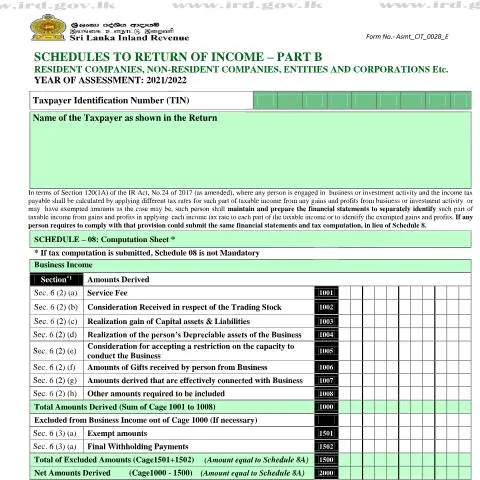
The Schedules to Return of Income – Part B (Form No. Asmt_CIT_002B_E) is a critical document for both resident and non-resident companies, entities, and corporations operating within Sri Lanka. This form provides the framework for reporting various sources of income for the assessment year, facilitating compliance with the Income Tax Act No. 24 of 2017, as amended. It plays a fundamental role in the country’s tax administration, ensuring that all entities adhere to the necessary tax obligations, thereby contributing to national revenue.
The Regulatory Framework: Historical and Current Context
The legal foundation for the Schedules to Return of Income is rooted in the Income Tax Act, established to regulate taxation in Sri Lanka. The Act mandates that entities engaged in business or investment activities must report their income accurately. Specifically, Section 120(1A) requires the reporting of taxable income, distinguishing between different income types and applying appropriate tax rates. Historically, tax compliance has evolved to incorporate digital transformations through the Electronic Transaction Act, enhancing the efficiency and accessibility of filing processes.
Preparing the Documentation: Identifying Required Justifications
Completing the Schedules to Return of Income requires meticulous preparation of financial statements. Companies must categorize their income sources and corresponding deductions effectively. The schedule outlines various sections for business, investment, and other income, necessitating distinct reporting for:
- Business Income: This includes income from service fees, trading stock, realization gains, and gifts related to business activities.
- Investment Income: Entities must report dividends, interest, and gains from the realization of investment assets, among other items.
- Other Income: This encompasses miscellaneous gains and profits not classified under business or investment activities.
Each source must be supported by relevant documentation, such as financial statements, supporting invoices, and records of capital transactions. The preparation of these documents should take into account varying tax treatments applicable to distinct income sources.
Filing Process: Channels and Methods
The submission of the Schedules to Return of Income can be completed through various channels, aligning with the government's push for digitalization. Taxpayers can choose between:
- Online Submission: Via ICTA’s dedicated platform (forms.gov.lk), where electronic forms can be filled and submitted directly.
- Paper Submission: Traditional filing is still an option, where completed forms can be mailed or delivered in person to the relevant tax office.
- Through Authorized Agents: Taxpayers may also opt to engage tax consultants or authorized agents for submission on their behalf, ensuring compliance with local regulations.
Each method has implications for processing times and documentation requirements, making it essential to consider which approach best suits the entity’s operational structure.
Understanding the Filing Calendar: Key Dates and Implications
The filing calendar for the Schedules to Return of Income is crucial for ensuring compliance and avoiding penalties. The tax year in Sri Lanka typically runs from April 1st to March 31st. The key dates include:
| Event | Date | Remarks |
|---|---|---|
| End of Financial Year | March 31 | Financial records should be finalized by this date. |
| Deadline for Submission | Within 6 months after the financial year-end | Late submissions may incur penalties. |
| Assessment Notice Issued | Typically within 30 days after the filing deadline | Taxpayer must be prepared for potential assessments or inquiries. |
Failure to adhere to these timelines can result in significant repercussions, including fines and interest on unpaid taxes. Keeping abreast of the fiscal calendar is essential for effective tax planning.
Post-Submission: Administration Review and Follow-Up
Once the Schedules to Return of Income are submitted, they are subject to review by the Department of Inland Revenue (DIR). The administration will assess the accuracy of reported income and deductions. Taxpayers may need to:
- Respond to inquiries or requests for additional documentation.
- Provide clarifications regarding income sources or deductions.
- Prepare for possible audits if the return raises any flags.
Entities should maintain organized records and documentation to facilitate any potential reviews. A proactive approach can significantly ease the audit process and foster a positive relationship with the tax authorities.
Tax Computation: Understanding Deductions and Exemptions
Accurate reporting of deductions is vital when completing the Schedules to Return of Income. Entities must comprehensively understand allowable deductions that directly impact their taxable income. Common deductions include:
- Trading Stock Allowances: Proper calculation of opening and closing stock values to determine allowable deductions.
- Repairs and Improvements: Expenses must be categorized and documented to qualify as deductible.
- Investment Incentives: Certain tax deductions available to encourage capital investments within specified sectors.
Each deduction must be substantiated with adequate documentation. In instances of complex income types or substantial deductions, consultation with tax professionals may be advisable to optimize tax liabilities legally.
Challenges and Considerations for Non-Resident Entities
Non-resident companies face unique challenges when completing the Schedules to Return of Income. Understanding local tax laws and their implications can be daunting. Key considerations include:
- Withholding Tax Obligations: Non-residents must comply with withholding tax rates applicable to income generated within Sri Lanka, posing additional reporting responsibilities.
- Double Taxation Agreements (DTAs): Familiarity with any existing DTAs can inform tax liabilities and reporting requirements.
- Local Representation: Engaging local tax consultants may facilitate a smoother filing process and compliance with local regulations.
Non-resident entities must ensure compliance with both local regulations and the intricacies of international tax law, which can significantly affect their tax obligations.
Final Remarks: The Importance of Compliance
Adhering to the requirements set forth in the Schedules to Return of Income is vital for all entities operating within Sri Lanka. Timely and accurate submission helps maintain good standing with tax authorities, contributing to a transparent and accountable business environment. Additionally, awareness of the regulations and preparation of necessary documentation are essential components of effective tax management.
In a rapidly evolving regulatory landscape, entities must remain vigilant and adaptable, ensuring they meet their obligations while capitalizing on available deductions and incentives. Engaging with tax professionals and leveraging available resources can significantly enhance compliance efforts and operational success.
Understanding the Schedules to Return of Income - Part B
The Schedules to Return of Income - Part B is a crucial component of the tax filing process for companies operating in Sri Lanka, especially for resident and non-resident entities. This section primarily focuses on various additional disclosures and computations that are mandatory for an accurate income tax assessment. Understanding the intricacies of this schedule is essential for compliance with the Inland Revenue Department (IRD) regulations under the Income Tax Act.
Entities are required to provide details about their financial performance, including the computation of chargeable income, adjusted profits, and any exemptions or deductions that may apply. Businesses should scrutinize the entire range of expenses that can be deducted to arrive at the taxable income. This includes capital allowances, losses carried forward, and any qualifying charitable contributions made during the fiscal year.
Part B typically necessitates detailed breakdowns of income sources, which may vary based on the nature of the business activities. Companies are advised to maintain meticulous records, as the IRD may request supporting documentation to validate the figures presented in this schedule. Moreover, being thorough and transparent in these disclosures can help mitigate risks during audits or reviews.
Implications of Non-Compliance with Part B Schedules
Failure to comply with the requirements set forth in the Schedules to Return of Income - Part B can lead to significant implications for businesses in Sri Lanka. The IRD takes non-compliance seriously, as it undermines the integrity of the tax system. Consequently, entities that do not submit accurate or complete returns may face penalties or additional assessments.
One of the most immediate repercussions is the imposition of fines or surcharges, which can escalate if the IRD deems the non-compliance to be willful or negligent. Additionally, incorrect submissions can lead to protracted audits, resulting in further scrutiny of the company's financial activities. This not only distracts management from core operations but can also damage the company's reputation in the business community.
Furthermore, persistent non-compliance can result in the suspension of business registrations or permits. Companies may find themselves unable to operate legally until they rectify outstanding tax issues. As such, it is prudent for businesses to engage tax professionals or consultants who are well-versed in local tax laws and can assist in ensuring compliance with the Schedules to Return of Income - Part B.
Best Practices for Filing Schedules to Return of Income - Part B
To ensure a smooth and compliant filing process for the Schedules to Return of Income - Part B, companies should adopt several best practices. These practices not only enhance the accuracy of submitted information but also contribute to a more efficient tax reporting process.
First and foremost, maintaining a robust accounting system is vital. Utilizing accounting software that aligns with local regulations can drastically reduce the margin for error in calculations and reporting. Regular reconciliations should be performed to align accounting records with bank statements, ensuring that discrepancies are addressed promptly.
Secondly, training staff members involved in the tax reporting process is critical. Employees should be well-informed about the legal requirements and nuances of the Schedules to Return of Income - Part B. Regular training sessions and updates on tax law changes can facilitate a culture of compliance within the organization.
Lastly, companies should consider the merits of engaging with tax consultants or legal experts who specialize in Sri Lankan tax law. These professionals can provide valuable insights into deductions applicable to specific industries and help navigate complex regulatory frameworks. Additionally, they can assist in preparing the Schedules to Return of Income - Part B to ensure all disclosures are accurate and complete, averting potential issues down the line.