Navigating the APIT Annual Statement: Your Essential Guide
As the financial year approaches its end, employers in Sri Lanka face the critical task of accurately reporting their employee taxes. The Instructions to Complete the Annual Statement of Employer and Schedules for the Advance Personal Income Tax (APIT) are indispensable for ensuring compliance with the Inland Revenue Act. Let's delve into this guide to understand its significance, structure, and practical application.
Understanding the APIT Annual Statement and its Schedules
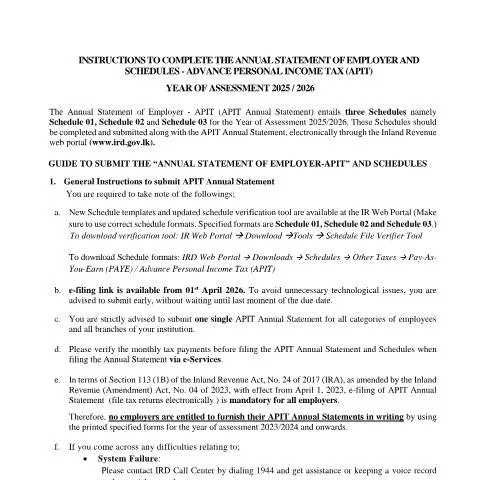
The APIT Annual Statement comprises three key components: Schedule 01, Schedule 02, and Schedule 03, which must be completed for the Year of Assessment 2025/2026. Each schedule serves a distinct purpose:
- Schedule 01: Covers employees from whom tax has been deducted under the APIT scheme.
- Schedule 02: Focuses on terminal benefits and their respective tax deductions.
- Schedule 03: Captures employees on primary and secondary employment whose tax has not been deducted.
These schedules must be submitted electronically through the Inland Revenue Department (IRD) web portal. Familiarizing yourself with these schedules and their roles is crucial for accurate reporting.
Key Components of the Annual Statement
The Annual Statement itself encompasses several parts that employers need to pay close attention to:
- Part I: This section demands the number of employees categorized by whether tax was deducted or not. Information recorded here directly connects to the relevant schedules.
- Part II: Here, you report exemptions and total remunerations that are liable for taxation, as well as payments made excluding any penalties or interest. This part requires meticulous attention to detail, especially regarding the calculations of gross remuneration and taxes.
- Part III: This section is a declaration where the employer certifies that the information provided is accurate and complete.
Practical Steps for Completing the APIT Statement
To effectively utilize the APIT Annual Statement and its schedules, employers should follow a structured approach:
- Download the Necessary Templates: Utilize the IRD web portal to access the most current versions of the schedules and the verification tool.
- Compile Employee Data: Gather all necessary information regarding your employees, paying particular attention to changes in employment status during the reporting period.
- Complete Each Schedule: Ensure that entries correspond accurately to the data collected. Double-checking entries against employee records can prevent costly mistakes.
- Verify Monthly Tax Payments: Before submission, confirm that all monthly tax deductions align with the figures reported in the schedules.
- File Electronically: Submit the completed Annual Statement and accompanying schedules through the IRD e-filing system. Remember, the e-filing link becomes active from April 1, 2026.
Importance of Timely Submission and Common Missteps
Timely submission of the Annual Statement is not just a regulatory requirement—it is essential for maintaining good standing with the IRD. Late filings can incur penalties, which are best avoided through proactive management:
- Submit Early: Do not wait until the last moment to file your statement. Early submissions reduce the risk of technological failures that could delay processing.
- One Statement Rule: Employers must submit a single APIT Annual Statement covering all employees across all branches, which can streamline the process but requires comprehensive data collection.
- Adhere to Electronic Filing Regulations: As per the amended Inland Revenue Act, e-filing is mandatory for all employers, eliminating the option to submit printed forms.
Decoding the Terminology: Key Concepts for Employers
Understanding the terms and concepts within the APIT framework is pivotal for avoiding misinterpretations. Here are some fundamental terms you should be familiar with:
- Primary Employment: Refers to the main job of the employee from which their primary tax deductions are made.
- Secondary Employment: Any additional employment that may also incur tax obligations.
- Gross Remuneration: The total earnings before any deductions, which is critical for accurate tax reporting.
- Exempt Remuneration: Income that is not subject to tax under the provisions of the Inland Revenue Act.
Dealing with Challenges: Support Resources Available
Employers may encounter various challenges while completing their APIT Annual Statement. There are resources available to assist:
- IRD Call Center: For issues related to system failures, employers can reach the IRD Call Center at 1944 for immediate assistance.
- Central Document Management Unit: For difficulties specifically related to uploading or verifying schedules, the CDMU can be contacted at designated numbers for support.
- Nanasala Services: Employing the services of Nanasala stations located at IRD offices can provide on-ground support for employers needing hands-on assistance.
Final Thoughts on Efficient Tax Reporting
Completing the APIT Annual Statement and its schedules may seem daunting, but breaking it down into manageable steps can significantly ease the process. By understanding the requirements, adhering to timelines, and utilizing available resources, employers can ensure a smooth filing experience that aligns with regulatory expectations.
As the financial landscape evolves with technological advancements and regulatory changes, remaining informed and proactive will aid in navigating the complexities of tax reporting in Sri Lanka.
Understanding the Structure of the Annual Statement of Employer
The Annual Statement of Employer is a comprehensive document that provides a detailed overview of an employer’s financial obligations and salary distributions towards their employees within a given fiscal year. This statement not only serves as a record for the employer but also ensures compliance with the Pay As You Earn (PAYE) system. Employers are required to capture various elements within the statement, including gross salaries, deductions, and net payments made to employees. The statement must also reflect any contributions made to the Employees Provident Fund (EPF) and Employees Trust Fund (ETF), as mandated by Sri Lankan employment regulations.
The structure of the Annual Statement typically comprises the following components:
- Employer Information: This includes the employer's name, address, and tax identification number, ensuring proper identification by the Department of Inland Revenue (DIR).
- Employee Details: Each employee's National Identity Card (NIC) number, full name, and relevant employment details must be accurately presented.
- Salary Breakdown: A detailed list of gross salaries, allowances, bonuses, and any other compensations must be categorized appropriately.
- Deductions: This section will encompass statutory deductions such as PAYE taxes, EPF contributions, and ETF deductions, clearly delineating the amounts deducted from each employee's salary.
- Net Payments: After deductions, the net payment made to each employee must be calculated and displayed.
- Summary Section: Employers must summarize total gross salaries, total deductions, and total net payments, providing a quick reference for the overall payroll expenditure.
In preparing the Annual Statement, it is imperative for employers to ensure that all information is accurate and corroborated by payroll records. Discrepancies can lead to penalties imposed by the DIR, making meticulous record-keeping and validation essential.
Important Deadlines for Submission and Compliance
One of the critical aspects of the Annual Statement of Employer process is adherence to submission deadlines established by the Department of Inland Revenue (DIR). Employers must be aware of the specific dates that correspond to the fiscal calendar of Sri Lanka to ensure compliance and avoid penalties.
Typically, the Annual Statement must be submitted by the end of the fiscal year, which concludes on March 31st. Employers are required to file the statement within one month after the end of the fiscal year, making the deadline for submission April 30th. However, it is advisable for employers to consult the latest notifications from the DIR as these deadlines may be subject to change based on administrative decisions or exceptional circumstances.
A delay in the submission of the Annual Statement can result in significant consequences, including financial penalties and interest charges. The DIR may impose a fine for late submissions, along with additional fees for each month the statement remains unfiled. Furthermore, failure to comply with employment-related statutory regulations could complicate future tax obligations and affect the employer’s standing with the tax authorities.
To ensure timely submission, employers are encouraged to establish a system for tracking and monitoring submission dates and to integrate this into their payroll systems. Utilizing reminders and alerts can significantly reduce the risk of missing these crucial deadlines.
Common Errors to Avoid When Completing the Annual Statement
While completing the Annual Statement of Employer, employers may encounter several common pitfalls that could jeopardize the accuracy of their submissions. It is essential to be aware of these errors to prevent unnecessary complications with the Department of Inland Revenue (DIR).
Some common errors include:
- Incorrect Employee Information: Failing to verify that the employee's NIC number, name, and other identifying details are accurate can cause delays in processing the statement. Employers should cross-reference these details with official documentation.
- Miscalculated Deductions: Errors in calculating statutory deductions such as PAYE, EPF, and ETF contributions can lead to significant discrepancies. Employers must ensure they are using the correct tax rates and deduction limits as prescribed by local regulations.
- Inaccurate Salary Breakdown: Overlooking allowances or bonuses when reporting gross salaries can result in incomplete information. It is important to thoroughly review payroll records to ensure a comprehensive depiction of total compensation.
- Failing to Report Changes in Employment Status: Employers must account for any changes in employee status, such as terminations or new hires, within the reporting period. Neglecting to include these changes can create inconsistencies.
- Not Keeping Accurate Records: Maintaining proper documentation and records of payroll transactions throughout the year is critical. Lack of accurate records can lead to challenges during the auditing process.
By being cognizant of these potential errors and implementing best practices for data accuracy, employers can facilitate a smoother process for completing the Annual Statement of Employer and ensure compliance with the regulatory framework in Sri Lanka.