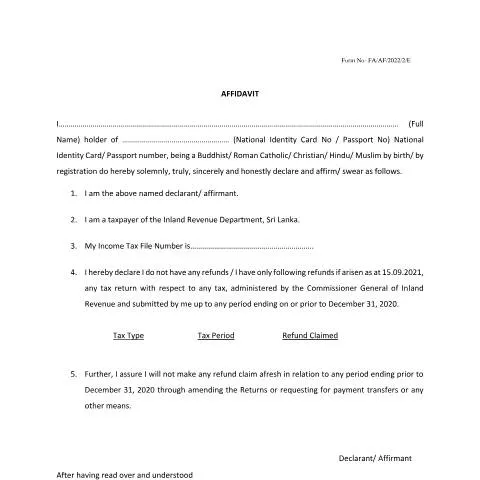
The Importance of the Affidavit – Individual in the Tax Write-Off Process
In the realm of Sri Lanka's tax regulations, the Affidavit – Individual serves as a pivotal document for taxpayers seeking to initiate a write-off of default tax under the auspices of the Inland Revenue Department. This affidavit serves not only as a declaration of taxpayer status but also as a significant instrument in confirming the lack of claims or refunds related to tax periods prior to December 31, 2020. With the implications of this affidavit being extensive, it is essential to understand its role within the broader context of tax compliance and obligations.
Navigating the Submission Channels: Online vs. Offline
The Affidavit – Individual can be submitted through various channels, reflecting the Sri Lankan government's commitment to facilitating digital engagement with its citizens. Understanding the nuances of these channels can significantly ease the submission process.
Online Submission via ICTA Portal
For those comfortable with digital processes, submitting the affidavit online through the ICTA digital government forms portal offers a streamlined experience. It allows taxpayers to fill out and submit the form directly from their devices, ensuring safety and efficiency. To utilize this method:
- Access the relevant form on forms.gov.lk.
- Complete the fields, ensuring all information is accurate and reflective of your tax situation.
- Submit the form electronically, retaining a confirmation receipt for your records.
Paper-Based Submission for Traditionalists
Alternatively, the affidavit can be submitted in a traditional paper format. This method may appeal to those who prefer tangible documentation. The process involves the following steps:
- Download the affidavit from the official website or obtain a hard copy from the local Inland Revenue office.
- Accurately complete the affidavit, double-checking all entries.
- Submit the completed affidavit to the appropriate local Inland Revenue office. It is advisable to ask for acknowledgment of receipt.
In-Person Submission at Designated Offices
For individuals who seek direct engagement, submitting the affidavit in person at designated offices is an option. Engaging face-to-face can provide immediate clarification on any issues. However, it is essential to check office hours and potential waiting times to avoid inconvenience.
Placing the Affidavit in the Context of Tax Responsibilities
Completing and submitting the Affidavit – Individual is not an isolated task; rather, it integrates into a larger framework of tax responsibilities. This document acts as proof that a taxpayer has settled their obligations concerning refund claims.
Understanding the Tax Compliance Cycle
The role of the affidavit becomes clearer when viewed through the lens of the tax compliance cycle, which consists of:
- Tax Return Submission: Taxpayers are required to file their returns timely.
- Assessment of Tax Obligations: The Inland Revenue Department assesses returns and determines taxation amounts.
- Refund Claims (if applicable): Taxpayers identify potential refunds for overpayment.
- Submission of Affidavit: To solidify refund claims or declare the absence of valid claims, the affidavit is submitted.
This cycle emphasizes the importance of accurate documentation and timely submissions to maintain good standing with the Inland Revenue Department.
Key Dates and the Timeline of Actions
Understanding the timeline associated with the Affidavit – Individual is crucial for compliance and avoiding pitfalls.
Critical Dates
| Action | Deadline |
|---|---|
| Tax Return Filing for the Year | By October 31 of the following year |
| Affidavit Submission for Claims | Prior to December 31, 2021 |
| Notification of Refund Decisions | Within three months post-affidavit submission |
Adhering to these dates ensures that taxpayers can manage their obligations effectively and avoid unnecessary complications.
Implications for Taxpayers: Rights and Obligations
The submission of an affidavit entails specific rights and obligations for the taxpayer. Recognizing these can enhance compliance and minimize risks.
Rights Conferred by the Affidavit
- Right to Transparency: Taxpayers have the right to know the status of their tax filings and any refund claims being processed.
- Right to Representation: Taxpayers can seek representation or assistance during the affidavit submission process.
Obligations Resulting from Submission
- Duty of Accuracy: All information provided in the affidavit must be accurate and truthful.
- Non-Submission of Fresh Claims: Taxpayers must adhere to the declaration made in the affidavit, which states no new claims will be made for periods prior to December 31, 2020.
Failure to comply with these obligations can lead to penalties or complications in future tax filings.
Special Cases: Navigating Unique Situations
Not all taxpayers have standard situations; some may find themselves in unique circumstances attracting specific considerations when submitting the affidavit.
Foreign Nationals and Their Responsibilities
Foreign nationals residing in Sri Lanka or those with income generated from Sri Lankan sources must be aware of the additional documentation potentially required when submitting the Affidavit – Individual. This may include:
- Valid Residency Documentation
- Proof of Income Sources
It is advisable to consult with a local tax advisor to ensure compliance with all local regulations.
Minors and Guardianship Considerations
In cases where the individual is a minor, the affidavit must be submitted by a guardian or parent. The following must be taken into account:
- Legal documentation establishing guardianship must accompany the affidavit.
- Careful attention must be paid to ensure that all tax responsibilities are outlined and submitted correctly on behalf of the minor.
Complex Personal Situations
Taxpayers experiencing complex situations, such as marital disputes or joint filings, should be aware that the affidavit may require additional clarifications or disclosures. Clear communication with the Inland Revenue Department is advisable to navigate these complexities.
The Path Forward: After Submission
After the successful submission of the Affidavit – Individual, taxpayers may be left wondering what the next steps entail.
Post-Submission Confirmation
Upon submitting the affidavit, taxpayers should expect to receive an acknowledgment receipt, which serves as proof of submission. It is critical to retain this document for future reference.
Review and Decision Timeline
Typically, the Inland Revenue Department will review the submitted affidavit and related documents within three months. Taxpayers can expect one of the following outcomes:
- Approval of Affidavit: If the affidavit is approved, the taxpayer will be notified of their current tax standing and any applicable write-offs.
- Request for Additional Information: In some cases, the department may seek further clarification or documentation before making a decision.
- Denial of Affidavit: If the affidavit is denied, taxpayers will be provided with reasons and may need to reassess their tax situation.
Conclusion: Empowering Taxpayers Through Knowledge
The Affidavit – Individual is more than just a document; it is a vital tool in the landscape of tax compliance in Sri Lanka. By understanding its implications, submission processes, and responsibilities, taxpayers can position themselves effectively within the existing tax framework. Whether navigating through online platforms, handling complex personal circumstances, or simply ensuring compliance, informed taxpayers are empowered to make sound decisions regarding their tax obligations.
Understanding the Role of Affidavits in Legal Proceedings
Affidavits play a crucial role in the legal landscape of Sri Lanka, particularly in civil and family law cases. An affidavit is a written statement that is made under oath and can be used as evidence in court. In Sri Lanka, they are governed by the Evidence Ordinance, which stipulates the admissibility of such documents. This section will elaborate on the various contexts in which an affidavit can be utilized, the procedural aspects of drafting one, and its implications in different legal scenarios.
In civil matters, affidavits are often submitted to support claims, counterclaims, or applications in various court proceedings. For instance, a party may submit an affidavit when applying for an injunction to prevent another party from taking specific actions that could cause irreparable harm. Similarly, in family law, affidavits may be utilized during divorce proceedings to provide evidence regarding child custody, asset division, or maintenance claims.
When drafting an affidavit, it is crucial to ensure that it is clear, concise, and accurate. The individual making the affidavit, known as the affiant, must declare their full name, address, occupation, and relationship to the matter at hand. The content of the affidavit should be organized logically, presenting facts in a manner that is easy for the court to understand. It is also vital for the affiant to sign the affidavit in the presence of a notary public or an authorized official, as this lends credibility to the document.
Moreover, the use of affidavits is not limited to domestic legal proceedings. They can also be pertinent in international contexts, such as applying for visas or during foreign legal proceedings, where verified statements about personal circumstances or attributes are required. In these cases, the affidavit must meet specific requirements, including translation into the relevant language and adherence to international legal standards.
The Process of Submitting an Affidavit in Sri Lanka
Submitting an affidavit in Sri Lanka involves several procedural steps that must be followed meticulously to ensure compliance with local laws and regulations. The submission process varies depending on the context, such as civil, criminal, or administrative matters. However, common elements are consistent across different types of legal proceedings.
Initially, the affiant must prepare the affidavit, including all relevant information and evidence. Once the affidavit is drafted, it should be reviewed for clarity and accuracy. After making any necessary amendments, the affiant must sign the document before a notary public or an authorized officer, who will then attest to the signature. This step is critical as it validates the affidavit and signifies that the affiant has sworn to tell the truth under penalty of perjury.
Following notarization, the next step is to file the affidavit with the relevant court or authority. In Sri Lanka, this could be a district court, family court, or any administrative body that requires the affidavit. The filing process often involves submitting the original affidavit along with a specified number of copies, depending on the court's requirements. It is advisable to retain a copy of the affidavit for personal records.
Upon submission, the court will assign a case number and, if applicable, provide a receipt to the filing party. This receipt is critical for tracking the status of the case and should be preserved until the case is resolved. It is also essential to be aware of any deadlines associated with the submission, as late filings may result in adverse legal consequences.
Affidavit Variations: Types and Use Cases
In Sri Lanka, affidavits can be categorized into several types, each serving a distinct purpose in legal and administrative contexts. Understanding these variations is crucial for individuals seeking to utilize affidavits effectively.
One common type is the Affidavit of Identity, which is often required in legal proceedings where identity verification is essential. This document serves to confirm that the affiant is indeed who they claim to be, especially in cases involving property disputes or succession matters. Another frequently encountered type is the Affidavit of Service, which provides evidence that legal documents have been properly served to the involved parties, thereby confirming that they were notified of court actions.
A different category is the Financial Affidavit, which is especially pertinent in family law cases such as divorce or child custody disputes. This document outlines the affiant’s financial status, including income, expenses, assets, and liabilities. The information provided in a financial affidavit is critical for the court to make informed decisions regarding alimony, child support, and property division.
Affidavits can also serve administrative purposes, such as those required for obtaining government services or permits. For instance, an individual may need to submit an affidavit to confirm residency, ownership of property, or to provide evidence for applications related to immigration or employment.
Each type of affidavit may have specific requirements regarding its format, content, and submission process. Therefore, individuals are advised to consult legal practitioners or refer to official guidelines from relevant authorities to ensure compliance with necessary legal and procedural standards. This understanding can help prevent delays and complications in legal matters where affidavits are involved.