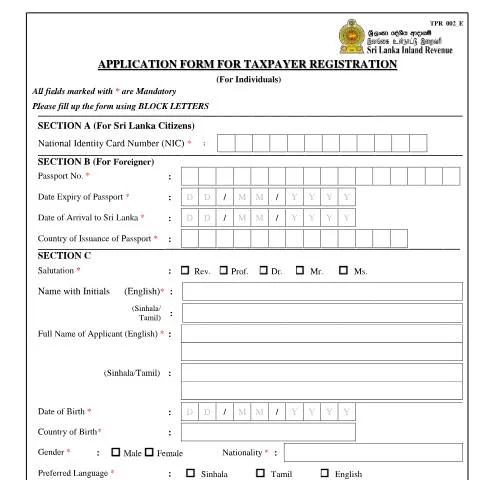
Understanding the Application Form for Taxpayer Registration (TPR_002)
In the landscape of Sri Lanka's tax administration, the Application Form for Taxpayer Registration (TPR_002) plays a pivotal role for individuals aiming to fulfill their tax obligations. This official document is essential for anyone intending to engage in business, employment, or investment activities within the country. It not only facilitates the process of taxation but also helps in establishing a formal connection between the individual and the Inland Revenue Department (IRD).
Context and Importance of the TPR_002
The necessity for taxpayer registration in Sri Lanka stems from a robust legal framework guided by English common law principles. The Inland Revenue Act, coupled with the provisions of the Electronic Transaction Act, provides a conducive environment for taxpayers. This form is designed specifically for individuals, outlining essential details that determine their tax status. By completing and submitting this form, applicants not only comply with legal requirements but also unlock their rights and responsibilities associated with being a taxpayer in Sri Lanka.
The Sequential Role of TPR_002 in Tax Compliance
Understanding where the TPR_002 fits in the broader tax compliance journey is crucial for prospective taxpayers. The form is typically the first step in becoming a registered taxpayer. Once submitted, the IRD assesses the information and issues a Taxpayer Identification Number (TIN), which is crucial for carrying out any financial activities that involve taxation.
- Step 1: Fill out the TPR_002 form accurately.
- Step 2: Submit the form along with required documentation to the IRD.
- Step 3: Await confirmation from the IRD regarding TIN issuance.
- Step 4: Utilize the TIN for tax filings and other official transactions.
Who Must Submit the TPR_002?
This form is primarily for individuals who meet the following criteria:
- Citizens of Sri Lanka, who possess a National Identity Card (NIC).
- Foreign nationals with a legal presence in Sri Lanka, requiring tax registration for income generated within the country.
It's important to note that individuals already registered under a different tax category or those who possess a valid TIN do not need to resubmit the TPR_002 unless there are changes in their personal circumstances that necessitate recompletion.
Navigating the Application Process: A Step-by-Step Guide
Completing the TPR_002 form is straightforward, yet attention to detail is paramount to avoid any delays in processing.
- Section A: For Sri Lankan citizens, provide your NIC number. Ensure it is valid and up-to-date.
- Section B: Foreign applicants must fill in passport details, including the expiration date and country of issuance.
- Section C: This section requires personal information such as name, date of birth, gender, nationality, and preferred language for communication.
- Contact Details: At least one contact number and a valid email address must be provided to facilitate communication with the IRD.
- Bank Information: Include the name of your bank and account number to streamline future transactions.
- Family Information: If applicable, provide details about your marital status and children.
- Individual Business Details: If you run a business, include this information for proper categorization.
- Authorization: Sign and date the form, certifying that the information provided is accurate.
Potential Pitfalls: Addressing Missing Information or Errors
Common challenges during the application process include missing documents or incorrect information. If the IRD identifies gaps in your submission, the registration will be delayed.
- Missing Information: If you fail to fill in mandatory fields, the IRD will return your application for completion.
- Errors: Incorrect details can lead to confusion, impacting your TIN issuance. Always double-check your entries.
In the event of a refusal or rejection, applicants should carefully review the IRD's feedback, amend their application as necessary, and resubmit to avoid future complications.
Understanding the Consequences of Non-Compliance
Failing to register as a taxpayer can lead to significant consequences. Individuals who neglect this obligation may face penalties, legal action, and difficulties in accessing financial services. Additionally, non-registration can limit one's ability to engage in formal employment or business ventures, as many employers and banks require proof of tax registration.
Moreover, registration provides certain rights, such as the ability to claim deductions, exemptions, and benefits under the tax laws of Sri Lanka. Thus, timely and correct submission of TPR_002 not only keeps you compliant but also ensures you can take advantage of the privileges afforded to registered taxpayers.
Interdependencies with Other Forms and Registrations
The TPR_002 form does not exist in isolation. It interacts with various regulatory forms and requirements. For instance, if you are involved in income-generating activities, you may also need to fill out the Application for Tax Type Registration (TPR_005). This form is crucial for individuals liable for different tax categories and must be submitted alongside the TPR_002 for effective registration.
Furthermore, if you are a business owner, understanding the distinction between the taxpayer registration and other business-specific registrations is essential. The nuances between them can impact your overall compliance strategy and tax obligations.
Regulatory Framework and Historical Context
The importance of the TPR_002 is underscored by the legal framework established in Sri Lanka's tax system. The Inland Revenue Act sets the groundwork for tax administration, while the Electronic Transaction Act has facilitated the transition toward more accessible digital forms. This evolution reflects a significant shift towards a more organized and transparent process, recognizing the technological advancements in governance.
Historically, the push for tax compliance and formalization of economic activities has been driven by a need for better revenue generation and economic stability. The IRD has continually sought to streamline processes, making the taxpayer registration process not just a bureaucratic hurdle but an essential part of economic participation in Sri Lanka.
Final Recommendations for Successful Submission
To ensure a smooth application process, prospective taxpayers should adhere to the following recommendations:
- Gather all required documents before starting the application to minimize delays.
- Utilize clear and legible handwriting when filling out the form to avoid misinterpretations.
- Choose the preferred language wisely as it will influence future communication from the IRD.
- Review the completed form with a peer or advisor familiar with tax processes in Sri Lanka.
- Submit the application in person at the Primary Registration Unit or designated IRD branches to ensure it is received correctly.
By taking these proactive steps, individuals can navigate the complexities of taxpayer registration more effectively and engage in the economic life of Sri Lanka with confidence.
Understanding the Taxpayer Registration Process for Individuals
The Taxpayer Registration process in Sri Lanka is designed to ensure that all individuals earning taxable income are registered with the Department of Inland Revenue (DIR). This registration not only facilitates the collection of taxes but also helps maintain a structured tax system in the country. Below are the critical steps involved in the taxpayer registration process for individuals:
- Eligibility Criteria: To register as a taxpayer, individuals must meet specific criteria. Generally, any individual whose annual income exceeds the stipulated threshold (which is subject to change annually) must register. It is essential to regularly check the latest guidelines from the DIR regarding the income threshold.
- Gather Necessary Documents: The successful completion of the application form relies on accurate documentation. Applicants should prepare their National Identity Card (NIC), proof of address, bank statements, and any other relevant financial documents that reflect their source of income.
- Filling Out the Application Form: The Taxpayer Registration Application Form can be obtained either online through the official DIR website or at local DIR offices. When filling out the form, individuals must provide precise information regarding their income, expenditures, and other personal details as requested.
- Submission of the Application: Once the form is filled out, applicants can submit it online or in person at the nearest DIR office. If submitting in person, it is advisable to go during non-peak hours to avoid long waiting times.
- Verification Process: After submission, the DIR will conduct a verification process to ensure that all provided information is accurate. This may involve cross-checking with other governmental agencies or conducting interviews if deemed necessary.
- Receiving the Taxpayer Identification Number (TIN): Upon successful verification, the DIR will issue a Taxpayer Identification Number (TIN) to the individual. This number is crucial as it will be required for all future tax-related transactions and communications with the DIR.
Common Challenges Faced During Taxpayer Registration
While the process of registering as a taxpayer in Sri Lanka is straightforward, several challenges may arise. Understanding these challenges can help individuals prepare better and navigate the registration process more effectively. Here are some common obstacles:
- Incomplete Documentation: One of the most common issues encountered is the submission of incomplete or incorrect documentation. Individuals must ensure that all required documents are gathered and that they meet the submission criteria. Missing documents can lead to delays or rejection of the application.
- Misunderstanding the Income Threshold: Many individuals are unaware of the exact income threshold that necessitates registration. Regularly updating oneself with the latest directives from the DIR can mitigate this issue.
- Technical Difficulties: For those opting to register online, technical challenges such as website outages or system errors can pose significant hindrances. It is advised to save copies of submissions and to reach out to the DIR for assistance if any technical issue occurs.
- Language Barriers: Although the application forms are available in English and Sinhala, some individuals may face difficulty understanding the technical terminology used in the forms. Seeking assistance from a knowledgeable person or a tax consultant can help clarify any doubts.
- Long Processing Times: In certain instances, the verification process may take longer than expected due to backlogs in the DIR. Patience is key, and individuals should follow up on their application status after a reasonable waiting period.
The Importance of Staying Compliant After Registration
Once an individual has successfully registered as a taxpayer and received their TIN, maintaining compliance with tax obligations becomes paramount. Failing to do so can result in penalties and issues with the DIR. Here are a few essential compliance practices to observe:
- Filing Income Tax Returns: Registered taxpayers must file their income tax returns annually. It is essential to be aware of the filing deadlines, which usually occur within a few months after the end of the fiscal year in Sri Lanka (which ends on March 31). Late submissions can attract penalties.
- Keeping Accurate Records: It is crucial for individuals to maintain detailed records of all income and expenses. These records will be vital when filling out annual returns and in the event of an audit by the DIR.
- Understanding Tax Deductions: Familiarizing oneself with allowable tax deductions can help reduce taxable income. Individuals should stay informed about the latest regulations regarding personal deductions, such as contributions to retirement funds or educational expenses.
- Engaging with Tax Professionals: For individuals with complex financial situations or multiple sources of income, consulting with a tax professional can provide insights and assistance in managing tax obligations effectively.
- Staying Updated on Tax Regulations: Tax laws can frequently change, and it is essential for individuals to keep abreast of any updates or changes in tax regulations issued by the DIR. Regular visits to the DIR website or subscribing to their newsletters can be beneficial.