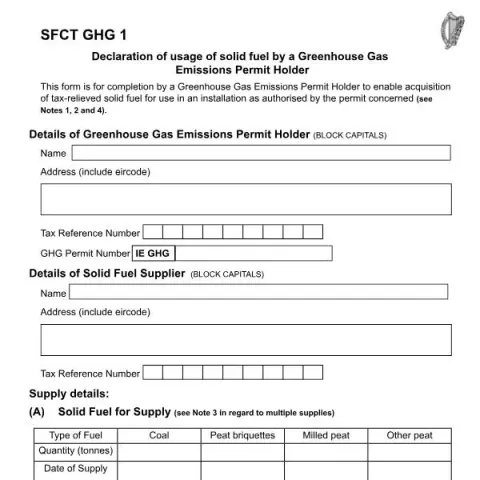
Understanding the SFCT GHG 1 Form: Declaration of Usage of Solid Fuel by a Greenhouse Gas Emissions Permit Holder
The SFCT GHG 1 form is an official document issued by the Revenue Commissioners of Ireland, designed for use by entities holding a Greenhouse Gas (GHG) Emissions Permit issued by the Environmental Protection Agency (EPA). Its primary purpose is to enable permit holders to acquire tax-relieved solid fuel for use in their specified installations, ensuring compliance with Irish tax legislation related to solid fuel carbon tax reliefs.
When and Why to Use the SFCT GHG 1 Form
This declaration must be completed each time a permit holder intends to acquire solid fuel—such as coal, peat briquettes, milled peat, or other peat—for use in an installation covered by their GHG permit. The form is essential for obtaining tax relief on the purchase, which reduces the applicable solid fuel carbon tax. It is a prerequisite for suppliers registered with Revenue for solid fuel tax purposes to release fuel at the relief or reduced rate, in accordance with Section 82(3) of the Finance Act 2010.
In practical terms, the form must be submitted in advance of each supply of solid fuel to ensure the supplier can provide the fuel at the tax-relieved rate. It serves as a legal declaration that the fuel will be used solely in the specified installation covered by the permit. Failure to submit the form or misuse of the fuel may result in the permit holder being liable for the full applicable tax, including penalties.
Details Required on the Form
The SFCT GHG 1 form requests comprehensive information to verify eligibility and ensure compliance:
- Permit Holder Details: Name, address (including Eircode), tax reference number, and GHG permit number.
- Solid Fuel Supplier Details: Name, address, tax reference number.
- Supply Details: Type of solid fuel (coal, peat briquettes, milled peat, other peat), quantity in tonnes, and date of supply.
- Installation Details: Name and address(es) of the installation(s) where the fuel will be used, with additional addresses attached if multiple premises are involved.
Declaration and Signatory Requirements
The permit holder or an authorized signatory must sign the declaration, confirming that the solid fuel supplied is solely for use in the specified installation covered by the GHG permit. The declaration also states that if the fuel is not used for its intended purpose, the permit holder agrees to pay the applicable solid fuel carbon tax on that fuel.
The form must include the signatory's name in block capitals, their designation within the organization, and the date of signing. It is crucial that the declaration is accurate and truthful, as it forms the basis for tax relief eligibility.
Filling Out and Submitting the Form
To complete the SFCT GHG 1 form properly:
- Ensure all permit holder and supplier details are accurate and correspond with official records.
- Specify the correct type and quantity of solid fuel, along with the supply date.
- Attach a list of addresses if multiple premises are involved.
- Have the declaration signed by an authorized individual with appropriate authority.
- Provide the completed form to the solid fuel supplier before the supply occurs.
The supplier then retains the declaration and may submit it to Revenue if requested. It is the permit holder's responsibility to maintain records of all supplies and declarations for audit purposes.
Fill in your form directly online
No printing: type your details into the boxes of the official form, tick, then download the PDF ready to send.
- 1Type into the form boxes
- 2Tick in one click
- 3Save and download the PDF
Points of Attention and Practical Tips
- Timeliness: Submit the declaration before the fuel is supplied to benefit from tax relief.
- Accuracy: Double-check all details, especially addresses and permit information, to avoid delays or penalties.
- Record-Keeping: Maintain copies of all declarations and supporting documentation for at least six years, as required by Irish tax law.
- Compliance: Use the form solely for the intended installation and purpose. Any misuse may result in the obligation to pay full tax and potential penalties.
- Multiple Supplies: For multiple supplies within a calendar month, a composite declaration may be acceptable if supported by proper records.
Legal and Regulatory Context
The SFCT GHG 1 form operates within the legal framework established by the Irish Finance Act 2010 and related regulations. It ensures that solid fuel used in qualifying installations benefits from the appropriate tax relief, promoting environmentally compliant practices while maintaining revenue integrity.
Permit holders must ensure their GHG permits are valid and current at the time of supply. The form's completion and submission are vital steps in aligning with Ireland's environmental and tax policies regarding solid fuel consumption.